

TL;DR:
- Choosing a Canada-focused 3PL with strong carrier relationships and transparent pricing ensures better service and customer satisfaction. Shiporo, suitable for Quebec and national brands, offers real-time rate shopping, order accuracy guarantees, and native integrations. Selecting the right partner requires evaluating coverage, technology, costs, and negotiating clear SLAs to optimize logistics performance.
The shortest answer: pick a Canada-focused 3PL that matches your order volume, channel mix, and warehouse location needs. For most Canadian merchants, especially those in Quebec, that means a provider with national carrier relationships, Shopify or WooCommerce integration, and transparent pricing, not just a low headline pick-and-pack rate.
Here is a quick shortlist to orient your search:
Shiporo — best for small to mid-market Quebec-based and national DTC brands that need real-time carrier rate shopping, a 100% order accuracy guarantee, and a dedicated account manager. Runs on ShipHero WMS.
Stallion — best for small-to-mid-volume sellers who want discounted Canada Post and courier rates with basic fulfilment add-ons.
FedEx Fulfilment (Canada) — best for brands already deep in the FedEx network that need cross-border US/Canada shipping baked in.
247 Fulfilment — best for mid-market brands needing multi-channel support and Canadian warehouse coverage.
DHL Supply Chain (Canada) — best for high-volume enterprise shippers that need global reach and advanced warehouse automation.
Shopify Fulfilment Network — best for Shopify-native merchants who want to manage 3PL partners directly from their Shopify admin without switching systems.
Canada’s e-commerce logistics market reached USD $16.2 billion in 2025 and is projected to grow at a 9.10% CAGR through 2034. The market is not short on providers. The challenge is picking the right one for your specific operation.
Table of Contents
What factors matter most when choosing a Canadian fulfilment partner?
Top ecommerce fulfilment providers in Canada: who each one is best for
Why a Canada-first 3PL beats a generic one for most merchants
What factors matter most when choosing a Canadian fulfilment partner?
Getting this decision wrong costs you more than a bad rate card. It costs you customer trust, return business, and months of re-onboarding. Screen every candidate against these criteria before you send a single RFP.
Geographic coverage and network reach
A provider with a single warehouse in the Greater Toronto Area is not a national fulfilment partner. Ask specifically about Quebec coverage, Prairie and Atlantic reach, and rural delivery capability. Rural first-attempt failure rates in Canada are often significant, with re-delivery delays sometimes stretching a full week. A provider without local carrier relationships in those lanes will quietly destroy your customer satisfaction scores.

Shipping speed and service levels
Same-day and next-day expectations are no longer limited to Amazon Prime customers. Confirm what service levels the provider can actually commit to by postal code, not just by province. Ask for lane-by-lane transit time data, not a blanket “2–3 business days” promise.

Storage and warehouse capabilities
Not every warehouse handles every product type. If you sell temperature-sensitive goods, oversized items, or anything with hazardous materials classifications, confirm compatibility upfront. Ask about cubic-foot versus pallet-based storage pricing, and whether they charge per SKU or per bin.
Technology and WMS compatibility
WMS and integration mismatches are one of the most common causes of post-selection problems. Ask every provider which WMS they run, whether they offer a native Shopify or WooCommerce connector, and what their API uptime SLA looks like. A provider that cannot give you a straight answer on integration timelines is a red flag.
Pricing transparency and accessorials
Headline rates typically represent a portion of the total fees of your actual total cost. The rest comes from accessorial charges, fuel surcharges, technology fees, minimums, and special handling. Always request a full fee schedule, not just pick-and-pack rates.
Pro Tip: Ask every provider to quote against a sample order profile that includes your average SKU count, order weight, and a mix of urban and rural postal codes. That single exercise will surface hidden fees faster than any RFP questionnaire.
Additional factors to verify
Minimums and scalability: Does the provider have a monthly order minimum that you cannot currently meet? Will they grow with you through peak season?
Returns handling: What is the returns processing turnaround? Do they restock, quarantine, or dispose of returned units?
Bilingual service: For Quebec merchants, bilingual customer support and French-language documentation are not optional extras.
Onboarding timeline: Realistic onboarding runs 4–12 weeks depending on integration complexity. A provider who promises two weeks for a complex Shopify plus custom API build is not being straight with you.
Red flags to walk away from: opaque rate cards with no itemised accessorials, vague answers about WMS or integration methods, no financial stability documentation, unwillingness to provide reference clients, and single-carrier dependency with no backup routing.
Top ecommerce fulfilment providers in Canada: who each one is best for
Shiporo
Shiporo is a Montreal-based 3PL built specifically for DTC and marketplace brands that need to scale without building their own warehouse operation. It runs on ShipHero, a WMS purpose-built for direct-to-consumer fulfilment, and connects natively with Shopify and WooCommerce. The real differentiator is real-time carrier rate comparison across Canada Post, FedEx, UPS, Purolator, and regional carriers like Intelcom, which means every shipment routes to the lowest-cost option that still meets the delivery commitment.
Best for: Quebec-focused and national DTC brands on Shopify, and brands that want a dedicated account manager and partnership rather than a ticket queue.
Key strengths:
100% order accuracy & on-time shipping guarantee
Real-time multi-carrier rate shopping
Native Shopify and WooCommerce integrations plus custom API and CSV import
Dedicated account managers (not a shared support pool)
Marketplace seller support for Amazon, eBay, and Etsy
Cross-border fulfilment capabilities
Limitations: primarily serves the Canadian market, so brands needing US-based warehouse nodes will need to discuss cross-border arrangements directly.
Stallion
Stallion operates as a shipping and fulfilment platform focused on helping Canadian small-to-mid-volume sellers access discounted rates with Canada Post, UPS, and USPS. Their fulfilment offering is more limited than a full-service 3PL, but the rate discounts are meaningful for merchants shipping under a few hundred orders per month.
Best for: Early-stage brands and low-volume sellers prioritising carrier rate savings over full-service warehouse management.
Key strengths:
Discounted Canada Post and courier rates
Accessible entry point for small merchants
Limitations: less suited to brands needing advanced WMS, kitting, or dedicated account support.
FedEx Fulfilment (Canada)
FedEx Fulfilment leverages the FedEx carrier network to offer storage, pick and pack, and shipping for Canadian merchants. The main advantage is tight integration with FedEx Express and FedEx Ground lanes, including cross-border US/Canada routing. It suits brands whose customer base is split across both countries and who already have a FedEx account relationship.
Best for: Mid-to-large brands with significant US/Canada cross-border volume and existing FedEx relationships.
Key strengths:
Deep integration with FedEx carrier network
Cross-border US/Canada capability
Limitations: carrier dependency on FedEx means limited rate-shopping flexibility; less suited to brands needing multi-carrier optimisation.
247 Fulfilment
247 Fulfilment is a Canadian 3PL with warehouse operations and multi-channel order management capabilities. They serve mid-market brands selling across Shopify, Amazon, and other channels, with a focus on Canadian domestic fulfilment.
Best for: Mid-market brands needing multi-channel support and Canadian warehouse presence without enterprise-level complexity.
Key strengths:
Multi-channel order management
Canadian domestic coverage
Limitations: publicly available integration and WMS details are limited; confirm specifics directly during RFP.
DHL Supply Chain (Canada)
DHL Supply Chain is the contract logistics arm of DHL Group, operating large-scale warehouse and distribution facilities across Canada. It is built for high-volume enterprise shippers who need global reach, advanced automation, and complex supply chain management.
Best for: Enterprise brands shipping thousands of orders per day who need global carrier reach and warehouse automation.
Key strengths:
Global network and enterprise-grade warehouse automation
Strong cross-border and international capabilities
Limitations: high minimums and complex onboarding make it impractical for most growing DTC brands.
Shopify Fulfilment Network
Shopify Fulfilment Network (SFN) connects Shopify merchants directly with vetted 3PL partners through the Shopify admin. Merchants manage fulfilment without switching systems, and inventory syncs automatically. SFN partners include providers with Canadian warehouse nodes.
Best for: Shopify-native merchants who want integrated fulfilment management without a separate 3PL relationship to manage.
Key strengths:
Native Shopify admin integration
Inventory auto-sync across SFN partners
Limitations: limited to Shopify merchants; partner network and Canadian coverage vary by SFN provider selected.
How do these providers compare side by side?
| Provider | Best for | Canada coverage | Key integrations | Pricing model | Minimums | Order accuracy | Value-added services | Carrier options |
|---|---|---|---|---|---|---|---|---|
| Shiporo | Quebec/Canadian DTC Shopify Brands | Quebec + national, multi-carrier rural reach | Shopify, WooCommerce, API, CSV, ShipHero WMS | Per-unit pick & pack, storage, shipping; transparent fee schedule | No Minimums | 100% accuracy guarantee | Kitting, custom packaging, returns management, marketplace support | Canada Post, FedEx, UPS, Purolator, Intelcom |
| Stallion | Small/low-volume sellers | Ontario-focused with national shipping | Canada Post, UPS, USPS integrations | Rate-discount model; basic fulfilment fees | 1000 orders/month | Not publicly specified | Basic fulfilment add-ons | Canada Post, UPS, USPS |
| FedEx Fulfilment (Canada) | Mid-large, US/Canada cross-border | National + US cross-border | FedEx network, limited third-party | FedEx rate-based; storage and handling fees | Mid-to-high | Not publicly specified | Cross-border shipping, returns | FedEx Express, FedEx Ground |
| 247 Fulfilment | Mid-market multi-channel | Canadian domestic | Shopify, Amazon, multi-channel | Per-unit and storage fees | Mid-market | Not publicly specified | Multi-channel order management | Not publicly specified |
| DHL Supply Chain (Canada) | Enterprise high-volume | National + global | Enterprise WMS, EDI, API | Contract-based; volume pricing | High; enterprise minimums | Enterprise SLA-based | Automation, global distribution, complex supply chain | DHL network + global carriers |
| Shopify Fulfilment Network | Shopify-native merchants | Varies by SFN partner | Native Shopify admin | Varies by SFN partner selected | Varies by partner | Varies by partner | Depends on SFN partner | Depends on SFN partner |
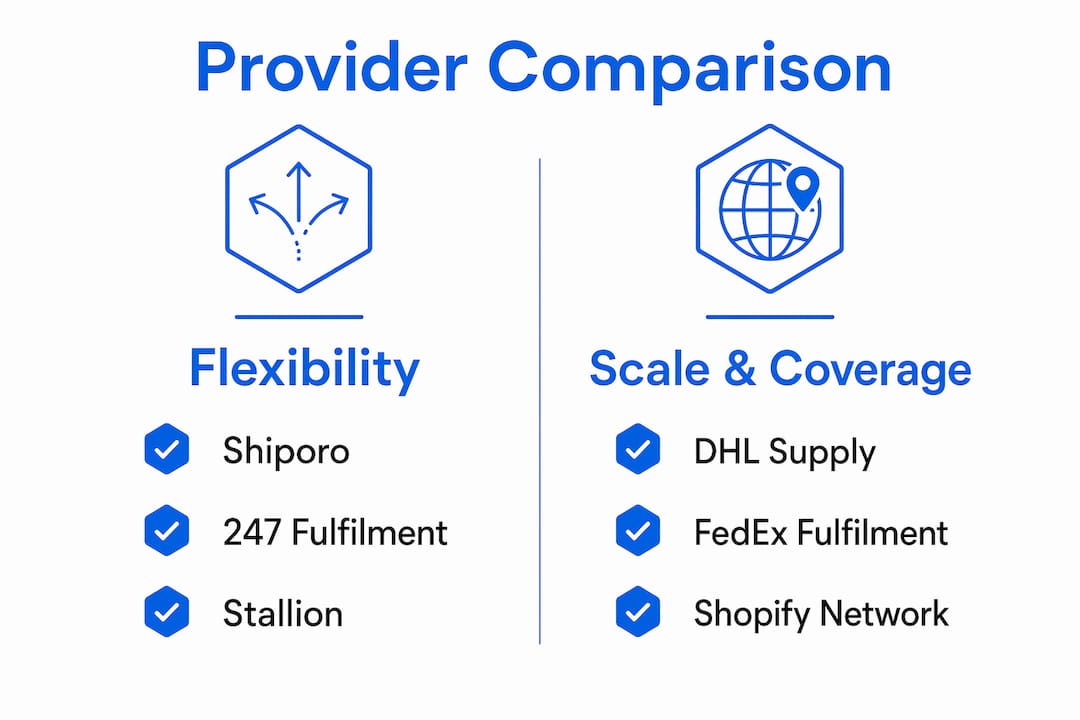
The clearest trade-off in this table is between flexibility and scale. Shiporo and 247 Fulfilment serve growing DTC brands that need real integration depth and Canadian-market focus. DHL Supply Chain handles volume that most DTC brands will not reach for years. Stallion is the right starting point for merchants not yet ready to commit to a full 3PL relationship.
If you are a Quebec-based merchant, the bilingual service gap narrows your shortlist quickly. Confirm French-language support capability with any provider before you move to an RFP.
How to run an RFP and choose the right fulfilment partner
The Supply Chain Alliance’s 7-step framework is the most practical structure for a Canadian 3PL selection process. Here is how to apply it:
Define your requirements in writing before contacting any provider. Document your average monthly order volume, SKU count, average order weight, peak season spikes, required integrations, and geographic delivery mix. Skipping this step produces incomparable RFP responses.
Build a shortlist of 3–5 providers based on your requirements, not on who has the best website.
Issue a structured RFP with identical questions to every provider so you can compare responses on the same dimensions.
Evaluate technology compatibility by asking for a live demo of their WMS and integration workflow, not a slide deck.
Conduct site visits and reference checks for any provider that makes your final two.
Model total cost of ownership (TCO) using your actual order profile, including accessorials, minimums, and seasonal surcharges.
Negotiate SLAs before signing, not after.
Sample RFP questions by category
| Category | Sample questions |
|---|---|
| Operations | What is your pick-and-pack accuracy rate? How do you handle damaged or mispicked orders? |
| Technology | Which WMS do you run? Do you have a native Shopify/WooCommerce connector? What is your API uptime SLA? |
| Pricing | Provide a full fee schedule including all accessorials, fuel surcharges, and technology fees. |
| Onboarding | What is your typical integration timeline? Who manages the onboarding project on your side? |
| References | Can you provide two references in our product category and order volume range? |
| Financial stability | How long have you been operating? Can you provide a financial reference or audited statement? |
| KPIs and SLAs | What order accuracy, on-time shipping, and inventory accuracy rates do you contractually commit to? |
KPIs to negotiate into your contract
Order accuracy rate (target: 99.5% or higher; Shiporo guarantees 100%)
On-time shipping rate by carrier and lane
Inventory accuracy rate
First-attempt delivery success rate (especially for rural postal codes)
Returns processing turnaround time
Red-flag answers: “We don’t track that metric,” vague SLA language without numeric commitments, and any provider who cannot name their WMS platform.
What does ecommerce fulfilment in Canada actually cost?
Pricing in Canadian fulfilment is modular; see the Orders & shipping · The Meow Picks page for a practical example of pricing components and delivery options in ecommerce. You pay for each service component, and the total is almost always higher than the headline rate suggests. Here is what to budget for:
Receiving: charged per pallet, per carton, or per unit when inventory arrives at the warehouse
Storage: billed monthly, either per pallet, per cubic foot, or per bin/SKU depending on the provider
Pick and pack: per-unit fee, often with a base order fee plus a per-item fee for multi-SKU orders
Kitting and assembly: per-unit fee, quoted separately based on complexity
Returns processing: per-unit fee for receiving, inspecting, and restocking or disposing of returned items
Integration and setup fees: one-time or monthly, depending on the provider and complexity of your tech stack
Account or portal fees: some providers charge a monthly platform fee on top of per-unit fees
Carrier label and shipping costs: passed through at carrier rates, sometimes with a handling markup
Headline rates typically represent 40–60% of total actual fees. Model your TCO using a real order sample before committing to any provider.
Onboarding timeline: what to expect
Days 1–2: contract finalisation and requirements documentation
Days 2–3: integration build (Shopify, WooCommerce, or API connection; EDI setup if required)
Days 3–4: test orders and inventory receiving
Weeks 4–5: soft launch with limited order volume
Weeks 5–10+: full ramp to normal volume
Complex integrations or custom API builds push timelines toward the longer end. A provider promising a one-week go-live for a multi-channel setup is not being realistic.
Multi-carrier rate shopping reduces total shipping cost meaningfully, particularly for rural and remote Canadian destinations where first-attempt failure rates are highest. Routing each shipment to the best-performing carrier for that specific lane, rather than defaulting to a single national carrier, lowers both label cost and re-delivery expense. Shiporo’s real-time rate comparison across Canada Post, FedEx, UPS, Purolator, and Intelcom does exactly that automatically.
Peak season surcharges from major carriers typically apply from mid-October through December. Budget for a 10–20% increase in per-shipment costs during that window, and confirm your provider’s peak capacity commitments in writing before Q4.
What marketplace and cross-border sellers need to know
Selling on Amazon, Shopify, or eBay while using a third-party fulfilment provider adds a layer of complexity that catches many merchants off guard.
Cross-border checklist
Confirm your provider has customs brokerage relationships or in-house customs expertise for US/Canada shipments
Ask specifically about duties and tariff handling, including who is responsible for HS code classification errors
Verify whether bonded warehousing is available if you hold imported goods before customs clearance
Check that the provider has established carrier relationships for cross-border lanes, not just domestic routing
For a detailed breakdown of customs and cross-border logistics, Shiporo’s cross-border fulfilment guide covers the practical steps for Canadian merchants shipping into and out of the US.
Marketplace integration requirements
Amazon MCF (Multi-Channel Fulfilment): if you use Amazon’s fulfilment network for non-Amazon orders, confirm your 3PL can route orders to Amazon MCF or manage FBA prep (labelling, bundling, poly-bagging) to Amazon’s specifications
Shopify Fulfilment Network: SFN-connected 3PLs sync inventory automatically through the Shopify admin; confirm which SFN partner you are actually working with and their specific Canadian coverage
eBay and Etsy: these platforms require accurate tracking data pushed back to the marketplace within tight windows; ask your 3PL how tracking updates are transmitted and at what frequency
Multi-channel inventory strategy
Selling across multiple channels from a single warehouse location creates stock contention risk during peak periods. Placing inventory strategically near your customers and using predictive demand forecasting reduces both lead times and the risk of a single channel depleting shared stock. For merchants with significant Quebec volume alongside national sales, a Quebec-based warehouse node is worth the added complexity.
Pro Tip: If you sell on both Amazon and your own Shopify store, ask your 3PL how they handle channel-level SLA conflicts. When Amazon MCF and a DTC order arrive simultaneously for the same SKU, which ships first? The answer tells you a lot about how the provider actually operates.
Key takeaways
Choosing the right Canadian 3PL comes down to matching your order volume and channel mix to a provider with transparent pricing, genuine integration depth, and proven coverage in your key delivery lanes, including Quebec.
| Point | Details |
|---|---|
| Shortlist by fit, not brand | Match provider to your order volume, channel mix, and Quebec/national coverage needs before comparing rates. |
| Accessorials inflate real cost | Headline pick-and-pack rates represent only 40–60% of total fees; the remainder comes from accessorial charges, special handling fees, technology fees, minimums and fuel surcharges. Always model full TCO with a real order sample. |
| Rural delivery needs multi-carrier | First-attempt failure rates reach 20–25% in rural Canada; choose a provider with diversified carrier routing. |
| Run a structured RFP | Use the 7-step Supply Chain Alliance framework to generate comparable responses and negotiate SLA commitments. |
| Shiporo for Quebec DTC brands | Shiporo offers a 100% accuracy guarantee, real-time multi-carrier rate shopping, and ShipHero WMS for Canadian merchants. |
Why a Canada-first 3PL beats a generic one for most merchants
Most merchants I see evaluate 3PLs the same way they shop for a SaaS tool: they look at the feature list, check the pricing page, and pick whoever has the best-looking dashboard. That approach fails in fulfilment because the variables that actually determine your landed cost and customer experience are invisible until you are live.
The providers that consistently underperform for Canadian merchants are the ones with US-headquartered operations that treat Canada as an afterthought. Their carrier relationships are US-optimised. Their customer support teams do not know the difference between a Canada Post Expedited Parcel and a Priority shipment. Their rural delivery commitments are copy-pasted from their US SLAs and bear no relationship to what actually happens in Northern Ontario or rural Quebec.
A Canada-focused 3PL, by contrast, has built carrier relationships specifically for Canadian lanes, understands the bilingual service requirements for Quebec merchants, and has already solved the customs and cross-border problems that trip up US-centric providers. That operational knowledge is not something you can replicate by reading a rate card.
The other thing most articles get wrong: they treat the 100% order accuracy claim as marketing language. For a DTC brand shipping 500 orders a month, a 1% error rate means five wrong or damaged shipments, five customer service tickets, five potential chargebacks, and five customers who probably will not reorder. Accuracy guarantees backed by a real WMS like ShipHero are not a nice feature. They are the baseline you should demand from any provider before signing.
Shiporo’s fulfilment services for Canadian merchants
Shiporo is not the right fit for every merchant, but for Quebec-based and national DTC brands shipping between a few hundred and several thousand orders per month, it is worth a direct conversation. The combination of real-time carrier rate comparison across Canada Post, FedEx, UPS, Purolator, and Intelcom, a 100% order accuracy guarantee, and ShipHero WMS integration is genuinely hard to match at that scale.
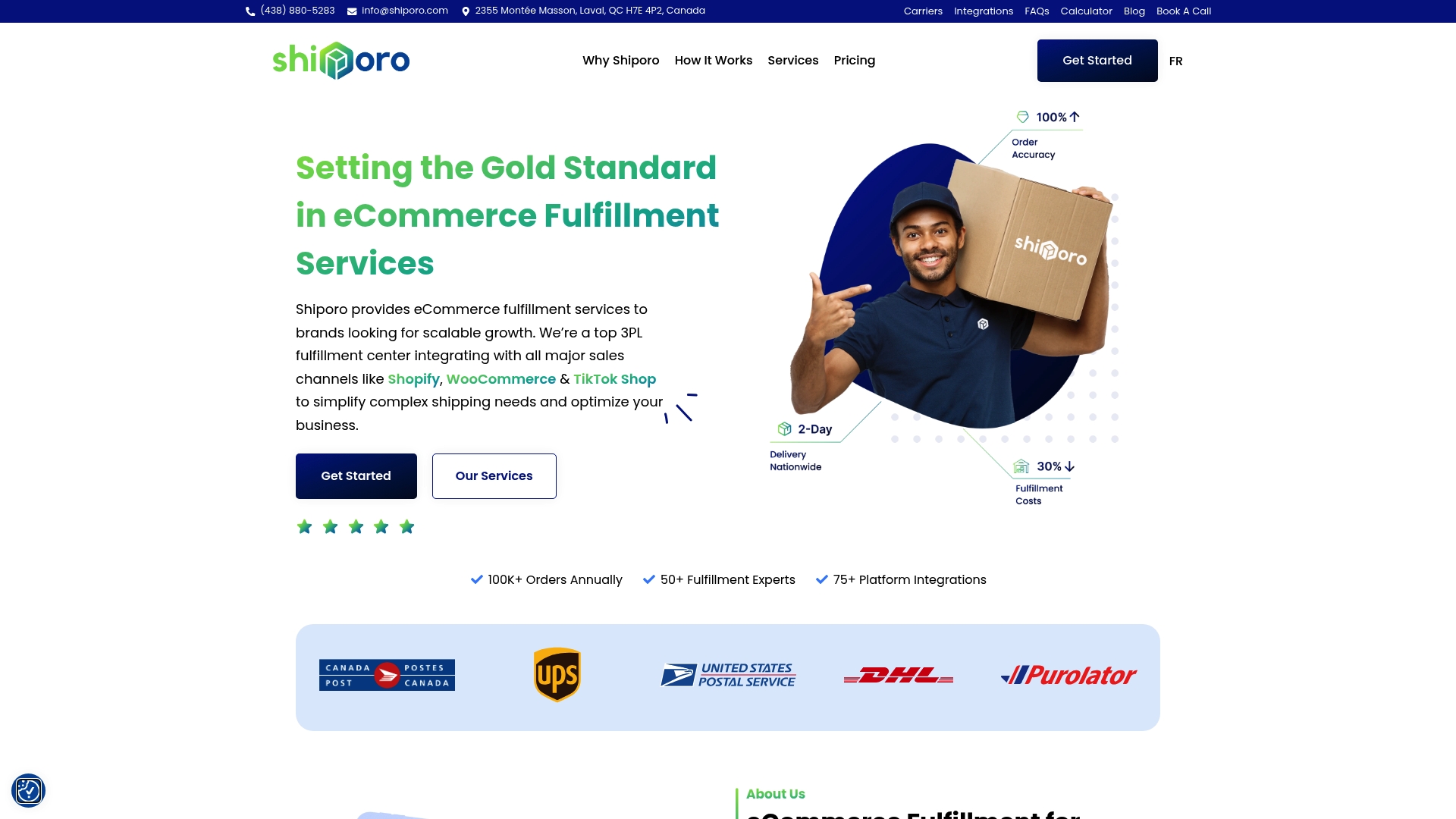
Where Shiporo stands apart from generic 3PL options is the dedicated account manager model. You are not submitting tickets to a shared inbox. You have a named contact who knows your account, your SKUs, and your peak season patterns. That matters when something goes wrong at 4 PM on a Friday before a long weekend.
To see what fulfilment actually costs for your order profile, use Shiporo’s pricing calculator to build a realistic estimate before your first conversation. For a full overview of services, integrations, and the accuracy guarantee, visit the Shiporo fulfilment services page. Ready to talk specifics? Request a fulfilment audit or quote directly through the site.
Useful sources for further research
These are the strongest Canada-specific sources referenced in this article. Each one is worth bookmarking if you are building an RFP or benchmarking providers.
Supply Chain Alliance — 7-step 3PL evaluation framework: the most practical Canadian-market RFP framework available. Use it to structure your requirements document and SLA negotiations.
ULS Freight — last-mile delivery challenges in Canada: detailed data on rural first-attempt failure rates and carrier performance by lane. Use it when evaluating provider rural coverage claims.
Kain Logistics — ecommerce logistics in Canada: market commentary on automation, micro-fulfilment, and technology trends. Useful for understanding where the market is heading when evaluating a provider’s tech roadmap.
IMARC Group — Canada e-commerce logistics market: market size and growth data for the Canadian e-commerce logistics sector.
Shiporo — ecommerce fulfilment services: full service overview including integrations, accuracy guarantee, and carrier network.
Shiporo — marketplace seller fulfilment: specific guidance for Amazon, eBay, and Etsy sellers using a Canadian 3PL.
Shiporo — driving growth with fulfilment in Canada: thought leadership on how fulfilment strategy connects to growth outcomes for Canadian merchants.
FAQ
What is ecommerce fulfilment and how does it work in Canada?
Ecommerce fulfilment is the process of storing inventory, picking and packing orders, and shipping them to customers. In Canada, most growing brands outsource this to a 3PL provider with warehouse facilities and established carrier relationships across national and regional networks.
How much does ecommerce fulfilment cost in Canada?
Costs vary by provider and order profile, but expect to pay for receiving, storage, pick and pack, shipping, and returns processing as separate line items. Headline rates typically cover only 40–60% of total fees; always model full TCO including accessorials before committing.
How long does it take to onboard with a Canadian 3PL?
Realistic onboarding runs 4–12 weeks depending on integration complexity. Simple Shopify connections are faster; custom API builds or EDI setups take longer. Any provider promising a one-week go-live for a complex multi-channel setup should be pressed for specifics.
Which ecommerce fulfilment provider is best for Quebec merchants?
Shiporo is purpose-built for Quebec-based and national Canadian DTC brands, with bilingual service capability, real-time multi-carrier rate shopping, and a 100% order accuracy guarantee backed by ShipHero WMS.
What should I ask a Canadian 3PL before signing a contract?
Ask for a full fee schedule including all accessorials, confirm their WMS platform and integration timeline, request two client references in your product category, and negotiate numeric SLA commitments for order accuracy, on-time shipping, and returns turnaround before you sign anything.

