

TL;DR:
- For Canadian LTL, pallets must be Grade A 48"×40" GMA decks, within carrier height and weight limits. Accurate data and WMS enforcement prevent costly re-class fees, refusals, and delays at the dock. Proper securement and pallet configuration ensure compliance and smooth transportation.
For Canadian LTL, every pallet should sit on a Grade A 48"×40" GMA deck, stay under the maximum total height allowed by carriers, and land within the typical per-pallet weight range carriers expect. Get those three numbers wrong and you are looking at re-class fees, retailer refusals, or a load that comes back to your dock.
Before you tender any freight, run through this quick checklist:
Pallet grade: Grade A, 48"×40" GMA, four-way access, no broken boards or protruding nails
Footprint: zero overhang beyond the pallet edge
Height: measured from floor to top of load, including pallet base, within your carrier’s specified maximum
Weight: total pallet weight within your carrier’s stated limit
Labelling: carrier-compliant labels on all four sides, correct freight class
ASN/manifest: advance shipment notification sent and confirmed before pickup
Your immediate next step: pull SKU dimensions and weights from your item master, then use a pallet build calculator to convert those numbers into cases per layer and layers per pallet before you touch a single carton.
Table of Contents
Which stacking pattern should you use, and how do you secure the load?
How do LTL carriers and transport mode affect your pallet build in Canada?
What pallet mistakes cause fees, chargebacks, or retailer rejections?
How does WMS automation prevent pallet configuration errors?
What is the standard pallet configuration for Canadian LTL?
The Canadian LTL default is the common 48"×40" GMA pallet size. Nearly every trailer, dock door, and warehouse rack in the country is built around that footprint, so deviating from it creates real friction.
A non-standard footprint is occasionally justified. Container exports, for instance, may benefit from an alternate footprint to optimise container cube and reduce wasted space. Odd-shaped loads sometimes demand a wider base. But for domestic LTL, the cost of a non-standard size almost always outweighs any stacking benefit.
On pallet grade and material:
Grade A wood pallets are the baseline for retailer docks and automated warehouses. Broken boards or inconsistent dimensions cause conveyor jams and refused loads.
Plastic pallets suit food, pharmaceutical, or hygiene-sensitive shipments; they are moisture-resistant and reusable, though more expensive upfront.
Grade B pallets are acceptable for internal warehouse moves but should never go out on a retailer-bound shipment.
Pro Tip: If your destination is a major retailer or a distribution centre with automated conveyors, specify Grade A block pallets in your 3PL’s pallet template. One rejected load costs more than a full pallet of premium decks.
How much can a pallet weigh, and how tall can it be?
The practical Canadian LTL range is 1,500–2,500 lb per pallet, with a maximum recommended height of 84 in./213 cm measured from the floor to the top of the load. Those numbers include the pallet base itself, which typically adds 5–6 in.
Weight and height are not suggestions. Carriers charge re-class fees when declared dimensions or weights do not match what arrives at the dock. A pallet that comes in at 2,700 lb when you declared 2,200 lb will cost you in billing disputes and, potentially, a refused pickup.
If a SKU’s weight pushes a single pallet past carrier weight limits, split the load across two pallets rather than stacking higher. Taller is rarely safer, and exceeding height limits can create trailer-loading problems for carriers.
Pro Tip: Set a WMS weight warning at 2,300 lb, not 2,500 lb. That 200 lb buffer absorbs pallet weight variance and stretch wrap without triggering a re-class.
How do you calculate cases per layer and layers per pallet?
This is the arithmetic that drives every pallet build. Work through it in order:
Gather SKU data from your item master: case length, width, height, and gross weight.
Calculate cases per layer: divide the pallet footprint area (48"×40" = 1,920 sq. in.) by the case footprint area (length × width). Round down to the nearest whole number.
Check stackability: confirm whether the SKU is stackability-flagged (fragile, top-load only, or prohibited from stacking). If prohibited, layers per pallet = 1.
Calculate layers per pallet: divide available height (84 in. minus pallet base, typically ~78 in. usable) by case height. Round down.
Compute total weight: (cases per layer × layers per pallet × case gross weight) + pallet tare weight.
Validate: total weight ≤ carrier limit, total height ≤ 84 in., no overhang.
Worked example:
| Parameter | Value |
|---|---|
| Case dimensions | 12"L × —"W × —"H |
| Cases per layer | (48×40) ÷ (12×—) = — cases |
| Usable pallet height | 78 in. |
| Layers per pallet | 78 ÷ — = — layers |
| Total cases per pallet | — × — = 144 cases |
| Total load weight | 144 × — = 1,440 lb + ~50 lb pallet = 1,490 lb |
| Total height | — × —" + 6" base = 78 in. ✓ |
Validation checklist before committing the build:
No case overhangs the pallet edge
Weight per tier does not exceed carton compression rating
Total pallet weight is within carrier limit
Stackability flag respected for every SKU on the pallet
A free pallet configuration calculator or a pallet build calculator can automate steps 2–5, but the item master data feeding it must be accurate or the output is worthless.
Which stacking pattern should you use, and how do you secure the load?
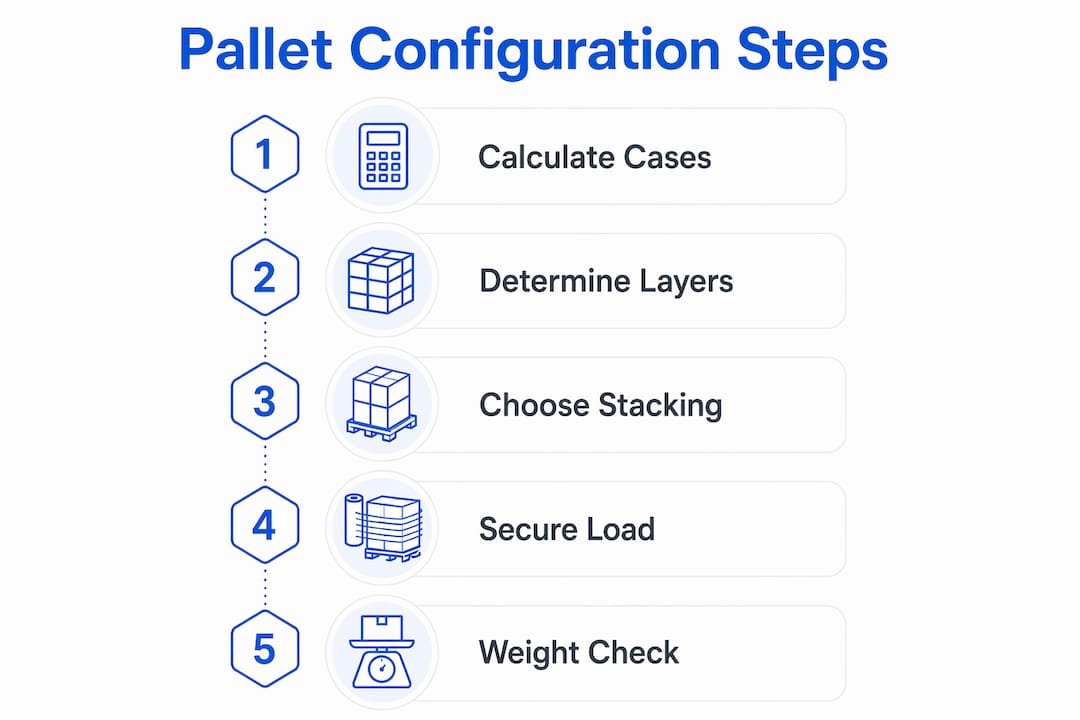
Column stacking (cases aligned directly above one another) maximizes compression strength and suits dense or double-height loads. Interlocking patterns increase lateral stability but can reduce carton compression performance, important when stacking multiple layers of heavy cartons.

Use interlocking (brick) patterns for lighter, mixed-SKU loads where lateral shift is the bigger risk. For heavy, uniform cartons, column stack and add slip sheets between layers to protect carton integrity.
Securement best practices:
Start stretch wrap at the base of the pallet and encircle the bottom tier at least three times to anchor the load.
Twist the wrap on alternating passes to increase tensile strength.
Apply corner boards on all four vertical edges before wrapping to prevent crushing.
Use banding (strapping) for heavy or tall loads in addition to stretch wrap.
Add a top cap or top frame for loads that will be double-stacked in transit.
Pro Tip: Never start wrapping at the top of the load. A load anchored only at the top will slide off the pallet on a hard brake. Base-first wrapping is what Purolator’s packaging guidelines require, and it is what actually keeps the load on the deck.
How do LTL carriers and transport mode affect your pallet build in Canada?
LTL carriers in Canada, including Purolator, FedEx Canada, UPS Canada, all expect the 48"×40" footprint and enforce height and weight limits at the dock. Each carrier has slightly different maximums and charging models, so always confirm specifics with your carrier or 3PL before tendering.
Cost drivers to watch:
Dimensional weight: carriers calculate freight charges on whichever is greater, actual weight or dimensional weight. A tall, light pallet can cost as much as a heavy one.
Cube utilisation: a poorly configured pallet wastes trailer space and increases your cost per unit shipped. Optimising pallet footprint fit and weight distribution reduces the number of shipments needed.
Re-class fees: inaccurate declared dimensions or weights trigger billing adjustments that are almost always in the carrier’s favour.
Appointment discipline matters. Retailers enforce strict inbound scheduling, and a missed delivery slot can take days to reschedule, directly harming your Must Arrive by Date (MABD) performance and OTIF score.
For container exports, the calculus shifts. A different pallet footprint may fill a 20-foot or 40-foot container more efficiently than the standard 48"×40" deck. Run the numbers before defaulting to LTL assumptions on an ocean shipment.
What pallet mistakes cause fees, chargebacks, or retailer rejections?
Most costly pallet errors are preventable and repeat themselves across shipments:
Overhang: any case extending past the pallet edge is an automatic rejection at many retailer docks and a damage liability in transit.
Grade B pallets: broken boards and inconsistent dimensions cause conveyor jams and refused loads at automated distribution centres.
Under-reported weight or dimensions: triggers re-class fees and billing disputes with every major carrier.
Interlocking stacking on heavy cartons: reduces compression strength and leads to crushed bottom layers.
Weak wrap technique: starting at the top, skipping base passes, or not twisting the wrap leaves the load free to shift.
Missing or incorrect labels: a pallet without carrier-compliant labels on all four sides will not move. Missing ASN documentation compounds the problem.
Each of these converts directly to a fee or a refused load. The fix is a dock QA checklist, an item master audit to catch dimension errors before they reach the carrier, and mandatory WMS prompts that block a non-compliant pallet build before it leaves the warehouse.
How does WMS automation prevent pallet configuration errors?
Manual pallet builds cause re-class fees because humans guess, round up, and forget stackability flags. A WMS that reads item master data calculates exact pallet dimensions, weights, and case counts automatically, removing the guesswork entirely.
Minimum WMS features to require from a 3PL:
Accurate item dimensions and gross weights stored in the item master
Stackability flags per SKU (fragile, top-load only, no-stack)
Pallet build templates with height and weight warnings
Automated ASN/manifest generation before carrier pickup
Integration with carrier systems for real-time rate comparison
Shiporo runs Shiphero WMS, a platform built specifically for DTC fulfilment. Shiphero enforces pallet templates at pick and pack time, flags weight or height violations before a build is committed, and generates carrier-ready ASNs automatically. That workflow is what keeps re-class fees off your invoice.
Pro Tip: Ask any 3PL candidate to show you how their WMS blocks a non-compliant pallet build. If they cannot demonstrate it, assume it does not exist and that manual errors will reach your carriers.
Sample pallet layouts for common eCommerce scenarios
| Scenario | Case dims (L×W×H) | Cases/layer | Layers | Total height | Est. weight | Notes |
|---|---|---|---|---|---|---|
| Standard retail carton | — | — | — | 78 in. | — | Column stack; slip sheets every 3 layers |
| Mixed-SKU bundle | — | — | — | — | — | Brick pattern; corner boards required |
| Heavy industrial carton | —“×14”×12" | — | 6 | 78 in. | — | Column stack; double-strap; Grade A only |
| Odd-shaped / tall item | —“×—”×18" | — | 4 | 78 in. | — | Single layer if retailer prohibits stacking |
The heavy industrial row sits near the 2,500 lb ceiling; split to two pallets if case weight increases.
Odd-shaped or tall items often trigger retailer double-stacking prohibitions. Confirm before building.
Mixed-SKU pallets benefit from a pallet configuration generator or pallet stack calculator to test multiple arrangements before committing.
Pre-shipment checklist: what to verify at the dock
Run these checks before any carrier pickup:
Pallet grade: Grade A, 48"×40", four-way access, no damaged boards or protruding nails
Overhang: zero tolerance, measure if in doubt
Height: tape measure from floor to top of load, confirm ≤84 in./213 cm
Weight: scale reading matches declared weight on the BOL
Securement: base wrapped at least three times, wrap twisted on alternating passes, corner boards in place
Labelling: carrier labels on all four sides, correct freight class, PO and destination visible
ASN: advance shipment notification sent and confirmed with the carrier or retailer
Appointment: pickup or delivery window confirmed in writing
Two rapid verification steps that take under 90 seconds: (1) photograph all four sides of the completed pallet before the driver arrives; (2) compare the BOL declared weight against the scale ticket on the load sheet. Those two steps catch the majority of billing disputes before they start.
Store photographs and load sheets in a shared folder tied to the shipment reference number. When a carrier raises a re-class fee or a retailer disputes a delivery, documented evidence is the fastest path to a resolution.
Key takeaways
Correct pallet configuration for Canadian LTL comes down to three non-negotiables: Grade A 48"×40" pallets, height at or below 84 in./213 cm, and weight within the 1,500–2,500 lb carrier range, enforced automatically by a WMS with accurate item master data.
| Point | Details |
|---|---|
| Default pallet spec | Grade A 48"×40" GMA pallet for all Canadian LTL shipments. |
| Height and weight limits | Keep total height ≤84 in./213 cm and weight within 1,500–2,500 lb per pallet. |
| Calculate before you build | Use item master data and a pallet build calculator to determine cases per layer and layers per pallet. |
| Securement discipline | Anchor stretch wrap at the base, encircle three times, and twist on alternating passes. |
| Shiporo WMS enforcement | Shiporo’s Shiphero WMS enforces pallet templates and generates ASNs automatically, preventing re-class fees. |
The part most brands get wrong about pallets
Pallet configuration gets treated as a warehouse detail when it is actually a commercial decision. Every re-class fee, every retailer chargeback, every OTIF miss traces back to a pallet that was built wrong, declared wrong, or documented wrong. The fix is almost never “train the warehouse staff harder.” It is a WMS that makes a non-compliant build impossible to tender.
What surprises me about most eCommerce brands is how long they tolerate manual pallet builds. The math is not complicated. A WMS with accurate item master data and stackability flags will produce a better pallet layout in seconds than a warehouse team doing it by eye in minutes. The ROI on that automation is immediate: fewer re-class fees, fewer retailer refusals, and OTIF scores that do not require a weekly post-mortem.
The other thing worth saying plainly: Grade A pallets are not a premium. They are the minimum. A Grade B pallet that jams an automated conveyor at a major retailer DC costs you the pallet, the appointment slot, and potentially the retail relationship. That is not a warehouse expense. That is a sales problem.
Shiporo handles pallet compliance so you do not have to
Pallet compliance is one of those operational details that looks simple until a re-class fee lands on your invoice or a retailer refuses a load at the dock. Shiporo’s eCommerce fulfilment service is built to prevent exactly that.
Shiporo runs Shiphero WMS, which enforces pallet build templates, flags weight and height violations before a build is committed, and generates carrier-ready ASNs automatically. Real-time carrier rate comparison across FedEx, UPS, Purolator means your freight moves on the best rate available, not the default one. Every account includes a dedicated account manager and a 100% order accuracy guarantee. Get a fulfilment quote or request a pallet audit at shiporo.com/ecommerce-fulfillment.
Useful sources
Freightzy: How to ship pallets in Canada — LTL weight, height, and footprint rules for Canadian carriers
Purolator pallet and LTL packaging guidelines — carrier-level wrap technique and overhang rules
ShipCanada freight preparation guidelines — stacking patterns, slip sheets, and pallet condition requirements
Owlery: pallet optimisation glossary — item master automation and re-class fee prevention
Ameisenhardt: navigating retailer demands in Canada — OTIF, Grade A pallet requirements, and appointment scheduling
Olympic Forest Products: how pallet configuration reduces shipping costs — unit load analysis and transport savings
FAQ
What is the standard pallet size for Canadian LTL shipments?
The standard is the 48"×40" (122 cm × 102 cm) GMA pallet. Nearly all Canadian LTL carriers, including Purolator, FedEx Canada, UPS Canada, are equipped to handle this footprint.
How do you calculate how many cases fit on a pallet?
Divide the pallet footprint area (48"×40" = 1,920 sq. in.) by the case footprint (length × width), round down, then divide available height by case height to get layers. Multiply cases per layer by layers for total cases per pallet.
What causes re-class fees on Canadian LTL shipments?
Inaccurate declared dimensions or weights are the most common trigger. A WMS that reads item master data and generates accurate ASNs automatically is the most reliable way to prevent them.
Does Shiporo handle pallet configuration for eCommerce brands?
Yes. Shiporo uses Shiphero WMS to enforce pallet build templates, flag non-compliant builds before tender, and generate carrier-ready ASNs, with dedicated account managers and a 100% order accuracy guarantee.
When should you use column stacking versus interlocking stacking?
Column stacking preserves carton compression strength and suits heavy or dense loads. Interlocking (brick) stacking adds lateral stability for lighter, mixed-SKU pallets where shifting is the primary risk.

