

Warehouse order fulfillment is the end-to-end process of receiving inventory, storing it, picking and packing individual orders, shipping them to customers, and handling returns — and for most Canadian DTC and marketplace sellers, outsourcing that process to a professional fulfillment warehouse becomes the right call the moment packing boxes is eating more of your week than building your business. Platforms like Shopify and WooCommerce connect directly to fulfillment centres, carriers like Canada Post, Purolator, FedEx, UPS, and Intelcom handle last-mile delivery, and 3PLs like Shiporo manage the whole operation under one roof.
The core steps inside a fulfillment warehouse are:
- Receiving — inbound inventory is counted, inspected, and logged against purchase orders
- Storage — SKUs are slotted by velocity and size
- Order processing — customer orders flow in from your sales channels in real time
- Picking — warehouse staff or automated systems pull the right items
- Packing — orders are packed to spec, with branded inserts if required
- Shipping — carrier labels are generated and parcels handed off
- Returns — inbound returns are inspected, sorted, and restocked or disposed of
Pro Tip: The clearest signal that you have outgrown in-house fulfillment is when your team spends more time at the packing table than on product, marketing, or customer acquisition. That inflection point usually arrives somewhere between 50 and 150 orders per day, though the exact number depends on your SKU complexity and packaging requirements.
Table of Contents
- What makes a fulfillment warehouse different from a traditional warehouse
- How the order fulfillment process works, step by step
- What services do fulfillment warehouses actually offer?
- What technology powers accurate, scalable fulfillment?
- KPIs and SLAs every eCommerce team should track
- How fulfillment pricing works in Canada
- How to choose a Canadian fulfillment partner
- How Shiporo runs warehouse order fulfillment in Canada
- Key takeaways
- The fulfillment partner question most brands ask too late
- Shiporo handles Canadian eCommerce fulfillment so you can focus on growth
- Useful sources and references
- FAQ
What makes a fulfillment warehouse different from a traditional warehouse
A traditional warehouse stores goods. Full stop. A fulfillment warehouse stores goods and executes individual customer orders — receiving, processing, picking, packing, shipping, and handling returns as a continuous operation. That distinction matters practically: fulfillment centres are designed to manage eCommerce order processing from receiving to dispatch, not just to hold pallets until a buyer shows up.

The operational focus is entirely different. A traditional industrial warehouse optimises for bulk throughput: full-pallet moves, case-pick efficiency, and long-term storage. A fulfillment warehouse optimises for parcel throughput: individual unit picks, fast pack cycles, carrier label generation, and real-time inventory syncing with your Shopify or WooCommerce store. The pricing model reflects that difference too — traditional warehousing charges mainly for space (per pallet or per square foot), while fulfillment pricing layers in per-order and per-pick fees alongside storage.
| Dimension | Fulfillment warehouse | Traditional/industrial warehouse |
|---|---|---|
| Primary function | End-to-end order execution (pick, pack, ship, returns) | Bulk storage and pallet/case distribution |
| Typical customer | DTC eCommerce brand, marketplace seller | Manufacturer, wholesaler, retailer |
| Platform integrations | Shopify, WooCommerce, marketplace APIs | ERP, EDI, TMS |
| Carrier relationships | Multi-carrier parcel (Canada Post, Purolator, FedEx, UPS, Intelcom) | LTL/FTL freight carriers |
| Pricing drivers | Per order, per pick, storage by SKU or cubic | Storage by pallet/sq ft, handling by pallet move |
| Order type | Individual parcels to end consumers | Pallets or cases to retailers/distributors |
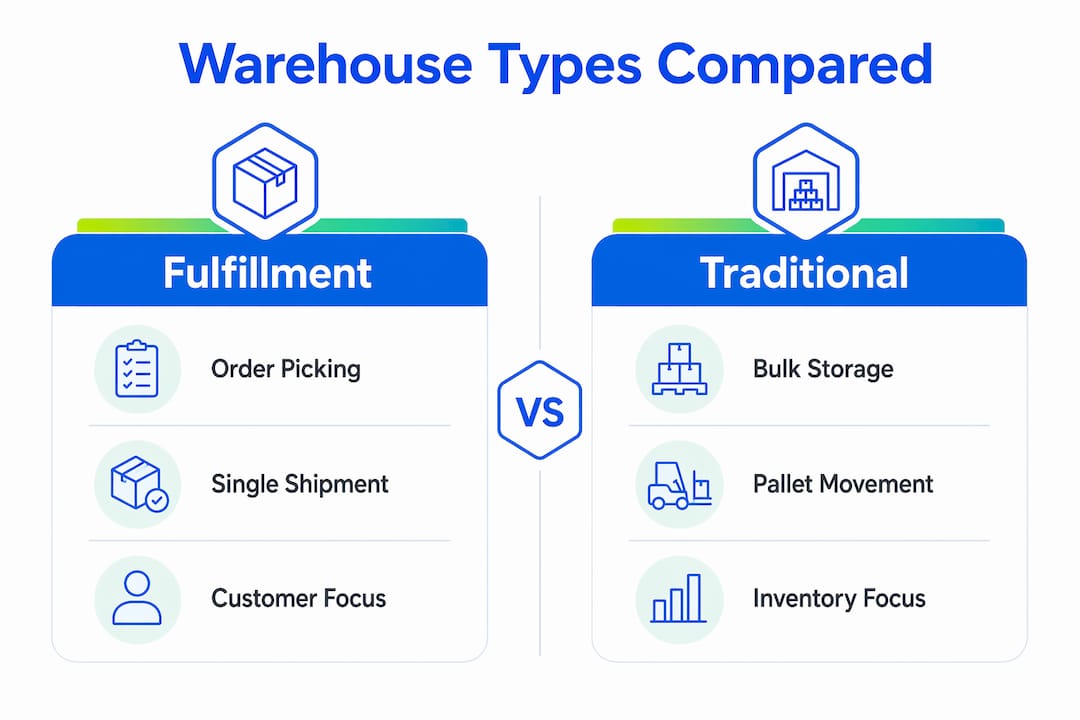
For a small DTC brand shipping 100 orders a week, a fulfillment warehouse is the obvious fit — you need individual picks, branded packaging, and real-time inventory sync. A marketplace seller running both DTC and wholesale channels needs a partner who can handle both parcel and bulk orders, which is where parcel vs. pallet order mix becomes the deciding factor. A pure wholesale distributor moving full pallets to retailers can often get away with storage-only warehousing and save on the per-pick overhead.
How the order fulfillment process works, step by step
The seven-stage process — receiving, storage, order processing, picking, packing, shipping, and returns — is the canonical framework, though modern fulfillment operations add inventory syncing and carrier label generation as distinct handoffs. Here is how each stage plays out in practice, with realistic timing benchmarks.

1. Receiving. Inbound freight arrives at the dock. Staff count units, scan barcodes, and reconcile against the advance shipping notice (ASN). Discrepancies are flagged immediately. Typical duration: same day for standard pallets; 24–48 hours for large or complex inbounds.
2. Putaway and storage. SKUs are slotted based on velocity: fast-movers go near the packing stations, slow-movers go to deeper racking. A well-designed layout reduces travel time and picking errors significantly. Duration: same day as receiving.
3. Inventory syncing. Once items are received and slotted, the WMS updates available inventory counts across all connected sales channels. For Shopify and WooCommerce stores, this sync should be real time — any lag creates oversell risk.
4. Order processing. Customer orders flow from your storefront into the WMS automatically. The system generates pick lists, assigns orders to pickers, and queues packing instructions. Duration: minutes after order placement, assuming integration is live.
5. Picking. Pickers pull items according to the pick list. The method used depends on order volume and warehouse layout:
| Picking method | Best for | Trade-off |
|---|---|---|
| Discrete (single-order) | Low volume, high SKU complexity | Slower; more travel time per order |
| Batch picking | Medium volume, similar SKUs | Faster per unit; requires sorting step |
| Zone picking | High volume, large warehouse | Fastest throughput; needs coordination between zones |
Typical pick-to-pack handoff: under 30 minutes for same-day ship windows.
6. Packing. Packers verify items against the pick list, select the right box or poly mailer, add protective fill, include any branded inserts or custom packaging, and seal the parcel. Packing materials are chosen to hit the lowest practical dimensional weight, since carriers bill by whichever is greater — actual weight or DIM weight. For Canadian shipments, this matters: Canada Post, Purolator, FedEx, and UPS all apply dimensional weight billing, and a poorly chosen box can add dollars to every parcel.
7. Carrier label generation and shipment handoff. The WMS or rate-shopping engine compares live carrier rates, selects the best option for the destination zone and service level, and prints the label. Parcels are sorted by carrier and handed off at scheduled pickup times. Typical same-day ship cutoff: 2:00–3:00 PM local time.
8. Tracking. Once scanned by the carrier, tracking events flow back to the WMS and, ideally, to your customer-facing order status page automatically.
9. Returns processing. Returned parcels arrive at the dock, are inspected against condition criteria, and are either restocked, quarantined for vendor credit, or disposed of. A clean returns workflow keeps your inventory counts accurate and your refund cycle short.
Pro Tip: Barcode-scan verification at the pack station — where the picker scans every item before sealing the box — is the single most cost-effective way to catch pick errors before they leave the building. It adds roughly 10–15 seconds per order and eliminates most mis-ship complaints.
What services do fulfillment warehouses actually offer?
Modern fulfillment centres combine inventory storage with order processing, kitting, returns handling, and real-time inventory visibility — but the specific service mix varies by provider and by how you sell.
Standard services most fulfillment warehouses offer:
- Receiving and inbound inspection
- Storage (ambient, climate-controlled, or hazmat, depending on SKU type)
- Pick and pack for individual DTC orders
- Returns processing and restocking
- Carrier label generation and multi-carrier shipping
- Basic quality control checks at receiving and packing
Value-added services that separate full-service 3PLs:
- Kitting and assembly — bundling multiple SKUs into a single shippable unit (subscription boxes, gift sets, promotional bundles). Kitting adds complexity to onboarding and usually carries a per-kit assembly fee.
- Custom inserts and branded packaging — tissue paper, thank-you cards, custom boxes. Critical for DTC brands where unboxing is part of the customer experience.
- Lot and serial number tracking — required for regulated products (health, beauty, food). This materially increases WMS configuration time and ongoing overhead.
- Bulk and wholesale order handling — full-case or full-pallet picks for B2B customers, with EDI or purchase order-based workflows.
- Subscription and recurring order packing — scheduled batch fulfilment for subscription box businesses.
- Cross-border and international shipping — customs documentation, HS code assignment, duties and taxes handling for shipments leaving Canada. For sellers shipping to the US, CUSMA (formerly NAFTA) preferential treatment can reduce duties on qualifying goods, but the paperwork burden is real.
For a DTC brand, the mission-critical services are accurate pick and pack, real-time inventory sync, branded packaging capability, and a clean returns workflow. Wholesale and omnichannel sellers add bulk order handling and EDI capability to that list. Kitting and lot tracking are worth paying for only if your product line genuinely requires them — they add cost and onboarding time, so don’t pay for complexity you don’t need.
What technology powers accurate, scalable fulfillment?
The warehouse management system (WMS) is the operational core of any fulfillment centre. A good WMS tracks every SKU in real time, directs pickers to the right location, enforces barcode-scan verification, manages returns workflows, and syncs inventory counts back to your sales channels the moment a pick is confirmed. Without that real-time loop, stockouts and overstock are almost inevitable for multichannel sellers.
Core WMS features to confirm before signing with any 3PL:
- SKU-level inventory tracking with cycle count support
- Real-time bidirectional sync with Shopify, WooCommerce, and any marketplace you sell on
- Barcode scanning at receiving, picking, and packing
- Pick optimisation (batch, zone, or wave picking depending on your volume)
- Returns workflow with condition grading and restock logic
- Reporting dashboard with order accuracy, on-time ship rate, and inventory accuracy metrics
Platform integrations are where many 3PLs fall short. Shopify and WooCommerce connections should be native and maintained — not a CSV import you run manually every morning. If you sell on Amazon, eBay, or Etsy alongside your own store, confirm that the WMS handles multi-channel inventory allocation so you never oversell a SKU that is already committed to another channel. For brands with custom ERP systems or unusual order flows, a REST API or CSV import fallback is a reasonable minimum.
On the automation side, the honest picture is that most mid-market fulfillment centres use a hybrid model: conveyors and pick-to-light systems for high-velocity SKUs, human pickers for everything else. Full robotic automation (AS/RS systems, goods-to-person robots) is capital-intensive and makes economic sense only at very high volumes. For most Canadian DTC brands, the practical gains come from WMS-led pick optimisation and barcode verification, not from robotics. You can read more about the range of logistics automation tools available as your volume scales.
Rate-shopping is one of the most underrated capabilities in a 3PL’s tech stack. Rather than routing every parcel through a single carrier contract, a rate-shopping engine compares live rates across Canada Post, Purolator, FedEx, UPS, and regional carriers like Intelcom at the moment of label generation. The cheapest option for a 500g parcel going from Montreal to Vancouver may be different from the cheapest option for a 2kg parcel going to a rural address in Nova Scotia. Real-time carrier comparison reduces parcel spend and can also improve delivery times by routing to the carrier with the best service level for a given zone.
Pro Tip: Ask any 3PL candidate to show you a sample rate-shopping report from a real shipment. If they can’t produce one, they’re probably routing everything through a single carrier contract — which means you’re paying their negotiated rate, not the market rate.
KPIs and SLAs every eCommerce team should track
Order fulfillment requires real-time inventory management to avoid stockouts or overstock — but inventory accuracy is just one of several KPIs that tell you whether your fulfillment operation is actually performing.
The KPIs that matter most for DTC operations:
| KPI | What it measures | Healthy target |
|---|---|---|
| Order accuracy rate | the proportion of orders shipped without error | 100% accuracy rate (as guaranteed by Shiporo and expected in leading fulfillment operations) |
| On-time ship rate | the proportion of orders shipped within the agreed window | Same-day or next-day for orders placed before cutoff |
| Pick-to-ship lead time | Hours from order receipt to carrier scan | Same-day for orders before cutoff |
| Inventory accuracy | the correspondence between WMS counts and physical inventory | 100% accuracy level |
| Fill rate | the proportion of ordered units available and shipped | A consistently high fill rate |
| Return rate | % of orders returned | Varies by category; track trend, not just level |
| Days of inventory on hand | the average duration stock remains at current velocity | Typically several weeks for most DTC SKUs |
The SLAs you should request in writing from any 3PL:
- Order accuracy guarantee — a written commitment to a 100% accuracy rate with a defined remediation process for errors
- Same-day or next-day pick window — orders received before a stated cutoff time ship the same day or the following business day
- Inventory reconciliation cadence — how often the 3PL reconciles WMS counts against physical stock (weekly cycle counts are a reasonable minimum)
- Reporting access — real-time or daily dashboard access to your KPIs, not a monthly PDF
Pro Tip: Build a simple SLA scorecard in a shared spreadsheet and review it with your account manager monthly. Track order accuracy, on-time ship rate, and inventory accuracy as three numbers. If any metric drops below its target two months in a row, that’s the trigger for a formal escalation call — not just an email.
How fulfillment pricing works in Canada
Fulfillment pricing in Canada is almost always modular: you pay for storage, receiving, pick and pack, outbound shipping, and any value-added services separately. There is no single “fulfillment fee”—the total cost per order depends on your specific inputs.
Common pricing components:
- Storage — charged per pallet, per bin, or per cubic metre per month. SKU count matters: a brand with 500 SKUs stored in small quantities pays more per unit than one with 10 SKUs in bulk.
- Receiving — per pallet or per hour for inbound processing. Some 3PLs include a free receiving allowance; others charge from the first pallet.
- Pick and pack — per pick (each individual unit pulled) plus a per-order fee for packing. A two-item order costs more than a one-item order.
- Packing materials — poly mailers, boxes, void fill, tape. Either included in the per-order fee or billed at cost.
- Outbound shipping — passed through at the 3PL’s carrier rate, sometimes with a handling markup. This is usually the largest single line item.
- Returns handling — per return received, plus per-unit inspection and restock fees.
- Kitting and assembly — per kit, priced based on complexity and number of components.
- Monthly account or platform fee — a flat monthly charge covering WMS access, integrations, and account management.
| Input | Low-volume example | Mid-volume example |
|---|---|---|
| Orders per month | 200 | — |
| Storage (pallets) | 2 | 10 |
| Primary cost drivers | Per-order fee, shipping | Shipping, storage, pick fees |
Use Shiporo’s pricing calculator to model your specific inputs — the numbers shift significantly based on parcel weight, zone distribution, and SKU count.
Canada-specific cost drivers to watch:
- Dimensional weight — all major Canadian carriers apply DIM weight billing. A lightweight but bulky product (think a foam pillow) can cost two or three times more to ship than its actual weight suggests.
- Zone pricing — shipping from Montreal to Vancouver crosses more zones than shipping to Toronto. If most of your customers are in Ontario and Quebec, a Montreal-based 3PL like Shiporo gives you a natural zone advantage for the majority of your volume.
- Cross-border duties and brokerage — shipping to the US adds customs brokerage fees and potential duties. These are usually passed through at cost, but they need to be in your unit economics model.
Pro Tip: Watch for minimum monthly fees, long-term storage surcharges (charged when inventory sits beyond 90 or 180 days), and SLA penalty clauses that work against you rather than for you. Ask for a sample invoice from a current client before you sign — a transparent 3PL will provide one.
How to choose a Canadian fulfillment partner
Choosing a 3PL is a procurement decision, not a vendor relationship. Treat it like one. The checklist for evaluating a fulfillment partner should cover capabilities, SLAs, technology, and commercial terms before you commit.
Must-have capabilities:
- Native integration with your sales platform (Shopify, WooCommerce, or your marketplace stack)
- Written SLA for order accuracy and on-time ship rate
- Returns management with condition grading and restock workflow
- Multi-carrier shipping with rate-shopping capability
- Dedicated account manager (not just a support ticket queue)
- Cargo insurance or clear liability terms for lost or damaged inventory
Questions to ask during discovery:
- How often do you reconcile WMS inventory counts against physical stock?
- What is your error remediation process — who pays for a mis-ship, and how fast is the resolution?
- How do you handle peak-season volume spikes (Black Friday, holiday)?
- Can you show me a sample invoice and a sample KPI report?
- What is your onboarding timeline for a new client at my volume?
First 90 days onboarding timeline:
- Days 0–30: Integration setup (Shopify/WooCommerce connection, SKU mapping, packaging spec sign-off), first inbound shipment received, test orders run and verified.
- Days 30–60: Live order flow begins, KPI baseline established, packaging and insert workflow confirmed, any integration issues resolved.
- Days 60–90: First monthly review with account manager, SLA scorecard reviewed, and any pricing or process adjustments agreed.
Red flags to walk away from:
- Vague or verbal SLAs with no written commitment
- Billing that is difficult to reconcile (bundled fees with no line-item breakdown)
- No native Shopify or WooCommerce integration (CSV-only is a manual process waiting to fail)
- No dedicated account manager — you will be triaging issues through a generic support inbox
- Reluctance to provide references or sample invoices
The 5 must-have features in a modern fulfillment partner — integrations, SLA guarantees, dedicated account support, rate-shopping, and returns management — are a useful shortlist to pressure-test any candidate against.
How Shiporo runs warehouse order fulfillment in Canada
Shiporo operates as a Canada-focused 3PL built specifically for DTC and marketplace eCommerce brands. The operational model is designed to remove the daily fulfillment burden from brand teams while maintaining the accuracy and speed that repeat customers expect.
The WMS backbone is ShipHero, a platform built specifically for DTC fulfillment. ShipHero handles real-time inventory syncing across Shopify and WooCommerce stores, barcode-scan verification at every pick and pack station, and returns workflows with condition grading. For brands with custom order flows, Shiporo also supports CSV import and custom API integration.
Shiporo’s core capabilities:
- 100% order accuracy guarantee with a defined remediation process for any error
- Real-time rate-shopping across Canada Post, Purolator, FedEx, UPS, and Intelcom to find the best rate for every parcel
- Native Shopify and WooCommerce integration with real-time inventory sync
- Dedicated account manager for every client (not a shared support queue)
- Storage, pick and pack, kitting, custom inserts, returns management, and bulk/wholesale order handling
- Freight coordination for inbound shipments
Onboarding timeline:
- Days 0–30: Integration live, SKUs mapped, packaging spec confirmed, first inbound received, test orders verified
- Days 30–60: Full order flow running, KPI baseline set, first account manager review completed
First-month KPIs to watch: 100% order accuracy rate, on-time ship rate (same-day or next-day), and 100% inventory accuracy. If all three are at target by day 60, the operation is running as it should. Shiporo’s eCommerce fulfillment services are available for Canadian brands at any stage of growth, with particular depth for Quebec-based sellers given the Montreal warehouse location.
Outsourcing fulfillment gives brands flexible capacity, reduced capital expense, and access to a fulfillment tech stack they would otherwise need to build and maintain themselves.
Key takeaways
Warehouse order fulfillment for Canadian eCommerce brands works best when you choose a 3PL with written SLAs, real-time platform integrations, multi-carrier rate-shopping, and a dedicated account manager who treats your brand as a priority.
| Point | Details |
|---|---|
| Fulfillment vs. warehousing | A fulfillment warehouse executes individual orders end-to-end; a traditional warehouse stores bulk inventory only. |
| When to outsource | Move to a 3PL when packing and shipping consumes more team time than core business activities. |
| KPIs to track | 100% order accuracy, same-day or next-day on-time ship rate, and 100% inventory accuracy are the three non-negotiable metrics. |
| Canada-specific costs | Dimensional weight billing and zone pricing materially affect per-parcel cost; a Montreal-based 3PL reduces zone costs for Ontario and Quebec volume. |
| Shiporo | Shiporo offers 100% order accuracy guarantees, ShipHero WMS, real-time carrier rate-shopping, and dedicated account managers for Canadian DTC brands. |
The fulfillment partner question most brands ask too late
Most eCommerce founders treat fulfillment as a back-office problem to solve once sales are already overwhelming them. That is the wrong sequence. By the time you are shipping 200 orders a day out of a spare bedroom or a rented unit, you have already absorbed months of margin erosion from inefficient packing, missed carrier rate opportunities, and customer service time spent on mis-ships.
The more useful frame is this: your fulfillment partner is a direct input to your customer experience. A parcel that arrives on time, accurately packed, in branded packaging, with a clean return process if needed — that is what drives repeat purchase. A 3PL who treats your account as a number in a queue will never deliver that consistently, regardless of what their SLA document says.
What actually separates good 3PLs from mediocre ones in Canada is not the warehouse square footage or the carrier list. It is the account management model and the WMS quality. A dedicated account manager who knows your SKUs, your seasonal patterns, and your packaging requirements will catch problems before they become customer complaints. A WMS with real-time sync and barcode verification will prevent the mis-ships that generate those complaints in the first place. The brands that scale well in Canadian eCommerce are almost always the ones that locked in a reliable fulfillment partner early, before the operational chaos forced their hand.
Shiporo handles Canadian eCommerce fulfillment so you can focus on growth
For Canadian DTC brands that have outgrown in-house packing or an unreliable 3PL, Shiporo offers a concrete alternative: a Montreal-based fulfillment operation with a 100% order accuracy guarantee, real-time rate-shopping across Canada Post, Purolator, FedEx, UPS, and Intelcom, and a dedicated account manager for every client.
The service covers everything from storage and pick and pack to kitting, returns management, and bulk wholesale orders. The ShipHero WMS connects natively to Shopify and WooCommerce, so your inventory counts stay accurate across every channel without manual reconciliation. Onboarding typically takes 30 days from integration to live order flow.
The next step is straightforward: contact Shiporo for a fulfillment audit and quote. You will get a clear picture of what your current per-order cost should be, where carrier rate-shopping can reduce your shipping spend, and what an onboarding timeline looks like for your specific SKU count and order volume. See the full eCommerce fulfillment services or use the pricing calculator to model your numbers before the call.
Useful sources and references
The sources below informed the process maps, KPI benchmarks, and carrier guidance in this article. Each is noted for what it specifically contributes.
“Order fulfillment encompasses systems and processes to move a product from warehouse to customer; inventory management is critical to balance supply and demand.” — Salesforce Order Fulfillment Guide
- Wikipedia: Order fulfillment — Canonical definition of the order fulfillment process and its stages; useful for confirming standard terminology and the scope of the process from sales enquiry to delivery.
- Salesforce: What is Order Fulfillment — Authoritative process definition covering receiving through returns, with emphasis on inventory management as a critical control point.
- NetSuite: Order Fulfillment Guide — Detailed breakdown of each fulfillment stage including dimensional weight billing, picking strategies, and returns processing; strong on operational mechanics.
- Sage Canada: What is the Order Fulfillment Process — Canada-specific context on warehouse layout, WMS tools, and picking efficiency; directly relevant to Canadian eCommerce operators.
- Modula: The Order Fulfillment Process in 7 Steps — Source for the canonical 7-step framework referenced throughout this article.
- Differ: Fulfillment Center Canada — Canadian 3PL industry context, including the operational inflection point for outsourcing and the benefits of flexible fulfillment capacity.
- Fulfilled.online: Warehousing vs Fulfillment Services — Practical guidance on when parcel-level fulfillment services are preferable to storage-only warehousing, based on order mix.
- Worldwide Logistics: What is a Fulfillment Warehouse — Carrier rate structures, zone pricing, and dimensional weight billing in the Canadian context.
- FreightSuite: Real-Time Logistics Tracking — Guide to real-time tracking and carrier rate-shopping capabilities; relevant to the technology section and 3PL selection criteria.
FAQ
What is order fulfillment in a warehouse?
Warehouse order fulfillment is the complete process of receiving inventory, storing it, picking and packing individual customer orders, shipping them via a carrier, and processing returns. It covers every operational step from the moment goods arrive at the warehouse to the moment the parcel reaches the customer.
What are the 7 steps of order fulfillment?
The seven steps are: receiving inventory, storage, order processing, picking, packing, shipping, and returns handling. Shiporo guarantees 100% order accuracy throughout each stage. Modern fulfillment operations add real-time inventory syncing and carrier label generation as distinct steps within that framework.
What is the difference between fulfillment and warehousing?
A fulfillment warehouse executes individual customer orders — picking, packing, and shipping each parcel — while a traditional warehouse focuses on bulk storage and pallet-level distribution. Parcel-level order flows favour fulfillment services; pallet and case shipments to retailers can often be handled by storage-only warehousing.
How does a 3PL like Shiporo handle fulfillment for Canadian brands?
Shiporo manages the full fulfillment cycle using the ShipHero WMS, with native Shopify and WooCommerce integrations, real-time rate-shopping across Canada Post, Purolator, FedEx, UPS, and Intelcom, and a 100% order accuracy guarantee. Every client has a dedicated account manager and can expect live order flow within 30 days of onboarding.
What does fulfillment mean in warehousing?
In a warehousing context, fulfillment means the warehouse is responsible not just for storing goods but for actively processing and shipping individual customer orders. It implies the full operational cycle — receiving, inventory management, order processing, pick and pack, carrier handoff, and returns — rather than passive storage alone.

