

TL;DR:
- Shiporo is a Quebec-based eCommerce logistics provider with Shopify and WooCommerce integration, offering real-time carrier rate comparison and a 100% order-accuracy guarantee. It is best suited for mid-volume brands in Quebec needing local fulfilment and dedicated support. Larger cross-border or high-volume brands should consider global or national logistics providers with extensive networks and enterprise services.
For Quebec-based eCommerce brands, Shiporo is the top pick among 3PL logistics companies in Canada. It combines local Montreal fulfilment capacity with Shopify and WooCommerce integrations, real-time carrier rate comparisons across Canada Post, FedEx, UPS, Purolator, and Intelcom, plus a 100% order-accuracy guarantee. For brands that need coast-to-coast freight density or cold-chain handling, a national or global network operator is the better fit.
Here is the quick shortlist:
- Quebec and mid-volume DTC brands: Shiporo. Dedicated account managers, ShipHero WMS, and a pilot-friendly onboarding model make it the lowest-friction entry point for brands shipping a moderate monthly order volume from Montreal.
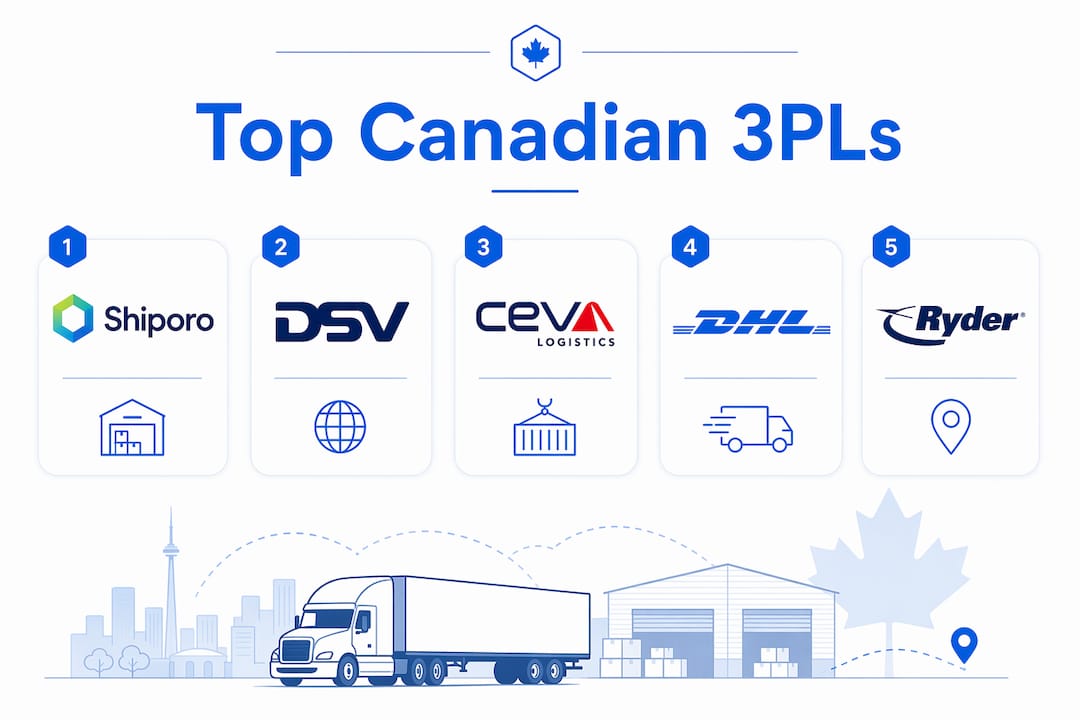
- National freight and transborder volume: A global network operator (DSV, CEVA Logistics, Kuehne + Nagel, DHL Supply Chain, DB Schenker) handles the scale and cross-border customs complexity that a regional specialist cannot.
- High-volume eCommerce velocity at national scale: A national eCommerce operator (Ryder Supply Chain Solutions, TSI, Polaris Worldwide Logistics, Stallion) offers the multi-hub inventory splits and carrier redundancy that fast-growing brands need once they outgrow a single fulfilment centre.
Ready to move from shortlist to pilot? Request a quote from Shiporo and get a pricing estimate within one business day.
Pro Tip: Before you contact any provider, confirm whether they are registered with the Canada Border Services Agency (CBSA) as a customs broker or have a direct CBSA partnership. For brands selling cross-border into the US or receiving inbound freight from overseas, this single credential check saves weeks of onboarding surprises.

Table of Contents
- How do the top Canadian 3PL options compare?
- Provider profiles: who does what, and for whom?
- How do you pick the right 3PL in Canada?
- What does Canadian 3PL pricing look like, and how long does onboarding take?
- What WMS and integrations should you require from a 3PL?
- Key takeaways
- The part most brands get wrong when choosing a 3PL
- Shiporo: eCommerce fulfilment built for Quebec brands
- Useful sources
- FAQ
How do the top Canadian 3PL options compare?
The Canada 3PL market is concentrated around Ontario but capacity is growing in Alberta, British Columbia, and Quebec. That geography matters when you are choosing a provider: a warehouse in Mississauga does not give you the same transit times to Montreal customers as a hub in Laval or Pointe-Claire.
The table below maps provider categories and Shiporo across the dimensions that actually drive a shortlist decision.
| Provider category | Best for / size & verticals | Core services | Coverage & hubs | Integrations & WMS | Minimums & scalability | Pricing model shape | Service levels | Account model | Trust signals to request |
|---|---|---|---|---|---|---|---|---|---|
| Shiporo | Quebec-centric DTC brands; Shopify/WooCommerce sellers; 200–2,000 orders/month | Warehousing, pick & pack, FBA prep, returns, real-time rate comparison, freight coordination | Montreal hub; national carrier network (Canada Post, FedEx, UPS, Purolator, Intelcom) | ShipHero WMS; Shopify, WooCommerce APIs; custom API; CSV import | Low-to-mid volume; pilot-friendly onboarding | Storage + pick/pack + shipping pass-through; no hidden minimums disclosed publicly | 100% order-accuracy guarantee; dedicated account manager | Dedicated account manager | Order-accuracy guarantee; pilot offer; reference checks available |
| Local Quebec fulfilment specialist | SME brands, bilingual customer service needs, Quebec tax compliance | Pick & pack, returns, light kitting | Quebec province; limited national reach | Varies; confirm API vs CSV | Low minimums; limited peak-season surge capacity | Per-order or per-unit; storage by pallet/bin | SLA varies; ask for written guarantee | Often pooled | Local client references; Quebec-specific compliance experience |
| National eCommerce velocity operator (e.g. Stallion, TSI, Polaris Worldwide Logistics) | Mid-to-high volume DTC; marketplace sellers; FBA prep | Pick & pack, FBA prep, returns, parcel consolidation | Multi-province hubs (ON, BC, AB typically) | Varies by provider; confirm EDI/API | Mid-to-high minimums; strong peak-season capacity | Volume-tiered; parcel rate discounts built in | Written SLAs common; order accuracy varies | Pooled or semi-dedicated | Volume case studies; carrier rate benchmarks |
| Global network operator (e.g. DSV, CEVA Logistics, Kuehne + Nagel, DHL Supply Chain, DB Schenker, Ryder) | Enterprise; transborder freight; cold chain; retail compliance (Costco-style) | Full 3PL + 4PL; freight management; customs brokerage; cold chain | National + cross-border US; international gateways | Enterprise WMS; EDI standard; API available | High minimums; strong scalability | Contract-based; management fees + transactional | ISO-certified operations; formal SLA contracts | Dedicated key account | ISO certifications; CBSA partnerships; published case studies |
How to use this table to narrow your shortlist:
- If your primary warehouse-to-customer transit corridor is Quebec, start with Shiporo and one local specialist, then add one national operator as a backup bid.
- If a notable portion of your orders cross into the US, include at least one global network operator with a confirmed CBSA customs brokerage relationship.
- If you sell on Amazon Canada and need FBA prep, prioritise providers with documented FBA compliance experience, not just a checkbox on their website.
Provider profiles: who does what, and for whom?
Shiporo
Shiporo operates out of Montreal and is built specifically for DTC eCommerce brands that sell through Shopify or WooCommerce. The ShipHero WMS handles real-time inventory sync and order webhooks, which means your store’s stock count updates the moment a pick is confirmed, not at the end of a batch cycle. Shiporo’s carrier mix (Canada Post, FedEx, UPS, Purolator, Intelcom) feeds a live rate-comparison engine, so each order ships on the cheapest qualifying service rather than a pre-negotiated flat rate. The 100% order-accuracy guarantee and dedicated account manager model are the two proof points worth verifying during a pilot. For Montreal-area eCommerce brands, Shiporo is the most direct fit.
Best for: Quebec-centric brands, 200–2,000 orders/month, Shopify/WooCommerce sellers, brands that want a named contact rather than a support ticket queue.
DSV
DSV is a global freight and contract logistics operator with Canadian operations concentrated in Ontario and BC. Its strength is transborder freight management and customs brokerage, which makes it a natural fit for brands with significant US import or export volume. Expect formal contract terms, high minimums, and an enterprise onboarding process measured in months rather than weeks.

Best for: Enterprise brands, transborder freight, retail compliance programmes.
CEVA Logistics
CEVA runs contract logistics and freight management across Canada with particular depth in automotive, technology, and consumer goods verticals. Its WMS integrates via EDI, which is standard for retail-compliance shipments but can be slow to configure for a DTC brand used to API-first tools.
Best for: Mid-to-large brands with retail compliance requirements or complex inbound freight.
Kuehne + Nagel
Kuehne + Nagel’s Canadian footprint leans heavily on air and ocean freight forwarding rather than domestic DTC fulfilment. If your supply chain involves significant international inbound freight, Kuehne + Nagel’s customs and forwarding capabilities are worth including in an RFP. For pure domestic pick-and-pack, it is not the natural first call.
Best for: Brands with complex international inbound freight; less suited to high-frequency DTC pick-and-pack.
DHL Supply Chain
DHL Supply Chain operates large-format contract logistics facilities in Canada, primarily in Ontario. Its technology stack is mature (SAP-based WMS, EDI, API options), and it carries ISO certifications relevant to food, pharma, and consumer goods. Minimum volume commitments are high.
Best for: High-volume consumer goods brands; food and pharma requiring temperature control or ISO compliance.
DB Schenker
DB Schenker’s Canadian presence focuses on freight forwarding and contract logistics. Like the other global operators, it suits brands that need a single provider to manage international freight plus domestic distribution, rather than a pure-play eCommerce fulfilment partner.
Best for: Brands with international freight complexity; enterprise contract logistics.
Ryder Supply Chain Solutions
Ryder brings a strong North American footprint and is one of the few providers with both dedicated fleet assets and contract warehousing in Canada. Its eCommerce fulfilment capabilities have grown, but its heritage is in B2B and retail replenishment rather than DTC. Confirm API integration depth before committing.
Best for: Brands with a mix of B2B retail replenishment and DTC; cross-border North American distribution.
TSI
TSI (The Shipping Intelligence) operates as a Canadian parcel and fulfilment specialist with multi-province coverage. It is a mid-market option for brands that have outgrown a single-hub provider but are not yet at enterprise scale. Ask specifically about peak-season capacity commitments in writing.
Best for: Mid-volume DTC brands needing multi-province reach without enterprise minimums.
Polaris Worldwide Logistics
Polaris Worldwide Logistics positions itself as a full-service Canadian 3PL with warehousing, freight, and customs brokerage under one roof. Its cross-border capabilities are a differentiator for brands selling into the US. Confirm WMS integration options early; EDI is standard but API availability varies by client tier.
Best for: Brands with active US cross-border volume; mid-to-large DTC or wholesale.
Stallion
Stallion is a Canadian parcel shipping and fulfilment platform that has built a following among eCommerce sellers for its discounted carrier rates and straightforward onboarding. Its fulfilment services are strongest in Ontario, and it integrates with Shopify and other major platforms. It is a competitive option for brands that prioritise parcel rate savings over dedicated account management.
Best for: Ontario-based DTC brands; price-sensitive sellers prioritising parcel discounts.
Pro Tip: Ask every provider for two reference clients with a similar order volume and product category to yours, not their flagship case studies. A provider that ships 50,000 orders a month for a large retailer may not have the attention or the process rigour for a 500-order-per-month DTC brand. The Supply Chain Alliance’s seven-step framework makes reference checks with similarly sized clients the single most predictive evaluation step.
How do you pick the right 3PL in Canada?
The Supply Chain Alliance’s evaluation framework structures the selection process in seven steps, with requirements definition and reference checks as the two highest-leverage activities. Here is how to run that process in practice.
Selection criteria checklist
- Geography: Does the provider have a warehouse within the transit-time corridor your customers expect? A Montreal hub matters if 60% of your orders ship to Quebec.
- Industry experience: Has the provider handled your product category (fragile, temperature-sensitive, oversized, hazmat) at your volume?
- Technology integration: Does the WMS connect via API or webhook to your Shopify or WooCommerce store? CSV-only is a red flag.
- Scalability: Can the provider handle a 3x volume spike during peak season without renegotiating your SLA?
- Financial stability: How long has the provider operated? Request a credit reference or financial summary for providers you are seriously considering.
- SLA metrics: Are order-accuracy rates, same-day cut-off times, and claims resolution windows stated in writing?
RFP questions to include
- What is your WMS, and does it support real-time API/webhook inventory sync with Shopify and WooCommerce?
- What are your standard and peak-season cut-off times for same-day fulfilment?
- How are accessorial charges (residential delivery, address correction, oversize) disclosed and billed?
- What is your documented order-accuracy rate, and how is it measured and reported?
- Describe your onboarding milestones and the typical calendar from contract signing to first live order.
- What is your process for handling a carrier failure or warehouse disruption? Do you have a secondary carrier or hub?
- How are billing disputes resolved, and what is your audit process for storage and pick/pack charges?
- Can you provide two reference clients with a similar order volume and product vertical?
Red flags
- No willingness to provide reference checks from similarly sized clients.
- Accessorial charges buried in an appendix with no cap or notification threshold.
- CSV-only integration with no API roadmap.
- SLA language that is vague (“we aim to ship within 24 hours”) rather than contractual (“98% of orders ship same day when received before 2 PM EST”).
- No written claims process for lost or damaged inventory.
Reference check questions
When you speak to a provider’s reference clients, ask: How does the provider perform during peak season compared to normal operations? Have there been billing discrepancies, and how were they resolved? If you were starting over, would you choose this provider again? Those three questions surface more useful signal than any RFP response.
Pro Tip: Retail Insider’s Q2 2026 logistics report flags network redundancy as a top priority for Canadian retailers. Ask every provider about carrier fallback plans and multi-hub inventory splits before you sign.
What does Canadian 3PL pricing look like, and how long does onboarding take?
Common pricing components
Most Canadian 3PL contracts include some combination of the following:
- Storage: Charged per pallet, per bin, or per cubic metre per month. Rates vary by location and facility type.
- Pick & pack: A per-order base fee plus a per-item fee for each unit picked. Kitting and custom packaging add a separate line.
- Packaging materials: Either pass-through at cost or a flat per-order materials fee.
- Returns processing: Per-return fee covering receipt, inspection, and restocking or disposal.
- Technology and integration fees: One-time setup fee for WMS integration; sometimes a monthly platform fee.
- Minimums: Monthly minimum spend or minimum order volume. Missing the minimum triggers a shortfall charge.
- Accessorials: Residential delivery surcharges, address correction fees, oversize handling, fuel surcharges passed through from carriers.
For an SME eCommerce brand shipping roughly 500 orders per month with an average of 1.5 units per order, a realistic total cost model includes storage for a modest SKU count, a per-order pick/pack fee, and carrier pass-through rates. The exact figures vary by provider and location, so use Shiporo’s pricing calculator to model your specific scenario before you enter RFP negotiations.
Cross-border and multi-carrier routing services are increasingly important for Canadian brands selling into the US, and those capabilities typically carry additional brokerage or handling fees. Model them into your total cost of ownership from the start, not as a surprise line item after go-live.
Onboarding timeline
| Phase | What happens | Typical duration |
|---|---|---|
| Requirements & contract | Define SKUs, volumes, SLAs, integration specs; sign agreement | 1–2 weeks |
| WMS integration & testing | API/webhook setup, test orders, inventory mapping | 1–3 weeks |
| Inventory intake | Ship initial stock to fulfilment centre; receiving and putaway | 1–2 weeks |
| Parallel run | Run new 3PL alongside existing process; compare accuracy and timing | 1–2 weeks |
| Go-live & ramp | Cut over fully; monitor SLAs daily for first 30 days | Ongoing |
Total calendar from contract to first live order: typically several weeks for a straightforward eCommerce integration. Complex EDI setups or multi-SKU cold-chain onboarding can run longer. Budget for transition costs: inbound freight to the new facility, potential duplicate storage fees during parallel run, and staff time for reconciliation.
What WMS and integrations should you require from a 3PL?
The Canada eCommerce logistics market is moving toward automated warehousing and real-time tracking as baseline expectations, not premium features. A provider that cannot offer API-based inventory sync is already behind.
Technology checklist
- Shopify and WooCommerce APIs: Real-time order import and inventory push, not a nightly batch.
- Order webhooks: Instant status updates (picked, packed, shipped, exception) back to your storefront.
- EDI/API for freight: Carrier label generation and tracking number injection without manual steps.
- Returns portal: A branded or white-label returns flow that updates inventory automatically on receipt.
- Reporting dashboard: SKU-level velocity, days of stock on hand, order-accuracy rate, and carrier performance by service level.
- Custom API or CSV import: For brands with ERP systems or non-standard order sources.
Integration priority table
| Integration | Priority | Why it matters |
|---|---|---|
| Shopify / WooCommerce API | Must-have | Eliminates manual order entry; prevents overselling |
| Real-time inventory sync (webhook) | Must-have | Accurate stock counts across all sales channels |
| Carrier label generation (EDI/API) | Must-have | Removes manual carrier booking; enables rate shopping |
| Returns portal with auto-restock | Should-have | Reduces returns processing time and manual reconciliation |
| Custom API / ERP integration | Should-have | Required for brands with multi-channel or wholesale orders |
| Branded tracking page | Nice-to-have | Reduces “where is my order” support tickets |
| Automated accessorial alerts | Nice-to-have | Flags unexpected carrier surcharges before billing |
API and webhook-based integrations dramatically reduce manual reconciliation and stock-sync errors compared with CSV-based processes. A provider that offers only CSV export is not a technology partner; it is a warehouse with a spreadsheet.
Pilot test scenarios to run
During any pilot, run these specific test cases before you commit to a full go-live:
- High-velocity burst: Submit 50–100 orders in a 30-minute window and confirm all ship same day.
- Partial cancellation: Cancel an order after it has been picked but before it ships; confirm the inventory is restocked correctly.
- Split shipment: Submit an order with two items where one is out of stock; confirm the provider’s handling matches your agreed policy.
- Returns flow: Process five returns and confirm inventory updates in your WMS and storefront within the agreed window.
These four scenarios reveal WMS and carrier edge cases that a standard RFP answer will never surface.
Pro Tip: Shiporo runs on ShipHero, a WMS built specifically for DTC order fulfilment. ShipHero’s real-time rate comparison across Canada Post, FedEx, UPS, Purolator, and Intelcom means each order is automatically routed to the lowest qualifying carrier rate, not just the carrier your 3PL has a preferred contract with. That distinction shows up directly in your per-order shipping cost.
Key takeaways
Shiporo is a strong fit for Quebec-based eCommerce brands needing Shopify or WooCommerce integration, a dedicated account manager, and an order-accuracy guarantee without enterprise-scale minimums.
| Point | Details |
|---|---|
| Start with geography | A Montreal or Quebec hub cuts transit times and costs for brands with a Quebec-heavy customer base. |
| Demand API integration | CSV-only WMS connections create reconciliation errors; require real-time API or webhook sync as a contract condition. |
| Run a structured pilot | Test high-velocity bursts, partial cancellations, split shipments, and returns before full go-live. |
| Check references from similar-sized clients | Marketing case studies are unreliable; ask for two clients at your volume and vertical. |
| Shiporo for Quebec DTC | Shiporo’s ShipHero WMS, carrier rate comparison, and 100% order-accuracy guarantee make it the recommended starting point for Quebec eCommerce brands. |
The part most brands get wrong when choosing a 3PL
The conventional wisdom says to evaluate 3PLs on price per pick. That is the wrong primary filter, and it leads brands to sign contracts they regret within six months.
What actually happens is that a provider with a low per-pick rate wins the RFP, then recovers margin through accessorial charges that were never clearly disclosed. Residential delivery surcharges, address-correction fees, and fuel adjustments can add significantly to a per-order cost that looked competitive on paper. By the time you notice, you are locked into a 12-month contract with a 90-day exit notice clause.
The smarter filter is integration quality and reference quality, in that order. A provider whose WMS talks to your Shopify store in real time, whose references from similarly sized clients are enthusiastic, and whose SLA is written in contractual language rather than aspirational prose is worth paying a slightly higher per-pick rate for. The operational cost of a CSV-only integration, a missed peak-season SLA, or a billing dispute that takes three months to resolve dwarfs any per-pick savings.
For Quebec-based brands specifically, bilingual customer service and Quebec-specific carrier knowledge are important considerations. Intelcom, for example, has strong last-mile density in Quebec that national carriers do not match on cost. A 3PL that does not actively rate-shop regional carriers is leaving money on the table for its Quebec clients.
The brands that get 3PL selection right treat it like hiring a senior operations hire, not like buying a commodity service. They define requirements before they talk to providers, they run a real pilot with adversarial test cases, and they call the references. The ones that skip those steps are the ones who are re-evaluating their 3PL again 18 months later.
Shiporo: eCommerce fulfilment built for Quebec brands
Quebec eCommerce brands that have outgrown self-fulfilment or a generic national provider have a direct alternative in Shiporo. Where large global operators require enterprise minimums and multi-month onboarding, Shiporo is designed for brands shipping in the 200–2,000 orders-per-month range who need a named account manager, not a support ticket queue.
Shiporo’s ShipHero WMS connects directly to Shopify and WooCommerce via real-time API, so inventory counts and order statuses update instantly across your storefront. Every order is rate-shopped across Canada Post, FedEx, UPS, Purolator, and Intelcom, which means you get the best available carrier rate on each shipment rather than a flat negotiated rate that may not reflect current market pricing. The 100% order-accuracy guarantee is backed by a dedicated account manager who knows your SKUs and your SLA, not a rotating support team.
For brands ready to move from shortlist to pilot, Shiporo offers a discovery consultation and a pricing calculator to model your specific volume and SKU mix. Book your discovery call and get a pilot proposal within one business day.
Useful sources
The following sources were used to support claims in this article and are worth consulting directly for market data, selection frameworks, and logistics trends.
| Source | What you will find there |
|---|---|
| Canada 3PL Market Size and Forecast, MarkWide Research | Market valuation, growth outlook, and geographic concentration of Canadian 3PL capacity |
| Canada eCommerce Logistics Market Overview, IMARC Group | Automation investment trends, real-time tracking adoption, and market growth drivers |
| How to Choose a 3PL in Canada: The 7-Step Evaluation Framework, Supply Chain Alliance | Structured seven-step selection process including RFP discipline, site visits, and reference checks |
| Q2 2026 Canadian Retail Logistics: From Efficiency to Optionality, Retail Insider | Automation investment, network redundancy priorities, and inventory visibility trends among Canadian retailers |
| Top Third-Party Logistics Companies in Canada, Clutch | Verified client reviews and ratings for Canadian 3PL providers |
FAQ
What is a 3PL, and how does it work in Canada?
A third-party logistics (3PL) provider warehouses your inventory, picks and packs orders, and ships them to your customers on your behalf. In Canada, 3PLs typically integrate with eCommerce platforms like Shopify and WooCommerce and use national carriers such as Canada Post, FedEx, UPS, and Purolator alongside regional carriers like Intelcom.
Who are the top 3PL companies in Canada for eCommerce brands?
The leading options for Canadian eCommerce brands include Shiporo (best for Quebec and mid-volume DTC), national velocity operators like Stallion, TSI, and Polaris Worldwide Logistics, and global network operators like DSV, CEVA Logistics, Kuehne + Nagel, DHL Supply Chain, DB Schenker, and Ryder Supply Chain Solutions for enterprise and transborder needs.
What is the largest logistics company in Canada?
Global operators such as DHL Supply Chain, DSV, and CEVA Logistics operate the largest Canadian logistics footprints by facility size and freight volume, with primary hubs concentrated in Ontario. For domestic eCommerce fulfilment specifically, national operators and regional specialists often outperform global providers on responsiveness and per-order cost.
Does Costco use a 3PL?
Yes. Large retailers including Costco use specialist 3PL partners to manage omnichannel fulfilment and meet strict retail compliance requirements. Brands supplying Costco or similar retailers need a 3PL with documented retail-compliance experience, EDI capability, and the ability to meet vendor routing guides precisely.
How do I choose a 3PL provider in Canada?
Define your requirements first (geography, volume, integrations, SLA), then issue an RFP to a shortlist of three to five providers, run a structured pilot with adversarial test cases, and call reference clients of similar size and product category. The Supply Chain Alliance’s seven-step framework is the most practical publicly available guide for this process.

