

TL;DR:
- Effective return management treats returns as a controllable profit and loss line, reducing costs through faster measurement and recovery. Implementing clear policies, automating stages, and outsourcing to platforms like Shiporo can significantly lower fully loaded return costs for Canadian ecommerce brands. Properly managing returns enhances margins, builds customer trust, and provides valuable data to improve product offerings.
Treat returns as a controllable P&L line. Every return has a cost, and for Canadian ecommerce brands, that cost typically runs 20–30% of order value in pure reverse logistics alone, with fully loaded costs (including markdowns and write-offs) reaching up to 50–66% for some categories. The brands that win on returns are not the ones with the most lenient policies. They are the ones that measure, route, and recover faster than their competitors.
Start here — five actions you can take this week:
- Measure cost per return (ops): pull your return volume, carrier costs, and labour time into one number. If you don’t have it, you can’t manage it.
- Tighten your policy language (ops/marketing): confirm your return window, eligibility rules, and fee structure are visible on product pages and at checkout, not buried in the footer.
- Prioritise exchanges over refunds (customer support): train your team to offer an exchange or store credit before processing a cash refund.
- Enable drop-off returns (ops): activate box-free, label-free returns through Canada Post or Purolator to cut friction and speed up inbound recovery.
- Assign a returns owner (leadership): returns that belong to everyone get optimised by no one. Put one person or team accountable for the full cycle.
Table of Contents
- Why returns deserve a line on your P&L
- How does the ecommerce returns management lifecycle actually work?
- How do you design a returns policy that scales?
- How do you reduce returns before they happen?
- Should you handle returns in-house or outsource to a 3PL?
- What does warehouse processing actually look like?
- What KPIs should you track for returns?
- How do you handle exchanges, refunds, and the accounting?
- What should you look for in a returns management partner or platform?
- How Shiporo handles returns for Canadian brands
- How do you protect against fraudulent returns?
- Key takeaways
- The returns trap most brands don’t see until it’s expensive
- Shiporo makes returns part of your growth strategy, not a drag on it
- Useful sources
- FAQ
Why returns deserve a line on your P&L
Canadian ecommerce return rates run at a significant level across categories, with apparel showing notably higher rates. That’s not a customer service problem. It’s a margin problem.
The fully loaded cost of a return — including markdowns, write-offs, and labour — can be substantial relative to the original order value for some product categories. Pure reverse logistics alone typically accounts for a sizable portion of order value.
At those numbers, a brand doing $2M in annual revenue with a 20% return rate is absorbing hundreds of thousands of dollars in return-related costs annually. Most of that is invisible because it’s spread across carrier invoices, warehouse labour, and inventory write-downs rather than sitting in one named budget line.
Canadian brands face a few compounding factors that make this worse than the US benchmark. Average order values tend to be lower relative to the cost of domestic shipping. Cross-border returns from US customers add FX exposure and customs friction. And post-holiday spikes are sharp: returns jump noticeably above a typical week in the week after Christmas, concentrated in apparel and beauty. If your routing and warehouse capacity aren’t built for that surge, you’re paying premium rates to process returns slowly.
The upside is real. Canadian shoppers treat easy returns as a trust signal, and returns friction is a documented switching trigger. Brands that invest in a clean returns experience convert more first-time buyers and retain more repeat customers. Returns handled well become a retention tool.
How does the ecommerce returns management lifecycle actually work?
Every return moves through the same eight stages. Most margin leakage happens because one or two of those stages lack a clear owner or SLA.
- Initiation: The customer submits a return request through your portal, email, or carrier label. Automated portals (Loop Returns, ReturnGO, or a custom Shopify flow) reduce support tickets and capture reason codes at the source.
- Approval and eligibility check: The system or a support agent verifies the item is within the return window, in eligible condition, and not excluded by policy. Automated rules handle the majority; edge cases escalate to a human.
- Collection: The customer ships the item back using a prepaid label, drops it at a carrier location, or arranges a pickup. Canada Post’s ecommerce returns solutions include over 30,000 drop-off points nationally, which meaningfully reduces the friction of getting the item back.
- Inbound routing: The return label or portal data tells the warehouse where the item is going. Multi-warehouse setups route based on the item’s disposition path — restockable items go to the nearest fulfilment centre; refurbishment candidates go to a dedicated processing location.
- Receiving and inspection: The warehouse team scans, opens, and grades the item against a defined condition rubric. This is where reason codes get confirmed or corrected.
- Disposition decision: Based on condition grade and reason code, the item is restocked, refurbished, discounted, donated, or written off. This decision should be pre-programmed, not made ad hoc on the floor.
- Refund or exchange execution: The customer receives their refund, store credit, or replacement. Timing here directly affects chargeback rates and review scores.
- Resale or disposal: Restocked items re-enter available inventory. Refurbished or discounted items move to a secondary channel. Write-offs are recorded and reported.
Automation pays off most at stages 1, 2, and 7. Connecting your order management system, WMS (Shiphero, for example), carrier API, and payment processor into a single flow means a return can be approved, labelled, received, and refunded with minimal human intervention for clean cases — freeing your team to handle exceptions.
Ownership by stage: customer support owns stages 1–2; operations and warehouse own 3–6; finance owns 7–8 with ops support.

How do you design a returns policy that scales?
A returns policy has two jobs: protect your margin and not cost you the sale. Most brands optimise for one and ignore the other.
The Canadian baseline is a 30-day return window. Extending beyond 30 days tends to increase return volume without lifting conversion, while windows shorter than 14 days generate negative reviews and hurt customer lifetime value. Thirty days is the right default for most categories. Exceptions worth building in: extended windows for gifting seasons (45–60 days from November through January), stricter windows for perishables or hygiene products, and no-return rules for final-sale items stated clearly at checkout.
Policy language that converts: “We accept returns within 30 days of delivery. Items must be unused and in original packaging. Start your return at [portal link].” That’s it. The simpler the language, the fewer the support tickets.
Place your policy in three spots: the product page (near the add-to-cart button), the checkout confirmation page, and the footer. Many online shoppers check a retailer’s returns policy before buying, so burying it is a conversion mistake, not a margin protection strategy.
On fees: charging a return shipping fee reduces frivolous returns but also reduces conversion for first-time buyers. Offering free returns for exchanges and store credit, while applying a modest fee for cash refunds, can work well. This steers customers toward revenue-preserving outcomes without feeling punitive.
Pro Tip: Offering store credit at 110% of the return value — for example, a $50 refund becomes $55 in store credit — converts a meaningful share of refund requests into retained revenue. Test it on preference-based returns (wrong colour, changed mind) before rolling it out broadly.
How do you reduce returns before they happen?
The highest-leverage returns reduction work happens before the customer clicks “buy,” not after they click “return.”
Product content fixes that move the needle:
- Size charts with real measurements: generic S/M/L charts cause apparel returns. Replace them with centimetre-based measurements and a “how to measure yourself” guide.
- Video and 360° imagery: customers who see a product from every angle and in motion return it less often. A 15-second clip showing fit, texture, or scale cuts uncertainty.
- Honest photography: lifestyle shots that misrepresent colour or scale are a leading cause of “not as described” returns. Calibrate your images to match real-world appearance.
- Verified reviews with fit feedback: displaying customer reviews that mention sizing or quality gives future buyers social proof that reduces guesswork.
Post-purchase communication is underused. A well-timed email three to five days after delivery — not a promotional email, a genuine “how does it fit?” message — gives your customer support team a window to resolve fit issues before a return request is submitted. Proactive outreach can steer customers toward exchanges rather than refunds, and it signals that you care about the purchase experience.
Technology: size-finder tools (Fit Analytics, True Fit) reduce apparel returns by helping customers select the right size before checkout. AI-driven analytics platforms can flag high-return SKUs automatically, surfacing which products need content fixes versus which ones have a quality or fulfilment problem. Fixing a product page is almost always cheaper than processing the returns it generates.

Pro Tip: Sort your SKUs by return rate, not just return volume. A low-volume SKU with a 60% return rate is a product content problem. A high-volume SKU with a 25% return rate might just be a popular category. They need different fixes.
Should you handle returns in-house or outsource to a 3PL?
The honest answer depends on your volume, your warehouse footprint, and how much of your team’s time returns are consuming.
Decision checklist:
| Factor | In-house makes sense | 3PL makes sense |
|---|---|---|
| Monthly return volume | Lower volumes | Higher volumes |
| Warehouse space | Dedicated returns area available | No dedicated space; returns compete with outbound |
| Tech integration | WMS already handles returns workflows | Need WMS + carrier + portal integration |
| Labour | Returns staff already on payroll | Returns labour is ad hoc or seasonal |
| Cost per return | Below $8–$12 fully loaded | Above $12 or unknown |
For most Canadian brands scaling past $1M in revenue, the math favours outsourcing. A 3PL with a multi-warehouse footprint can route returns to the closest facility, reducing transit time and carrier cost. Regional carrier selection matters here: Canada Post covers national reach with the broadest drop-off network; Purolator is strong for business-to-business and time-sensitive returns; Intelcom covers last-mile in Quebec and Ontario efficiently.
Cross-border returns from US customers add another layer. Without a US return address or a cross-border returns partner, you’re asking American customers to ship internationally, which kills the return rate and the customer relationship. A 3PL with cross-border capabilities can hold US returns domestically before consolidating and shipping them back to Canada, cutting per-unit costs significantly.
Pro Tip: When evaluating a 3PL for reverse logistics in Canada, ask for their cost-per-return breakdown: receiving fee, inspection fee, restocking fee, and carrier pass-through. A low headline rate with high per-touch fees can cost more than a transparent flat rate.
Shiporo operates as a Canadian 3PL with warehouse operations in Quebec, integrating with Canada Post, Purolator, and Intelcom for returns routing. Their WMS, Shiphero, handles inbound return scanning, condition grading, and inventory reintegration natively, which removes the need for manual reconciliation between your store and your warehouse.
What does warehouse processing actually look like?
Returns processing is where margin either gets recovered or disappears. The difference is almost always process design, not effort.
Receiving checklist:
| Step | Owner | SLA |
|---|---|---|
| Scan inbound return label | Warehouse associate | Same day as receipt |
| Open and triage (condition check) | Warehouse associate | Within 4 hours of receipt |
| Confirm reason code against customer-stated reason | Returns lead | Within 4 hours |
| Quarantine damaged or disputed items | Returns lead | Immediate |
| Execute disposition decision | Returns lead | Within 24 hours |
| Update inventory in WMS | System (automated) | Real-time on disposition |
| Trigger refund or exchange | System (automated) | Within 24 hours of disposition |
The disposition decision tree is the most important document in your returns operation. Map every reason code to an outcome before items start arriving:
- “Wrong size” + Grade A condition → restock immediately
- “Defective” + Grade B condition → refurbishment queue
- “Changed mind” + Grade A condition → restock with inspection note
- “Damaged in transit” + Grade C condition → carrier claim, then write-off or donate
- “Not as described” + any grade → escalate to merchandising for product content review
Pro Tip: The single biggest cause of margin erosion in returns processing is items sitting in a “pending” queue with no assigned disposition. Set a hard SLA: every item gets a disposition decision within 24 hours of receiving. Anything older than 48 hours triggers an alert to the returns lead.
Shiphero, Shiporo’s WMS, supports returns best practices including reason-code capture, condition grading, and automated inventory updates — which means disposition decisions feed directly back into your available stock count without a manual step.
What KPIs should you track for returns?
Returns analytics is where most brands are flying blind. Here are the metrics that actually drive decisions:
| KPI | Definition | Target (Canadian ecommerce) |
|---|---|---|
| Return rate by category | Returns ÷ orders shipped, by product category | Apparel: under 25%; hard goods: under 10% |
| Cost per return (reverse logistics) | Carrier + warehouse labour ÷ return volume | Target is low per unit cost |
| Cost per return (fully loaded) | Add markdowns, write-offs, and refund processing | Should be managed to avoid excessive cost relative to order value |
| Time to disposition | Hours from receiving scan to disposition decision | Under 24 hours |
| Resale recovery rate | Revenue from restocked/refurbished items ÷ original item cost | Over 60% |
| Repeat returner rate | % of customers with multiple returns in a year | Monitored for unusual patterns |
| Reason code distribution | % of returns by reason (fit, defect, preference, fraud) | Track monthly; no single target |
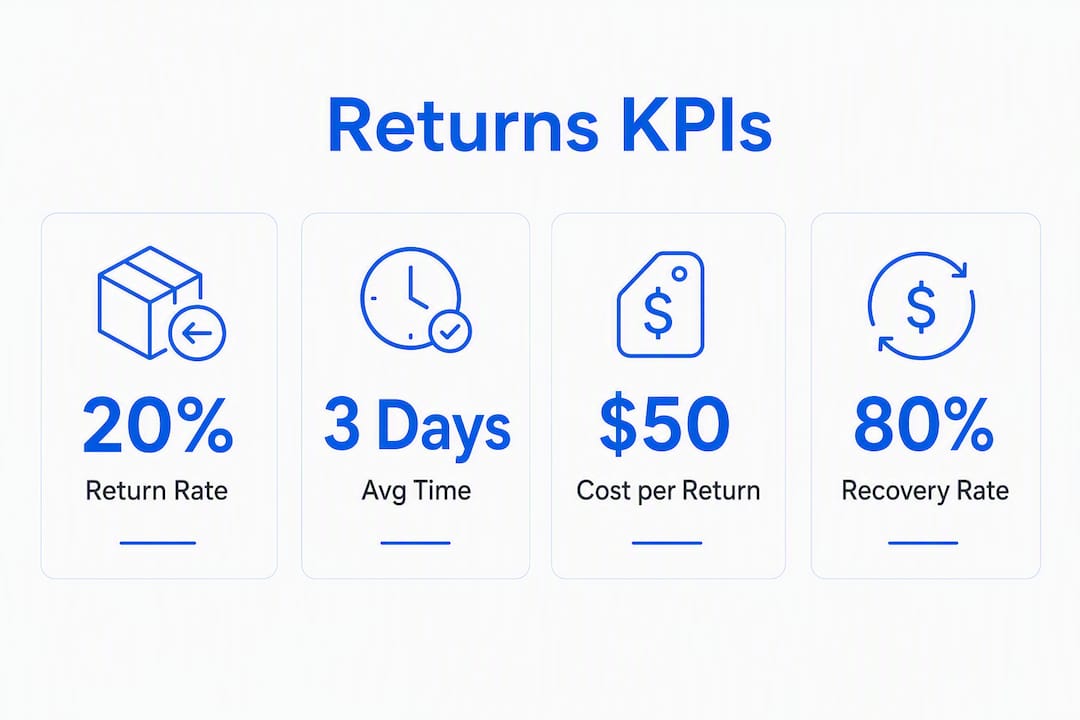
Build your dashboard in layers. The first layer is operational: daily return volume, time to disposition, and items in queue. The second layer is financial: cost per return, resale recovery, and write-off rate. The third layer is strategic: return rate by SKU, reason code trends, and repeat returner flags.
Connect your returns data to your merchandising team. A SKU with a rising “not as described” return rate is a product page problem. A SKU with a rising “defective” rate is a supplier problem. Neither gets fixed if the data stays in the warehouse.
Bullet checklist for dashboard setup:
- Pull return data from your WMS (Shiphero exports this natively) into a reporting tool (Google Looker Studio, Tableau, or a Shopify analytics app).
- Segment by category, SKU, and reason code from day one. Aggregated return rates hide the problems.
- Set a monthly review cadence with ops, merchandising, and finance in the same room.
- Flag any SKU where the return rate exceeds 1.5x the category average for immediate content review.
How do you handle exchanges, refunds, and the accounting?
Exchanges are almost always better for your business than refunds. The customer stays in your ecosystem, you keep the revenue, and you avoid the full cost of a return. The operational challenge is making exchanges as easy as refunds, because if the exchange path has more friction, customers will default to the refund.
Operational flow for exchanges: Customer submits return request → selects exchange item in portal → new order is created automatically → return label is issued → new item ships when return is scanned inbound (or immediately for high-trust customers). The key is automating the new order creation so your team doesn’t have to manually process it.
Refund timing matters. Issue refunds within 3–5 business days of receiving the item. Delays beyond that generate chargebacks, which cost more than the refund itself. Automate the refund trigger from your WMS to your payment processor so it fires on disposition, not on a manual review cycle.
On the P&L: returns should be modelled as a named line item, not absorbed into cost of goods or shipping expense. A clean model shows: gross revenue → returns reserve (estimated % of sales) → net revenue → reverse logistics cost → resale recovery credit → net returns impact. That structure forces accountability and surfaces which levers (product, policy, routing) actually move the number.
Accounting treatment: set a returns reserve on your balance sheet as a percentage of open orders, updated monthly based on trailing return rates. When a return is processed, the reserve absorbs the cost. Resale recovery from restocked items flows back as a credit. Write-offs hit the P&L directly. This approach gives finance a clean view and prevents end-of-quarter surprises.
Customer messaging that prevents chargebacks: “Your return has been received and is being processed. You’ll receive your refund within 3–5 business days. Questions? Reply to this email.” Simple, specific, and it sets an expectation that reduces disputes.
What should you look for in a returns management partner or platform?
Choosing a returns platform or 3PL partner is an RFP exercise, not a demo exercise. Here’s what to evaluate:
Feature checklist:
- Native integration with your order management system (Shopify, WooCommerce) and WMS (Shiphero compatibility is a strong signal for Canadian brands)
- Prepaid label generation and box-free/label-free drop-off support through Canada Post and Purolator
- Reason-code capture at the customer portal level, not just at the warehouse
- Automated refund and exchange triggering tied to WMS disposition events
- Returns analytics dashboard with SKU-level and reason-code-level reporting
- Cross-border returns support if you sell into the US or internationally
RFP questions to ask:
- What is your cost-per-return breakdown (receiving, inspection, restocking, carrier pass-through)?
- How do you handle items that fail inspection? What’s your write-off and donation process?
- What’s your SLA for time-to-disposition?
- How does your system handle reason-code discrepancies (customer says “wrong size,” warehouse finds damage)?
- What’s the onboarding timeline for a standard Shopify integration?
Red flags:
- No reason-code support at the portal level (you’ll lose the data you need to reduce returns)
- Refund reconciliation done manually or on a weekly batch cycle
- No visibility into items in transit or in the processing queue
- Carrier costs passed through at retail rates with no volume negotiation
Total cost model: add tech platform fees, per-return processing fees, carrier costs, and onboarding time. A platform that charges $0.50 per return but takes six weeks to integrate and has no analytics is more expensive than one that charges $1.50 and goes live in a week.
How Shiporo handles returns for Canadian brands
Here’s what the operational picture looks like for a Canadian brand that outsources returns to Shiporo.
WMS and integration: Shiporo runs Shiphero as its warehouse management system. Shiphero is built for DTC fulfilment and handles inbound return scanning, condition grading, reason-code capture, and inventory reintegration natively. When a return is received and dispositioned, your Shopify or WooCommerce store updates in real time — no manual reconciliation.
Carrier network: Shiporo routes returns through Canada Post, Purolator, and Intelcom depending on origin, destination, and service level. Canada Post’s national drop-off network (30,000+ locations) handles the bulk of consumer returns. Purolator covers business-to-business and time-sensitive flows. Intelcom handles regional last-mile in Quebec and Ontario. Real-time rate comparison across carriers means you’re not defaulting to one carrier’s pricing.
Onboarding timeline: for a standard Shopify or WooCommerce integration, Shiporo’s typical onboarding runs 4–5 days from signed agreement to live fulfilment. The merchant needs to supply SKU data, packaging specs, and carrier rate preferences. Shiporo handles the WMS setup, carrier account configuration, and platform integration.
What merchants should prepare:
- Complete SKU list with weights, dimensions, and condition grades
- Return policy rules (window, eligibility, fee structure)
- Disposition rules by reason code (restock, refurb, write-off thresholds)
- Shopify/WooCommerce API credentials or CSV export format
Shiporo’s dedicated account manager model means you have a named contact who knows your product mix and return patterns, not a support ticket queue. For Quebec-based brands, the warehouse proximity reduces inbound transit time and keeps returns processing within the province.
For Canadian brands managing Shopify returns outsourcing, the combination of Shiphero’s WMS, Shiporo’s carrier partnerships, and a 4–5 day onboarding timeline removes the two biggest barriers to outsourcing: integration complexity and ramp-up time.
How do you protect against fraudulent returns?
Return fraud is a real cost for Canadian ecommerce brands, and it’s worth building safeguards before volume makes it expensive to fix retroactively.
Common fraud patterns:
- Wardrobing: customer buys, uses, and returns an item in apparently new condition. Common in apparel and electronics.
- Empty box returns: customer returns a box with the wrong item or nothing inside.
- Receipt fraud: customer uses a forged or altered receipt to return an item purchased elsewhere.
- Refund without return: customer claims a return was shipped but never sends the item.
Safeguards that work:
Require photo documentation at the return initiation stage for high-value items. A portal that asks the customer to upload a photo of the item before issuing a label adds friction for fraudsters without materially affecting legitimate returners.
Track your repeat returner rate as a KPI. Customers with three or more returns in a 12-month window warrant a manual review before the next return is auto-approved. This isn’t about penalising good customers; it’s about flagging patterns that don’t match normal purchase behaviour.
Use serialisation or tagging for high-value SKUs. A security tag that must be intact for a return to be accepted, or a serial number that must match the original order, closes the empty-box and wrong-item vectors.
Set a blacklist policy for confirmed fraud cases. Once a customer has been confirmed as fraudulent, your returns portal should flag their account for manual review on all future requests. Document the policy so your customer support team applies it consistently.
On policy language: your returns policy should state clearly that Shiporo (or your brand) reserves the right to refuse returns that show signs of use, damage, or fraud. That language doesn’t need to be aggressive; it just needs to exist so you have a documented basis for refusal.
Finally, reconcile your return label scans against your refund records monthly. A label that was scanned as delivered but never received at your warehouse is a signal worth investigating. Shiphero’s inbound scan data makes this reconciliation straightforward.
Key takeaways
Returns handled well protect margin, build loyalty, and generate data that makes your product mix better. The brands that treat returns as a named P&L line, assign clear ownership, and invest in prevention and fast recovery consistently outperform those that treat returns as an unavoidable cost.
| Point | Details |
|---|---|
| Measure cost per return | Track both reverse-logistics cost (20–30% of order value) and fully loaded cost (up to 50–66%) to find the real margin impact. |
| Set a 30-day baseline policy | A 30-day window is the Canadian standard; shorter windows hurt CX, longer windows increase return volume without lifting conversion. |
| Prioritise exchanges over refunds | Offer store credit at 110% of return value to retain revenue on preference-based returns. |
| Build a disposition decision tree | Map every reason code to a disposition outcome before items arrive; target under 24 hours from receiving to decision. |
| Shiporo for Canadian brands | Shiporo’s Shiphero WMS, Canada Post and Purolator carrier partnerships, and 4–5 day onboarding remove the main barriers to outsourcing returns in Canada. |
The returns trap most brands don’t see until it’s expensive
There’s a pattern that shows up repeatedly in ecommerce operations: a brand invests heavily in acquisition, builds a solid fulfilment operation for outbound orders, and then treats returns as an afterthought. The returns process is manual, the reason codes are vague (“customer changed mind” covers everything), and the disposition decisions are made on the warehouse floor by whoever is available.
The result isn’t just slow processing. It’s invisible margin erosion. Items sit in a “pending” queue for days. Restockable goods miss their restock window and get marked down. Refunds are delayed, generating chargebacks. And because no one is tracking return rates by SKU, the same product page problems generate the same returns month after month.
The fix isn’t complicated, but it requires treating returns as a system, not a task. A few things that make a disproportionate difference:
- Granular reason codes from the start. “Too small” and “wrong item” need different responses. If your portal lumps them together, you can’t fix either.
- A disposition SLA with teeth. Every item gets a decision within 24 hours. No exceptions, no pending queue that grows unchecked.
- Returns data in the merchandising meeting. The SKU with a 45% return rate isn’t a returns problem. It’s a product page problem. The data needs to be in front of the people who can fix it.
- Store credit as the default offer. Before your team processes a cash refund, they should offer store credit at a slight premium. Most customers who returned for preference reasons will take it.
The brands that get returns right don’t have fewer returns. They recover faster, lose less margin per return, and use the data to reduce the next wave. That’s the actual competitive advantage.
Shiporo makes returns part of your growth strategy, not a drag on it
Canadian ecommerce brands that outsource fulfilment to Shiporo get returns management built into the same operation as outbound orders. No separate system, no separate team, no integration project.
Here’s what that looks like in practice:
- Shiphero WMS handles inbound return scanning, condition grading, reason-code capture, and real-time inventory reintegration.
- Canada Post and Purolator carrier partnerships give your customers 30,000+ drop-off points and box-free return options nationally.
- Real-time rate comparison across Canada Post, Purolator, Intelcom, FedEx, and UPS means every return ships at the best available rate.
- Dedicated account manager who knows your product mix, your return patterns, and your policy rules.
- 4–5 day onboarding for standard Shopify and WooCommerce integrations. Bring your SKU list, packaging specs, and policy rules, and Shiporo handles the rest.
Shiporo’s ecommerce fulfilment services are built for Canadian brands, with warehouse operations in Quebec and carrier coverage across the country. If you’re spending more time managing returns than growing your business, that’s the problem Shiporo is built to solve.
Get your fulfilment cost estimate or reach out to Shiporo directly to discuss your returns volume and routing requirements.
Useful sources
The sources below are the most authoritative Canadian references for ecommerce returns management. Each is worth bookmarking for policy benchmarks, carrier options, and operational guidance.
- Canada Post ecommerce returns solutions: Canada Post’s commercial returns hub, covering box-free and label-free options, volume-based contracts, and the Rethinking Returns report. Start here for carrier-side returns setup.
- Canada Post box-free label-free returns: Specific guidance on enabling drop-off returns without packaging requirements. Useful for reducing customer friction.
- Retail Council of Canada — Canadian Shopper Sentiment Study 2026: Primary research on Canadian shopper behaviour, including returns expectations and trust signals. Useful for policy design and CX benchmarking.
- Retail Council of Canada — Retail Conditions Quarterly, Winter 2026: Macro retail context for Canadian ecommerce operators, including margin pressures and consumer spending trends.
- Shiporo — Mastering ecommerce returns: reverse logistics simplified: Shiporo’s operational guide to reverse logistics for Canadian DTC brands, covering routing, processing, and carrier selection.
- Shiporo — Best practices for managing reverse logistics: KPI frameworks and process guidance for returns operations, aligned with Shiphero’s WMS capabilities.
FAQ
What is returns management in ecommerce?
Returns management is the end-to-end process of handling customer returns: from the initial request through inspection, disposition, and refund or exchange. In ecommerce, it spans carrier logistics, warehouse processing, inventory reintegration, and customer communication.
What is a realistic return rate benchmark for Canadian ecommerce?
Blended Canadian ecommerce return rates run roughly 19–21% across categories, with apparel closer to 30%. Post-holiday spikes can push weekly return volume about 39% above average.
What is the best returns management approach for ecommerce brands?
The most effective approach combines a clear 30-day policy, automated reason-code capture at the portal, a pre-built warehouse disposition decision tree, and a carrier network (Canada Post, Purolator) that supports box-free drop-off. Shiporo integrates all of these for Canadian brands through its Shiphero WMS and carrier partnerships.
What is the 80/20 rule in ecommerce returns?
In most ecommerce operations, roughly 20% of SKUs generate 80% of return volume. Identifying and fixing those high-return products — usually through better product content, sizing information, or quality control — delivers the largest reduction in return costs for the least effort.
How long does it take to onboard a 3PL for returns management in Canada?
For a standard Shopify or WooCommerce integration, a Canadian 3PL like Shiporo can go live in 4–5 days when the merchant supplies SKU data, packaging specs, and policy rules upfront.

