

For most small Canadian subscription brands, the most cost-effective approach is a mixed-carrier strategy: Canada Post for light domestic parcels, regional carriers like Intelcom for nearby provinces, and a negotiated account or 3PL for heavier or fragile kits. Get that foundation right, and you cut per-box cost without sacrificing delivery reliability.
Before your next shipment cycle, do three things:
- Measure your packed box (length × width × height) and calculate dimensional weight before choosing a carrier.
- Match the carrier to your box profile: lightweight and dense goes Canada Post, bulky or fragile goes a negotiated parcel account.
- Run sample shipments with two carriers on your most common box size and compare the invoiced cost, not the quoted rate.
If you are spending more than a few hours per cycle on packing and labelling, your error rate is climbing, or you are shipping to multiple provinces, it is time to call a 3PL. Those are the three triggers that flip the math.
Key takeaways
The single most important thing a Canadian subscription brand can do right now is measure its packed boxes, calculate dimensional weight, and match each box profile to the right carrier. Everything else follows from that.
| Point | Details |
|---|---|
| Right-size your packaging | Use the smallest safe box; stock 2–3 sizes to avoid paying dimensional weight on air. |
| Measure after packing | Weigh and measure every box post-packing to avoid carrier cubing surcharges on your invoice. |
| Split carriers by box profile | Canada Post for light domestic parcels; negotiated accounts or a 3PL for heavy or fragile kits. |
| Transmit manifests same day | Canada Post requires same-day electronic manifest transmission for U.S. and international shipments. |
| Shiporo for scale | Shiporo offers 4–5 day onboarding, 100% order accuracy, and real-time carrier rate comparisons for Canadian subscription brands. |
Table of Contents
- Which Canadian carrier is right for your subscription box?
- How packaging choices affect what you actually pay
- How shipping costs are calculated and what to declare
- In-house vs. outsourcing: when does a 3PL pay for itself?
- Your step-by-step shipping cycle checklist
- How to handle returns and exchanges for subscription boxes
- Packaging durability for Canadian weather and transit
- What subscription brands consistently get wrong about shipping
- Shiporo handles subscription fulfilment so you can focus on growth
- Sources
- FAQ
Which Canadian carrier is right for your subscription box?
Carrier choice is not a one-time decision. It shifts as your box size, weight, and subscriber geography change. Here is how each carrier maps to common subscription-box profiles.
- Canada Post is the default for light domestic parcels under 2 kg. Its network reaches every postal code in Canada, including rural and remote addresses no courier touches. Flat-rate prepaid boxes (up to 5 kg for some products) work well for dense, consistently sized kits. Pickup and drop-off options are widely available, and electronic manifest support is built into most shipping platforms.
- Purolator is the strongest choice for heavier domestic shipments and time-sensitive deliveries within Canada. Its ground network is deep in Quebec and Ontario, and it offers reliable next-day service between major centres. Claims handling is straightforward compared to some couriers.
- UPS (Canada) suits brands shipping heavier kits or those with a U.S. subscriber base. UPS has strong cross-border infrastructure and competitive rates on packages above 5 kg. Its dimensional weight rules are strict, so right-sizing matters even more here.
- FedEx (Canada) is worth considering for fragile or high-value boxes where delivery speed and tracking granularity matter. FedEx’s express network is fast, but the base rates are higher. If you are looking at FedEx alternatives in Canada, Purolator and UPS often undercut it on domestic ground.
- DHL is the go-to for international shipments outside North America. Its customs brokerage and DDP (Delivered Duty Paid) options reduce friction for subscribers in Europe or Asia. For domestic Canadian shipping, DHL is rarely the most competitive option.
- Intelcom is a regional carrier worth knowing if your subscriber base is concentrated in Quebec, Ontario, or British Columbia. Intelcom’s last-mile rates can beat national carriers on urban and suburban routes, and it integrates with Shopify. The trade-off is limited rural coverage, so it works best as a complement to Canada Post, not a replacement.
For international shipments, always declare shipments as DDP when your margin allows. Shipments sent DDU (Delivered Duty Unpaid) that arrive with unexpected customs charges at the door generate cancellations and chargebacks at a rate that erases any cost savings on the label.
Pro Tip: Split your carrier mix by box profile rather than picking one carrier for everything. Use Canada Post for small, dense parcels under 2 kg and a negotiated account or 3PL for bulky or fragile kits. That split alone can reduce your blended per-box shipping cost meaningfully.
How packaging choices affect what you actually pay
Packaging is the fastest lever you have on per-box cost, and most brands leave money on the table by defaulting to one box size for everything.
The three packaging categories
According to Canada Post’s packaging guide, each category has distinct trade-offs:
- Corrugated boxes offer the best protection and the most branding surface. They are heavier and bulkier, which raises dimensional weight. Use them for fragile products, heavy kits, or boxes where the unboxing experience is central to your brand.
- Protective mailers (bubble mailers, padded envelopes) are lightweight and add cushioning. They work well for flat or semi-rigid items like books, cosmetics, or small accessories. Lower volumetric weight means lower shipping cost.
- Polybags are the lightest and cheapest option. They offer minimal protection and a basic unboxing experience, but for non-fragile, soft goods (apparel, fabric items), they can cut per-unit shipping cost significantly.
How dimensional weight works
Carriers charge the greater of actual weight or dimensional (volumetric) weight. The standard formula is:
Dimensional weight = (L × W × H in cm) ÷ 5,000
So a box measuring 30 × 25 × 20 cm has a dimensional weight of 3 kg. If the actual contents weigh 1.2 kg, you pay for 3 kg.
That gap is real money per shipment, multiplied across hundreds of boxes per cycle. Canada Post warns explicitly that carriers verify dimensions in-network and apply cubing adjustments when declared dimensions differ from scanned ones, which means retrospective surcharges on your invoice if you declare the wrong size.
Practical optimisation steps
- Pack the box fully as it will ship, then measure it.
- Choose the smallest box that gives your product 2–3 cm of clearance on each side for void fill.
- Use void fill (kraft paper, air pillows) only where needed; excess fill adds weight and volume.
- Test two or three box sizes on your most common kit before committing to a bulk order.
- Re-evaluate sizing every time your product mix changes.
Pro Tip: *Stock two or three box sizes, not one. A single universal box almost always means you are over-boxing lighter kits and paying dimensional weight on air.
How shipping costs are calculated and what to declare
Shipping rates in Canada are built from three inputs: zone (origin to destination postal code), billed weight (actual or dimensional, whichever is higher), and service level. Flat-rate products exist but only suit specific profiles.
Flat-rate vs. zone/weight pricing:
- Canada Post flat-rate prepaid boxes work up to 5 kg for some products and are cost-effective when your box is consistently sized and your subscriber base is spread across zones. Beyond that weight or for variable box sizes, zone/weight pricing is usually cheaper.
- Zone/weight pricing scales with distance. A parcel from Montreal to Toronto costs less than the same parcel to Vancouver. For subscription brands with a national subscriber base, this means your per-box cost varies by subscriber location.
Common surcharges to watch for:
- Oversize fees (triggered when any single dimension exceeds carrier thresholds)
- Dimensional adjustments applied after in-network scanning
- Peak-season surcharges (October through January)
- Special-handling fees for irregular shapes or unpackaged items
- Remote-area delivery surcharges for rural postal codes
Labelling and manifest requirements:
Canada Post requires accurate declared weights and, for U.S. and international shipments, electronic customs data transmitted the same day, prior to pickup or drop-off. Missing or inaccurate customs fields can result in holds, surcharges, or returned parcels.
Practical labelling checklist:
- Weigh and measure every box after packing, not before.
- Declare the actual post-packing dimensions on the label.
- Transmit your electronic manifest the same day you ship.
- For international shipments, confirm all customs fields: HS code, declared value, country of origin, and item description.
Calculate your real per-shipment cost from your invoices, not from quoted rates. As the operator’s guide for Canadian e-commerce explains, using invoice-derived cost to set your shipping policy (free-above-threshold, flat-rate, or live carrier rates) is what keeps shipping from eroding your margins.
In-house vs. outsourcing: when does a 3PL pay for itself?
The honest answer is that most subscription brands hold on to in-house fulfilment longer than they should. The tipping point is not just volume; it is the combination of volume, time cost, and error rate.
According to Swell’s 2026 operator guide, subscription fulfilment is a two-phase operation: pre-cycle kitting and cycle execution. At scale, many operators treat it as a full-stack system and move to a dedicated 3PL when internal time costs exceed outsourcing fees. Published operator notes estimate all-in fulfilment costs in the low-to-mid teens per box for many brands, with volume materially affecting that per-box figure.
Decision checklist: in-house vs. 3PL
- Are you spending more than 10 hours per cycle on packing, labelling, and manifesting?
- Is your error rate (wrong item, wrong address, damaged box) above 1%?
- Are you shipping to more than two provinces regularly?
- Do you need to support pause, skip, or gift subscriptions without manual intervention?
- Is your monthly volume above 300–500 boxes and growing?
If you answered yes to two or more, a 3PL likely pays for itself within the first two cycles.
A subscription-aware 3PL must offer kitting SOPs, batched wave fulfilment, tracking sync back to your commerce platform, and returns handling. The integration layer matters as much as the warehouse. Subscription operators scale cleanly when they use an API-first platform with a 3PL that supports webhook or EDI batched handoffs, eliminating the 12–24 hour sync lag that causes split shipments and subscriber complaints.
Shiporo handles subscription-box kitting and cycle fulfilment for brands on Shopify and WooCommerce, with a 100% order-accuracy guarantee, dedicated account managers, and real-time carrier rate comparisons across Canada Post, Purolator, UPS, FedEx, and Intelcom. Onboarding typically takes 4–5 days. The Shiphero WMS powers the warehouse side, built specifically for DTC fulfilment. For brands that have outgrown their own packing table, this is the operational infrastructure that makes monthly cycles predictable.
Pro Tip: Before signing with any 3PL, run a test batch of 20–50 boxes through their system and check the tracking sync against your Shopify or WooCommerce orders in real time. A 3PL that cannot pass that test will cost you subscribers, not save you time. Learn more about kitting and assembly workflows before you commit.
Your step-by-step shipping cycle checklist
A clean cycle has five milestones. Miss one and the downstream steps compound the problem.
Week before ship date:
- Finalise the subscriber list and flag pauses, skips, and address changes.
- Complete kitting: assemble all boxes, verify contents against the pick list, and seal.
- Weigh and measure a sample of packed boxes to confirm dimensional weight.
Ship day:
- Generate labels in your shipping platform using post-packing dimensions.
- Sort boxes by carrier (Canada Post for light domestic, negotiated account for heavy or fragile).
- Transmit the electronic manifest before pickup or drop-off.
- For international shipments, confirm all customs fields are complete.
- Schedule recurring pickup if volume justifies it; drop-off at a postal outlet for smaller batches.
Same day or next morning:
- Upload tracking numbers to your commerce platform.
- Send subscribers a shipping notification with the tracking link.
- Flag any undeliverable addresses immediately for re-ship or refund.
Pickup vs. drop-off: Schedule a recurring Canada Post pickup when you are shipping more than 30 parcels per cycle. Below that, drop-off at a postal outlet is faster to arrange and avoids minimum-volume pickup fees.
How to handle returns and exchanges for subscription boxes
Returns in subscription commerce are structurally different from one-off e-commerce. Most subscribers do not return individual items; they cancel. When a physical return does happen, it is usually because a box arrived damaged, contained the wrong item, or was delivered to the wrong address.
Set a clear return policy before your first cycle ships. Canada Post’s return label options let you pre-print return labels or generate them on demand, which you can include in the box or email post-delivery. For damaged or wrong-item returns, cover the return shipping cost without asking. Subscribers who have to pay to return a mistake you made cancel at a much higher rate than those who get a prepaid label by email within 24 hours.
For exchanges, the practical approach is to ship the replacement immediately and handle the return separately. Waiting for the original item before shipping the replacement adds 5–10 days to resolution time and is the single fastest way to lose a subscriber in their first three months.
Keep a returns log per cycle. Track the reason code (damaged in transit, wrong item, address issue) and use it to improve your kitting SOPs and packaging choices.
Packaging durability for Canadian weather and transit
Canadian transit conditions are harder on packaging than most brands account for. Temperature swings between a Montreal winter and a warehouse loading dock, combined with the physical handling of parcels through multiple transfer points, mean that a box that survives a single drop test in your office may not survive a cross-country shipment in February.

Corrugated boxes should have a minimum edge crush test (ECT) rating of 32 for most subscription kits. For heavier contents or fragile items, move to 44 ECT or double-wall construction. Avoid single-wall boxes for anything over 3 kg or for products with sharp edges that can puncture from the inside.
Moisture is the underestimated threat. Parcels left on doorsteps in rain or snow, or moved through humid loading docks, absorb moisture through the bottom flaps first. Tape all seams, including the bottom, with pressure-sensitive tape rather than water-activated tape in winter, since water-activated tape does not bond reliably below 10°C. For products sensitive to moisture (food, paper goods, electronics accessories), add a poly liner or poly bag inside the outer box.
Void fill choice matters in cold weather too. Kraft paper is reliable year-round. Air pillows can deflate in cold temperatures, leaving your product loose inside the box by the time it arrives. If you use air pillows, slightly over-inflate them to compensate.
What subscription brands consistently get wrong about shipping
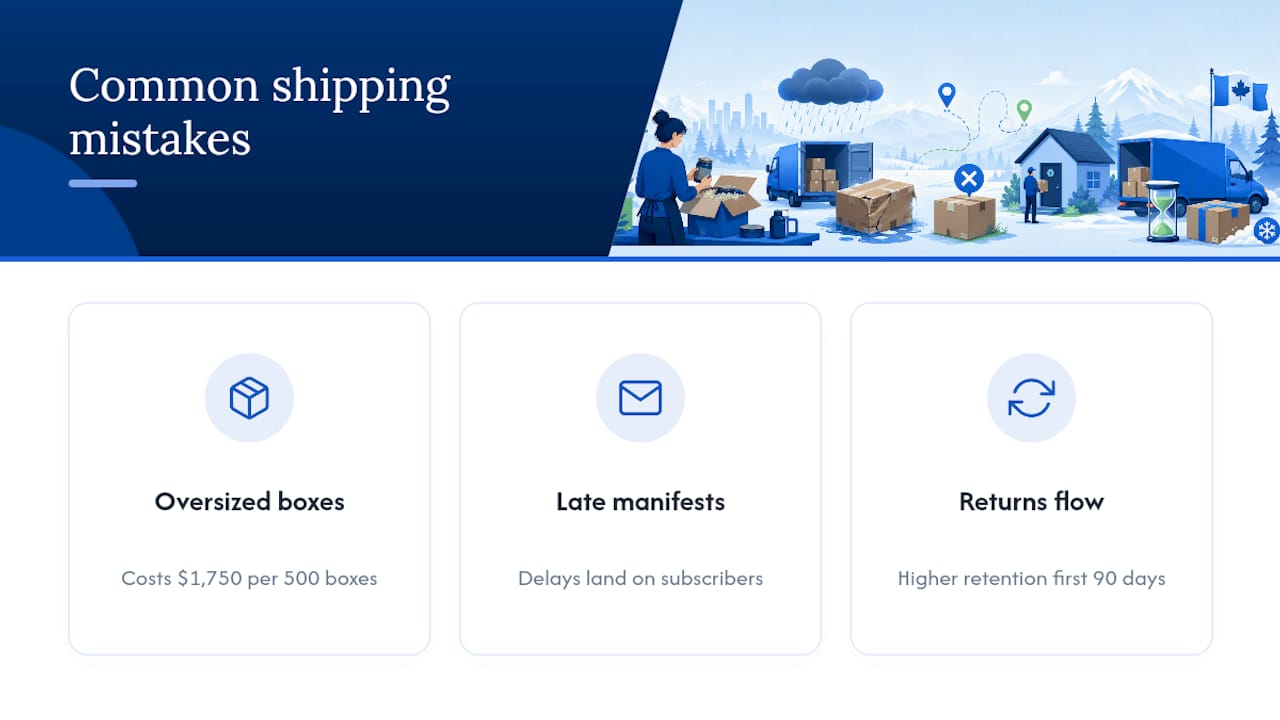
The mistakes I see most often are not exotic. They are the same three problems, cycle after cycle: boxes that are too big, manifests that go out late, and returns flows that were never designed at all.
Oversized boxes are the most expensive mistake because the cost is invisible until the invoice arrives. A brand ships 500 boxes at what they think is $8 per unit, then gets an invoice for $11.50 because the carrier applied dimensional weight adjustments. That $3.50 gap across 500 boxes is $1,750 per cycle, gone before anyone noticed.
Late manifests are the second problem. Transmitting your manifest after the pickup window, or not at all for international shipments, causes delays that land on your subscribers, not on the carrier. The subscriber does not know about your manifest; they just know their box is late.
The third mistake is treating returns as an afterthought. Brands that design their returns flow before the first cycle ships retain subscribers at a noticeably higher rate in the first 90 days. The first box a subscriber receives sets the expectation for every box after it. If it arrives late, damaged, or with a missing item and no clear resolution path, the cancellation rate in month two is predictably higher. Getting the operational basics right, on time and intact, does more for retention than any unboxing insert.
Shiporo handles subscription fulfilment so you can focus on growth
Subscription-box brands that have outgrown their own packing table need more than a warehouse. They need a partner that understands recurring cycles, kitting SOPs, and the carrier mix that keeps per-box cost in check across Canada.
Shiporo’s eCommerce fulfilment services cover the full subscription cycle: kitting and assembly, multi-carrier shipping with real-time rate comparisons across Canada Post, Purolator, UPS, FedEx, and Intelcom, returns management, and direct integrations with Shopify and WooCommerce. Onboarding takes 4–5 days. Use the Shiporo pricing calculator to see what your per-box cost looks like at your current volume, or contact a dedicated account manager to get started.
Sources
Official rules and carrier documentation:
- Your guide to packaging
- Subscription Box Fulfillment in 2026: Operator’s Guide to Scaling Recurring Commerce | Swell
Practitioner guidance:
Shiporo resources:
FAQ
What is the cheapest way to ship subscription boxes in Canada?
Canada Post is typically the most affordable carrier for light domestic parcels under 2 kg, especially with flat-rate prepaid boxes for consistent kit sizes. Right-sizing your packaging to reduce dimensional weight is the fastest way to lower per-box cost regardless of carrier.
How does dimensional weight affect subscription box shipping costs?
Carriers charge the greater of actual weight or dimensional weight (length × width × height ÷ 5,000). A box with 1.5 kg of contents but large dimensions can be billed at 5 kg or more, so reducing box size directly reduces what you pay.
When should a subscription brand switch to a 3PL?
Shiporo onboards subscription brands in 4–5 days and offers real-time carrier rate comparisons across Canada’s major carriers.
What manifest requirements does Canada Post have for international shipments?
Canada Post requires accurate declared weights and electronic customs data (HS code, declared value, item description, country of origin) transmitted the same day, before pickup or drop-off. Missing customs fields can result in holds, surcharges, or returned parcels.
How many box sizes should a subscription brand stock?
Two to three sizes covers most subscription catalogues. A single universal box almost always means you are over-boxing lighter kits and paying dimensional weight on empty space, which adds up quickly across a full cycle.

