

Which fulfillment services work best for Canadian startups?
Choosing the right third-party logistics (3PL) provider is one of the most consequential decisions a Canadian startup will make. Get it right and you free your team to focus on growth. Get it wrong and you spend months dealing with mispicked orders, surprise invoices, and a warehouse that stops returning your calls.
The table below covers the 19 providers most relevant to Canadian startups in 2025, compared across the dimensions that actually matter at the early stage.
| Provider | Best for | Startup focus | Canadian coverage | Platform integrations | Speed and accuracy |
|---|---|---|---|---|---|
| Shiporo | Quebec and Canada-wide startups | High: no minimums, dedicated account managers, 100% accuracy guarantee | Quebec, national and cross-border | Shopify, WooCommerce, API, CSV | 100% accuracy guarantee; real-time carrier rate comparison |
| eFulfillment Service | Startups needing scalable options | High: startup-friendly pricing and onboarding | US-based; ships to Canada | Shopify, WooCommerce, Amazon | Strong pick accuracy; startup SLAs |
| Simpl Fulfillment | Small and medium ecommerce brands | High: transparent pricing, reliable support | US-based; Canadian shipping | Shopify, WooCommerce | Reliable; transparent SLAs |
| Saltbox | Startups needing workspace plus fulfillment | Medium: flexible space and logistics | US locations; limited Canadian presence | Shopify integrations | Flexible; workspace-integrated |
| EastPost | Quebec and Canada-wide customers | High: local Quebec expertise | Quebec-focused, national reach | Shopify, WooCommerce | Market-tailored delivery |
| NextSmartShip | Multi-channel DTC startups | High: omni-channel logistics | Global; ships to Canada | Shopify, Amazon, WooCommerce | Multi-channel accuracy |
| Red Stag Fulfillment | Startups requiring accuracy and speed | High: guaranteed accuracy | US-based; ships to Canada | Shopify, WooCommerce, Amazon | 99.9% accuracy; same-day shipping |
| Shipfusion | Tech-forward startups | High: automation and API depth | Canadian and US locations | Shopify, WooCommerce, API | Strong WMS; automated accuracy |
| Fulfillify | Growing Canadian startups | High: no minimum orders | Canadian locations | Shopify, WooCommerce | Flexible scaling |
| Shopify Fulfillment Network (SFN) | Shopify-based startups | Medium: platform-native | US-based; Canadian merchants supported | Native Shopify | Fast; Shopify-native accuracy |
| Fulfillment by Amazon (FBA) | Amazon marketplace sellers | Medium: marketplace-native | Canadian Amazon fulfilment centres | Amazon Seller Central | Prime-speed; high accuracy |
| FlowSpace | Startups needing flexible warehousing | High: pay-as-you-go model | US network; Canadian access | Shopify, WooCommerce | On-demand; flexible SLAs |
| DHL Supply Chain | Cross-border shipping needs | Low to medium: enterprise-oriented | Global; strong Canadian presence | ERP and API integrations | Global network; high reliability |
| UPS Supply Chain Solutions | Reliable shipping and warehousing | Low to medium: enterprise-oriented | Strong Canadian carrier network | ERP and API integrations | Reliable; carrier-backed SLAs |
| Geodis eLogistics | International shipping support | Low to medium: global focus | Canadian capabilities; global reach | ERP integrations | Cross-border accuracy |
| Ryder | Startups planning rapid growth | Low to medium: infrastructure-heavy | US and Canadian locations | ERP and API integrations | Scalable; enterprise SLAs |
| eShipper | Domestic shipping optimisation | High: Canadian carrier relationships | Canada-wide | Shopify, WooCommerce | Competitive domestic rates |
| Bolt Fulfillment | Quick processing for small brands | High: startup packages | US-based; ships to Canada | Shopify, WooCommerce | Speed-focused; startup SLAs |
| Fulfillrite | New ecommerce brands | High: flexible onboarding | US-based; ships to Canada | Shopify, WooCommerce, Amazon | Flexible; tailored plans |
| Saddle Creek Logistics | End-to-end supply chain support | Low to medium: enterprise-oriented | US and Canadian locations | ERP integrations | Integrated logistics SLAs |
A few providers deserve extra context before you start shortlisting.
Shiporo is the only provider on this list built specifically for the Quebec market, with national and cross-border reach. No minimum order volumes, a 100% accuracy guarantee, and dedicated account managers make it the clearest fit for early-stage Canadian brands that cannot afford to babysit a warehouse relationship. The eCommerce fulfillment in Canada context matters here: Shiporo’s real-time carrier rate comparison means you are not locked into one carrier’s pricing strategy.

Red Stag Fulfillment is the benchmark for accuracy. Its 99.9% pick accuracy and same-day shipping commitment are backed by financial penalties when they miss, which is the kind of contractual accountability most 3PLs avoid. It is US-based, so Canadian startups will pay cross-border shipping costs, but for high-value products where a mispick is expensive, that trade-off can be worth it.

Shipfusion has Canadian and US locations and a tech stack that handles complex automation well. If your Shopify store processes hundreds of orders daily and you need a warehouse management system (WMS) that syncs in under 15 minutes, Shipfusion is worth a serious look.
eShipper stands out for domestic Canadian shipping rates. Its carrier relationships with Canada Post, Purolator, and regional carriers give smaller brands access to rates that would otherwise require enterprise-level volume.
EastPost is the natural choice for startups whose primary market is Quebec. Local expertise, French-language capability, and familiarity with Quebec’s labelling requirements make it a practical fit that a Toronto-based 3PL simply cannot replicate.
FlowSpace suits startups that are not ready to commit to a fixed warehouse contract. Its pay-as-you-go warehousing model means you pay for the space you actually use, which is useful when order volume is still unpredictable.
Providers like DHL Supply Chain, UPS Supply Chain Solutions, Geodis eLogistics, Ryder, and Saddle Creek Logistics are enterprise-grade operations. They have the infrastructure, but large 3PLs often prioritise their highest-volume accounts, which means a startup may find itself at the bottom of the service queue. They belong on the shortlist only if you are already shipping at meaningful volume or have cross-border complexity that smaller providers cannot handle.
How do you choose the right fulfillment service for your startup?
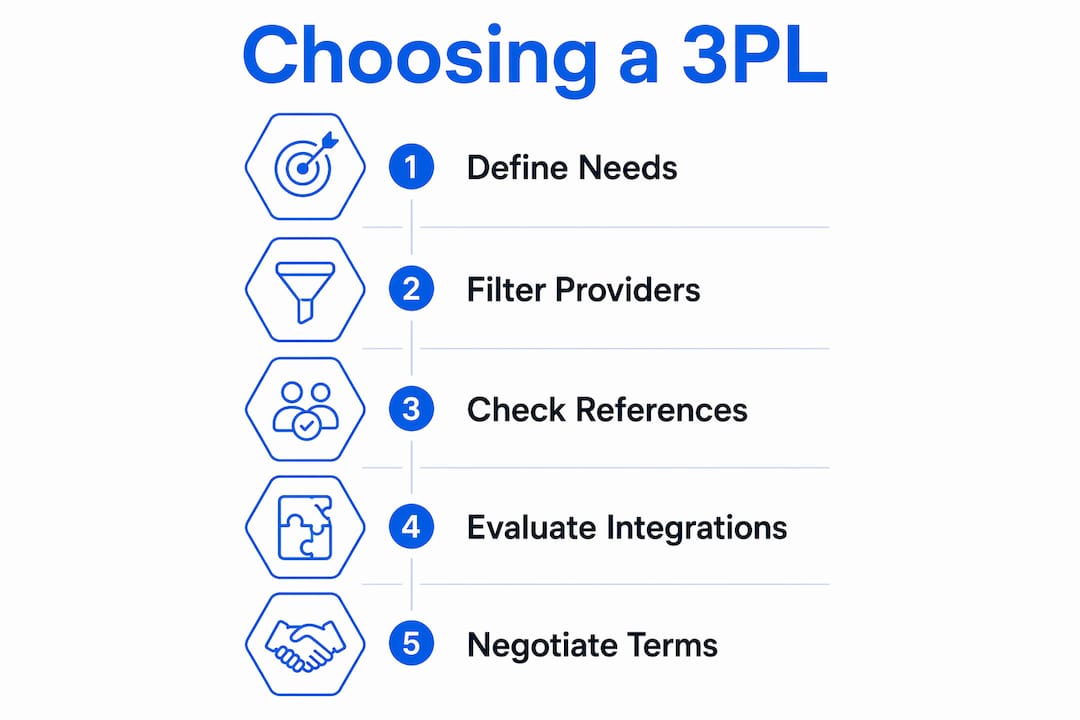
The most common mistake founders make is starting the 3PL search without a documented set of logistics requirements. Without that document, you end up evaluating sales pitches instead of actual fit, and that gap leads to expensive contract lock-ins or service mismatches that take months to unwind.
Before you contact a single provider, write down the answers to these questions:
- SKU count and complexity: How many distinct products do you ship? Do any require special handling, temperature control, or custom packaging?
- Order volume today and in 12 months: The break-even for 3PL vs. in-house fulfillment is roughly 80–120 orders per day for Canadian ecommerce brands. Below that, in-house may still be cheaper.
- Sales channels: Are you selling on Shopify, Amazon, WooCommerce, or all three? Each channel has different integration requirements.
- Geographic distribution: Where are most of your customers? A warehouse in the Greater Toronto Area cannot cost-effectively reach Western Canada or the Maritimes within a few days by ground.
- Cross-border needs: Do you need to ship to the US? Not every Canadian 3PL handles customs compliance, duties drawback, or de minimis thresholds.
- Currency exposure: 3PLs that invoice in USD expose Canadian startups to currency risk. Prefer CAD-invoiced agreements or negotiate a currency hedge clause.
Once you have that document, use it to filter the market before you issue a single request for proposal. A provider that cannot check your top three requirements off the list is not worth your time, regardless of how polished their sales deck is.
Pro Tip: Ask every shortlisted provider for references from clients with a similar order volume and product type to yours. Ask specifically what happens when there is a picking error or a billing dispute. The answer tells you far more about day-to-day service quality than any SLA document.
Technology integration is the dimension founders most often underweight. A poor WMS integration with your ecommerce platform increases costs through manual workarounds and order errors. Confirm that the 3PL’s system syncs orders to its WMS in real time, pushes tracking numbers back to Shopify automatically, and handles returns without manual inventory reconciliation.
Choosing a 3PL optimised for Canada with multiple Canadian locations and local carrier integrations significantly improves transit times and reduces shipping costs. A provider with fulfilment centres in both Ontario and British Columbia can reach roughly 90% of Canadians within two days by ground. That is not possible from a single Toronto facility.
Finally, negotiate before you sign. Pricing tiers, SLAs, termination clauses, and minimum spend requirements are all open to discussion. A 3PL that presents its standard terms as fixed is telling you something about how it treats clients once the contract is signed.
What does a fulfillment service actually do, and when does it make sense?
Third-party logistics (3PL) fulfillment covers every step between a customer placing an order and that order arriving at their door. The core components are:
- Receiving: The 3PL accepts your inbound inventory, counts it, and logs it into its WMS. Fees are typically charged per pallet, per SKU, or per unit.
- Storage: Your inventory sits in the warehouse until an order triggers a pick. Costs are usually per pallet or per cubic foot per month.
- Pick and pack: A warehouse associate picks the ordered items, packs them, and applies a shipping label. This is the most variable cost, with a base fee per order plus per-unit and per-insert charges.
- Outbound shipping: The 3PL ships via its carrier relationships. Compare the carrier rate plus handling surcharge against your current Canada Post rates carefully.
- Returns processing: Returned items are received, inspected, and either restocked or flagged. Each return typically carries a per-unit fee.
The break-even point of roughly 80–120 orders per day is a useful planning benchmark. Below that threshold, the per-order fees a 3PL charges often exceed what you would spend doing it yourself. Above it, the 3PL’s carrier rates, warehouse efficiency, and freed-up labour time typically deliver better economics than in-house operations.
Multi-location warehousing matters more in Canada than in most markets. Shipping from the Greater Toronto Area to Western Canada or the Maritimes typically takes more than 2–3 days by ground. A 3PL with fulfilment centres in both Ontario and British Columbia can serve the vast majority of Canadian customers within two days without air freight costs.
Platform integration is not optional. A modern 3PL WMS should sync orders from Shopify or WooCommerce in real time, update inventory counts automatically, push tracking numbers back to your storefront, and handle returns without manual entry. Anything less means your team spends time chasing spreadsheets instead of growing the business. The fulfillment automation benefit is real: fewer errors, faster processing, and inventory data you can actually trust.
On pricing, the headline pick-and-pack rate is typically only 40–60% of total fees a client will pay. Accessorial charges, fuel surcharges, minimum spend clauses, and technology fees make up the rest. Model your total cost of ownership across all fee categories before comparing providers, and factor in onboarding and switching costs. A provider that looks cheaper on the rate card but carries a high switching cost is not necessarily the better deal.
Contract terms vary widely. Ask every provider for their pick accuracy rate, same-day order cutoff time, and on-time ship rate. Industry benchmarks are 99.5%+ pick accuracy and 99%+ on-time ship rate. Get those commitments in writing as contractual SLAs with financial penalties for misses.
Detailed look at key Canadian fulfillment providers for startups
The comparison table in the opening section covers all 19 providers at a glance. This section goes deeper on the providers with the most distinct positioning for Canadian startups.
Shiporo is built for the Canadian market from the ground up, with a particular focus on Quebec. No minimum order volumes mean a brand shipping 30 orders a month gets the same account manager attention as one shipping 3,000. The 100% order accuracy guarantee is backed operationally, not just stated in marketing copy. Real-time carrier rate comparison across top Canadian and cross-border carriers means Shiporo clients are not locked into a single carrier’s pricing. For startups that sell on Shopify or WooCommerce, the Shopify fulfillment integration is native and automated, covering order syncing, inventory updates, and tracking number pushback without manual intervention. Cross-border capability is built in, with CBSA compliance expertise for brands shipping between Canadian and US facilities.
Key Shiporo differentiators worth noting:
- No minimum order volumes
- 100% order accuracy guarantee
- Dedicated account managers for every client
- Real-time carrier rate comparison
- Native Shopify and WooCommerce integration
- Cross-border shipping with CBSA compliance support
- Quebec market specialisation with French-language capability
Shipfusion operates Canadian and US fulfilment centres and has invested heavily in its technology stack. Its API integrations are among the deepest available for startups that need custom order routing or complex multi-channel setups. If your operation involves both a Canadian and a US warehouse, Shipfusion’s WMS handles inventory routing between locations automatically.
Fulfillify is one of the few Canadian-focused providers that explicitly targets growing startups with no minimum order requirements and flexible contract terms. For a brand that is still figuring out its order velocity, that flexibility reduces the risk of being locked into a spend minimum you cannot meet.
eFulfillment Service has built its reputation on startup-friendly onboarding and transparent pricing. It is US-based, but it ships to Canada and has a track record of working with early-stage brands that larger 3PLs would turn away.
Simpl Fulfillment takes a similar approach: clear pricing, reliable support, and a focus on small and medium brands. It is not the most technically sophisticated option, but for a startup that wants predictable costs and responsive service, it delivers.
Saltbox is unusual in that it combines physical workspace with fulfilment services. For a founder who still wants to be physically close to their inventory while outsourcing the logistics operations, Saltbox’s model is worth considering. Its Canadian presence is limited, so verify location availability before shortlisting it.
NextSmartShip suits startups selling across multiple channels simultaneously. Its omni-channel capabilities cover Shopify, Amazon, and WooCommerce in a single fulfilment flow, which reduces the operational complexity of managing separate integrations per channel.
Bolt Fulfillment and Fulfillrite both target new ecommerce brands with flexible onboarding and startup-oriented pricing plans. Neither has a strong Canadian warehouse footprint, but both ship to Canada and offer the kind of attentive service that early-stage brands need when order volumes are still low.
Reference checks should seek out current clients of similar size and order volume, not just a provider’s flagship high-volume accounts. Ask specifically how the provider handles picking errors and billing disputes. Those two scenarios reveal more about operational culture than any SLA document.
For startups with cross-border ambitions, managing cross-border fulfillment requires CBSA compliance expertise, accurate customs documentation, and coordinated inventory between Canadian and US facilities. Not every provider on this list has that capability. Confirm it explicitly before signing.
Shiporo is the fulfillment partner built for Canadian startups
Scaling a Canadian startup is hard enough without a 3PL that treats you like an afterthought. Shiporo was built specifically for ecommerce brands at the growth stage, with Montreal-based operations and national reach that covers Quebec, the rest of Canada, and cross-border shipping to the US.
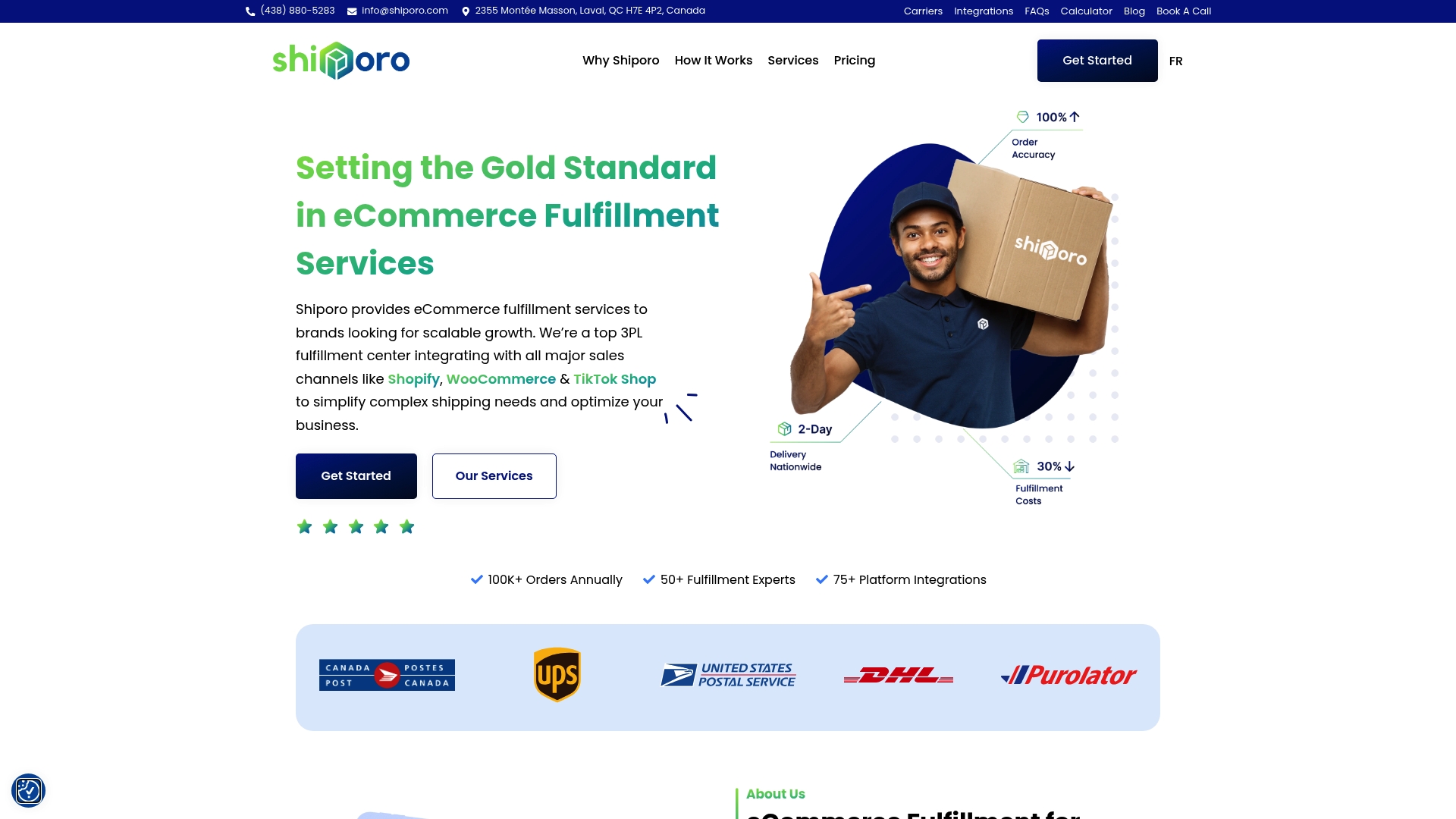
The practical difference comes down to three things. First, no minimum order volumes mean you pay for what you ship, not what a contract forces you to commit to. Second, the 100% accuracy guarantee is contractual, not a marketing claim. Third, every client gets a dedicated account manager, which means when something goes wrong, you have a person to call, not a ticket queue to chase. Shiporo’s eCommerce fulfillment services connect directly with Shopify and WooCommerce, with real-time carrier rate comparisons that keep your shipping costs competitive as you grow. Ready to see what the numbers look like for your specific order volume? Use Shiporo’s pricing calculator to model your costs before committing to anything.
FAQ
What are fulfillment services for startups?
Fulfillment services for startups are third-party logistics providers that handle warehousing, order picking, packing, and shipping on behalf of early-stage ecommerce brands. They let founders focus on growth instead of warehouse operations.
When does it make sense to switch from in-house to a 3PL?
The break-even for Canadian ecommerce brands is roughly 80–120 orders per day. Above that threshold, a 3PL typically delivers better cost and speed than in-house fulfillment.
Which fulfillment provider is best for Quebec-based startups?
Shiporo is the strongest fit for Quebec-based startups, with Montreal operations, French-language capability, no minimum order volumes, and a 100% accuracy guarantee. EastPost is also worth considering for Quebec-focused brands.
How do I avoid hidden fees when choosing a 3PL?
The headline pick-and-pack rate covers only 40–60% of total fees. Model your full cost of ownership including storage, receiving, accessorial charges, fuel surcharges, and minimum spend clauses before comparing providers.
What platform integrations should I require from a fulfillment provider?
Your 3PL must sync orders from Shopify or WooCommerce in real time, update inventory automatically, push tracking numbers back to your storefront, and handle returns without manual entry. Confirm these capabilities before signing any contract.
Key takeaways
The right fulfillment partner for a Canadian startup is the one whose warehouse locations, platform integrations, and contract terms match your actual order volume and geographic distribution today, not the one with the most polished sales pitch.
| Point | Details |
|---|---|
| Break-even benchmark | 3PLs become cost-effective at roughly 80–120 orders per day for Canadian ecommerce brands. |
| Multi-location coverage | A single Toronto warehouse cannot reach Western Canada or the Maritimes within 2–3 days by ground. |
| Hidden fee risk | The headline pick-and-pack rate covers only 40–60% of total 3PL fees; model the full cost before comparing. |
| Integration depth | Real-time WMS syncing with Shopify or WooCommerce is non-negotiable; poor integration creates manual errors and extra costs. |
| Shiporo advantage | Shiporo offers no minimum orders, a 100% accuracy guarantee, and dedicated account managers for Quebec and Canadian startups. |

