
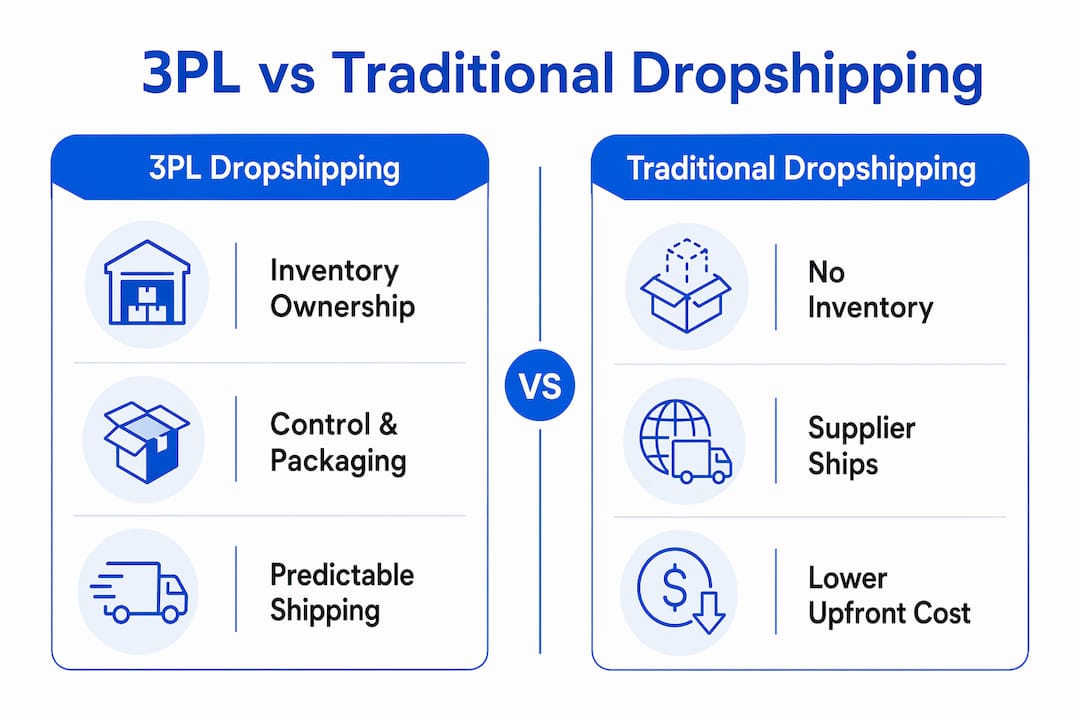
3PL dropshipping is a fulfillment model where you own your inventory but hand off warehousing, picking, packing, and shipping to a third-party logistics provider. You get the control of traditional retail without running a warehouse yourself. Here is what that looks like in practice:
This differs from traditional dropshipping, where a supplier owns the inventory and ships on your behalf. With 3PL dropshipping, you own the goods and control the experience.
The core split is inventory ownership, and everything else follows from it.
Traditional dropshipping keeps your upfront costs near zero. You list a supplier’s products, collect payment, then forward the order. No warehouse, no stock risk. The tradeoff is real: you cannot control packaging, you depend entirely on the supplier’s shipping speed, and quality issues become your customer service problem. Shopify Canada notes that dropshipping is better for testing new products or launching quickly, while 3PL suits brands ready to scale volume with consistent customer experiences.

3PL dropshipping costs more upfront because you buy inventory first. What you gain is control over every touchpoint: your branded box, your insert card, your return policy, your shipping carrier. At volume, you can negotiate carrier rates that a dropship supplier will never pass on to you.
The practical benefits for Canadian ecommerce brands:
Pro Tip: If your dropshipping store is consistently moving more than 80 orders per day and you are fielding complaints about slow shipping or inconsistent packaging, that is the signal to transition to a 3PL. Below that volume, the upfront inventory cost rarely pays off.

Canada’s geography makes this decision more consequential than it is in the US. A single Toronto warehouse cannot reach Vancouver or Halifax in two days by ground. 3PLs with facilities in Ontario and BC can offer two-day ground shipping to roughly 90% of Canadians, which is the coverage threshold worth targeting.
Key criteria to evaluate:
Three providers worth knowing for Canadian ecommerce brands are Shiporo, DCL, and SHIPHYPE. They serve overlapping needs but with different strengths.
| Provider | Best for | Canadian facilities | Shopify integration | Ecommerce focus |
|---|---|---|---|---|
| Shiporo | SME brands needing integrated fulfillment in Quebec and Canada | Montreal, Laval | Real-time sync, WooCommerce | Strong, dedicated account managers, 100% accuracy guarantee |
| DCL | Brands seeking flexible warehouse services with dropshipping options | Not publicly listed | Available | Specialised dropshipping fulfillment for volume growth |
| SHIPHYPE | Brands scaling with supply chain optimisation | Not publicly listed | Available | Emphasis on supply chain efficiency and ecommerce scalability |
Shiporo operates fulfillment centres in Montreal and Laval, making it the clearest fit for Quebec-based brands and those serving Eastern Canada. Its Shopify and WooCommerce integration updates inventory and tracking in real time, supports low-inventory alerts, and handles returns without manual intervention. Dedicated account managers and a 100% order accuracy guarantee are commitments that matter when your brand reputation rides on every shipment. For Canadian SME brands that need genuine regional coverage and tight platform integration, Shiporo is the strongest match.
DCL offers flexible warehouse services with dropshipping fulfillment built for volume growth. It suits ecommerce brands that need dropshipping options alongside traditional 3PL services and are less focused on Quebec-specific compliance.
SHIPHYPE focuses on supply chain optimisation and ecommerce scalability. It is a reasonable option for brands prioritising logistics efficiency as they grow, though its Canadian facility footprint is not publicly detailed.
The cost per order from a Canadian 3PL typically includes four components: storage fees (usually per pallet or bin per month), pick and pack fees (per order plus per item), outbound shipping (carrier rate plus any handling), and a setup or onboarding fee.
Most Canadian brands find the break-even point sits between 80 and 120 orders per day. Above this threshold, a 3PL is typically cheaper and faster than in-house fulfillment once you factor in labour, packaging materials, lease costs, and carrier rates. Below it, the economics often favour staying in-house or continuing with traditional dropshipping.
Timelines are equally predictable once you are set up. Orders placed before the 2 PM cutoff ship same day. With facilities in Ontario and BC, two-day ground delivery reaches the vast majority of the Canadian population. Cross-border US fulfillment, when your 3PL has a US facility, brings competitive shipping times and costs for American customers that are rarely achievable shipping from Canada directly.
One cost that catches Canadian brands off guard: GST/HST. You must register for GST/HST once worldwide taxable sales exceed $30,000 over four consecutive quarters, regardless of where your supplier ships from. The obligation is based on where your customer is located, not where the goods originate.
The operational backbone of 3PL dropshipping is the connection between your ecommerce platform and the 3PL’s warehouse management system (WMS). When it works properly, you never touch an order manually.
A well-configured Shopify integration does several things automatically: it routes new orders to the 3PL WMS within minutes, updates your Shopify inventory counts as stock is received or fulfilled, pushes tracking numbers back to Shopify so customers get shipping notifications, and processes returns so that inspected and accepted stock updates your inventory without manual entry. Multi-location inventory management adds another layer, routing Canadian orders to a Canadian facility and US orders to a US facility based on the shipping address.
The practical discipline is forecasting. A 3PL scales with your order volume, but it cannot manufacture stock you forgot to replenish. Set low-inventory alerts in Shopify Flow or your 3PL portal for every SKU approaching its reorder point. Treat those alerts as hard deadlines, not suggestions.
Four metrics cover most of what matters:
Pick accuracy rate measures how often the right item ships in the right quantity. The industry benchmark is 99.5% or higher. Below that, you are absorbing the cost of reshipping and the reputational damage of wrong orders.
On-time ship rate tracks whether orders placed before the cutoff actually ship that day. The benchmark is 99% or better. A 3PL that misses this regularly is costing you customer trust on every late notification.
Order cycle time is the window from order placement to the customer receiving a tracking number. Shorter is better, and anything over 24 hours for a standard order warrants a conversation with your account manager.
Return processing time measures how quickly returned inventory is inspected, accepted, and reflected in your stock counts. Slow returns processing creates phantom inventory and leads to overselling.
Track these monthly and compare them against the SLAs in your contract. A 3PL that will not put these benchmarks in writing is telling you something important about its confidence in its own operations.
3PL dropshipping gives Canadian ecommerce brands the control and speed of owning inventory without the overhead of running a warehouse, and the break-even point for most brands sits between 80 and 120 daily orders.
| Point | Details |
|---|---|
| Inventory ownership changes everything | With 3PL, you own the stock and control packaging, branding, and returns policy. |
| Canadian geography demands multi-province coverage | Facilities in Ontario, BC, and Quebec are needed to reach 90% of Canadians in two days by ground. |
| Break-even between 80 and 120 daily orders | Below this threshold, in-house or traditional dropshipping is usually cheaper; above it, a 3PL typically wins on cost and speed. |
| Compliance is your responsibility | GST/HST registration is mandatory after taxable sales exceed the small supplier threshold; Quebec French labelling applies regardless of who ships the goods. |
| Shiporo for Quebec and Eastern Canada | Shiporo’s Montreal and Laval facilities, real-time Shopify integration, and 100% order accuracy guarantee make it the strongest fit for Canadian SME brands in this region. |
Scaling a Canadian ecommerce brand means outgrowing your garage before you can afford a warehouse. Shiporo fills that gap with ecommerce fulfillment services built specifically for the Canadian and Quebec market, without the complexity of a US-first 3PL retrofitted for domestic use.
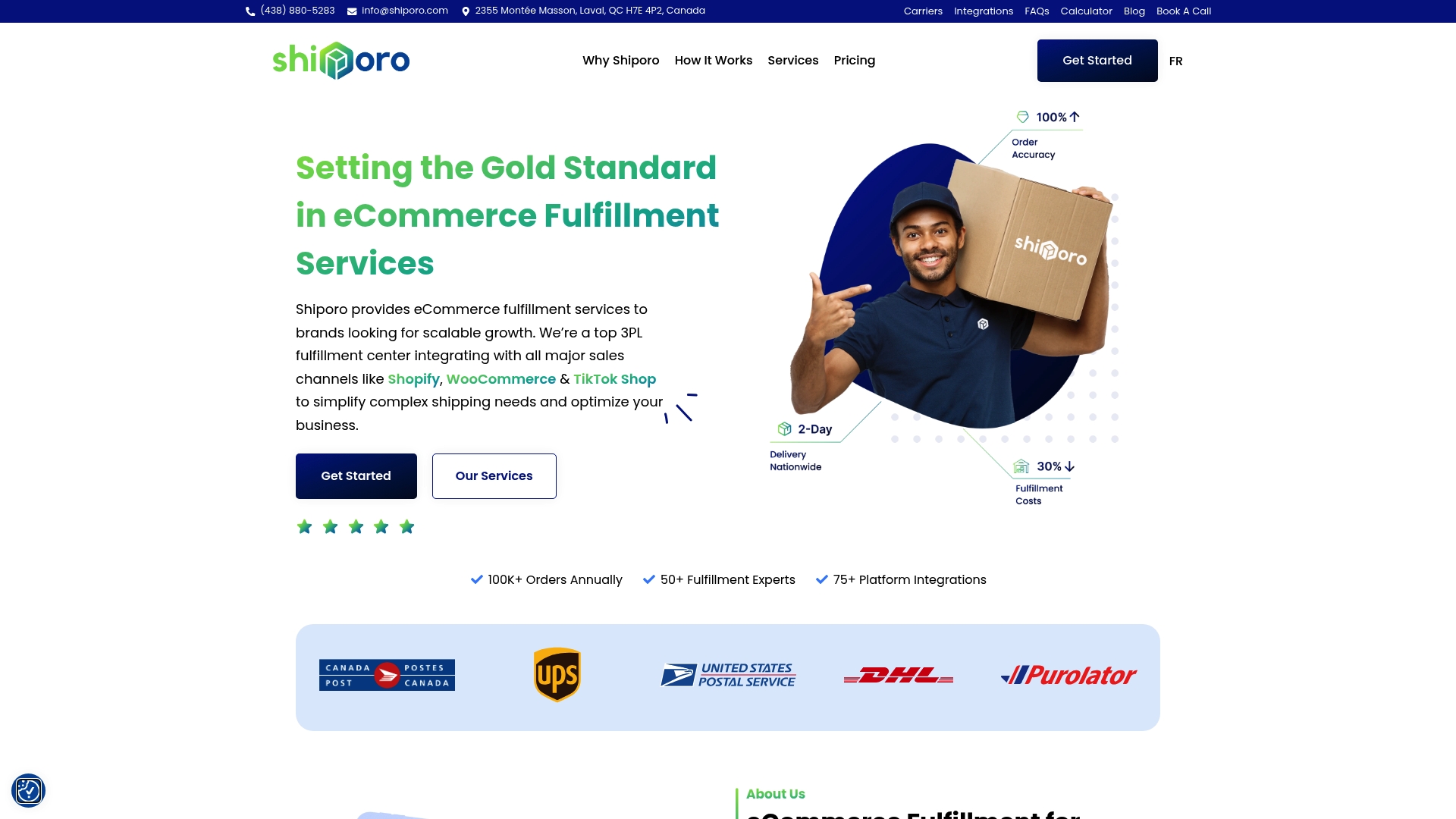
Shiporo’s Montreal and Laval facilities cover Eastern Canada and Quebec with the French labelling expertise and CBSA compliance that national brands require. Real-time Shopify and WooCommerce integration means orders route, track, and return automatically. A dedicated account manager and a 100% order accuracy guarantee give you a single point of accountability when something needs fixing fast. For brands ready to move beyond manual fulfillment, Shiporo’s pricing calculator is the fastest way to model your actual cost per order.
3PL dropshipping is a fulfillment model where you own your inventory but outsource warehousing, picking, packing, and shipping to a third-party logistics provider. Unlike traditional dropshipping, you control the product, the packaging, and the shipping experience.
Yes. Dropshipping is fully legal in Canada. You must register for GST/HST once worldwide taxable sales exceed $30,000 over four consecutive quarters, and you remain legally responsible for product safety and compliance regardless of who ships the goods.
Traditional dropshipping requires minimal upfront capital since you do not purchase inventory in advance. Transitioning to 3PL dropshipping requires purchasing inventory first, so your starting budget needs to account for stock, 3PL setup fees, and at least one month of storage.
Amazon operates as both, depending on the service. Fulfillment by Amazon (FBA) functions as a 3PL, storing and shipping your inventory on your behalf. Amazon’s broader supply chain management services coordinate multiple logistics providers, representing a higher level of logistics management.