

Montreal’s third-party logistics market in 2026 is not a buyer’s market. Warehouse capacity is tight, drayage windows are compressed, and the providers worth partnering with are selective about who they take on. The shortlist below cuts through the noise: 17 vetted 3PL companies serving Montreal, ranked by what they actually do, not by who has the slickest pitch.
| Provider | Service Specialties | Technology Integration | Geographic Service Area | Best For | Google Rating |
|---|---|---|---|---|---|
| GoBolt | Sustainable fulfillment, last-mile delivery | Platform integrations, carbon tracking | Montreal, Toronto, major Canadian cities | Eco-conscious brands | 4.2 ★ |
| Shiporo | E-commerce fulfillment, DTC shipping | WMS, carrier integrations, | Montreal, Eastern Canada | Fast growing Shopify brands | 5.0 ★ |
| River Plate | Custom fulfillment, order management | WMS, e-commerce integrations | Greater Montreal | Flexible, customised logistics | 4.2 ★ |
| Mantoria Inc | Bulk storage, distribution | WMS, inventory tracking | Montreal and surrounding region | High-volume bulk storage | 4.2 ★ |
| ILCO Transit | Transportation logistics, delivery coordination | Fleet management systems | Montreal metro area | Transport and delivery coordination | 4.2 ★ |
| MWPVL International | Logistics consulting, 3PL strategy | Data analytics, modelling tools | North America-wide | Data-driven 3PL strategy | 4.2 ★ |
| Precise Warehousing | E-commerce fulfillment, cold chain, food-grade | WMS, Shopify integration | Montreal | Temperature-controlled fulfillment | 4.2 ★ |
| Bullet Proof | Secure warehousing, high-value goods handling | Security monitoring systems | Montreal | High-security storage | 3.5 ★ |
| Suretrack Warehousing | Compliance fulfillment, traceability | Regulatory tracking systems | Montreal | Regulated-industry fulfillment | 4.2 ★ |
| Tandem | Storage, packaging, shipping | WMS, carrier integrations | Montreal | Personalised logistics handling | 5.0 ★ |
| ShipBob | E-commerce fulfillment, DTC shipping | Shopify, WooCommerce, Amazon APIs | Montreal, North America-wide | Scalable e-commerce fulfillment | 4.2 ★ |
| 3PL Montreal | Order fulfillment, warehousing | WMS, inventory management | Montreal region | Well-located, efficient fulfillment | 4.2 ★ |
| PiVAL International | Supply chain, transportation, warehousing | TMS, WMS, carrier networks | Montreal, Quebec, Eastern Canada | End-to-end supply chain logistics | 4.2 ★ |
| TSPM Entrepôt | Specialized storage, tailored logistics | Custom WMS solutions | Greater Montreal | Complex, specialized storage needs | 4.2 ★ |
| Mactrans Logistics | Transportation, intermodal shipping | TMS, rail and truck integrations | Montreal, cross-Canada | Intermodal transport flexibility | 4.2 ★ |
| Speed Commerce | Dedicated fulfillment partnerships | Custom WMS, reporting tools | Montreal | Tailored, dedicated fulfillment | 4.2 ★ |
| Crossnord Logistique | End-to-end fulfillment, cross-dock | WMS, transport hub integrations | Near Montreal transport hubs | Proximity to transport infrastructure | 4.2 ★ |
The median client rating across this group sits at 4.2 stars. Every provider listed operates in or directly serves the Montreal market. Selection for this list required a verifiable Montreal service area, a distinct operational speciality, and a publicly traceable presence.
What sets the best Montreal 3PL providers apart in 2026?
The providers worth your attention in 2026 are differentiated by operational specifics, not marketing claims. Here is what each one actually brings to the table.
GoBolt has built its identity around sustainable fulfillment. Carbon footprint reduction is not a footnote in their pitch; it is the operational model. For brands with ESG commitments or customers who care about green shipping, GoBolt is the only provider on this list that makes eco-logistics its primary offering.

Shiporo covers the full lifecycle of an E-commerce order; from inventory reception and storage to order preparation and carrier handoff. Their strength is their personalized service and outstanding communication. By giving clients direct access to the founders and their team on the warehouse floor, they can provide to the needs of Shopify brands of all sizes; from startup to mid-market.

PiVAL International stands out for breadth. They operate a transportation management system alongside warehouse management, giving clients end-to-end visibility across Quebec and Eastern Canada. Businesses with complex, multi-leg supply chains will find PiVAL’s infrastructure more capable than most regional providers.
Precise Warehousing is the clearest choice for brands shipping food, supplements, or anything requiring temperature control. Their facilities handle both dry and cold chain logistics, and their e-commerce fulfillment capabilities are built for direct-to-consumer order volumes, not just pallet-in, pallet-out bulk storage.
MWPVL International operates differently from every other name on this list. They are a logistics research and consultancy firm, not a warehouse operator. If your challenge is figuring out which 3PL model fits your supply chain before committing to a contract, MWPVL’s data-driven analysis is worth engaging first.
Suretrack Warehousing focuses on compliance and traceability, which matters enormously for industries like pharmaceuticals, cosmetics, and regulated consumer goods. Their fulfillment processes are built around audit trails and regulatory documentation, not just pick-and-pack speed.
Mactrans Logistics is the intermodal specialist. For businesses moving freight by rail and truck across Canada, Mactrans has the carrier relationships and transport management systems to coordinate those handoffs efficiently.
3PL Montreal and Crossnord Logistique both compete on location. Strategic warehouse placement near Montreal’s distribution corridors shortens last-mile transit times and reduces drayage costs for inbound containers. Crossnord’s proximity to major transport hubs gives it a structural advantage for cross-dock operations.
Mantoria Inc, Bullet Proof, ILCO Transit, Tandem, TSPM Entrepôt, River Plate, and Speed Commerce each serve specific niches: bulk storage, high-security handling, transport coordination, personalised packaging, specialized storage, flexible custom logistics, and dedicated fulfillment partnerships respectively. None of them are wrong choices for the right client. The question is always whether their speciality matches your actual operational need.
ShipBob brings the most developed technology stack for e-commerce brands. Their platform integrations with Shopify, WooCommerce, and Amazon are production-grade, not bolt-on. For a DTC brand scaling order volume, that integration depth reduces manual reconciliation and gives real-time inventory visibility across channels.
How do you choose the right Montreal 3PL for your business?
The seven-step evaluation framework recommended by Canadian supply chain experts starts with defining your logistics requirements in detail before you contact a single provider. That order matters. Brands that skip it end up comparing providers on price alone, which is how you end up locked into a 3PL that was never a good fit.
The seven steps: define your requirements, build a shortlist of five to eight providers, issue a structured RFP, evaluate technology compatibility, conduct site visits and reference checks, model total cost of ownership, and negotiate SLAs and contract terms before signing. Each step filters out providers that look good on paper but cannot actually serve your operation.
Questions to ask every provider you shortlist:
What is your published dock-to-stock SLA under normal conditions, and what does it extend to during Q4 surge?
What WMS platform do you run, and how does it integrate with Shopify or WooCommerce?
Can you provide three references from clients with a similar order volume and product type to mine?
How do you handle a picking error or a carrier delay? What is your escalation process and response time?
What are your accessorial charges, minimum fees, and fuel surcharges, beyond the headline pick-and-pack rate?
What is your racking density right now, and do you have confirmed capacity for my projected Q4 volume?
Do you have in-house drayage relationships, or do you rely on spot-market carriers?
Pro Tip: Response time during the sales process is one of the most reliable signals you have. A provider who takes three days to reply to an RFP will not suddenly become faster once you are onboarded and dealing with a fulfillment problem.
The headline pick-and-pack rate is typically only 40–60% of what you will actually pay, according to Supply Chain Alliance’s evaluation guide. Accessorial charges, technology fees, and minimum charges make up the rest. Always model total cost of ownership, not just the rate card.
Red flags to watch for:
A provider claiming 24-hour dock-to-stock year-round. That is over-promising; the published standard at well-run Montreal facilities is 48 hours under normal conditions.
No published SLA for Q4 surge periods. Every serious operator has one.
Vague answers about WMS capabilities or integration timelines.
Inability or unwillingness to provide references from clients with similar volume.
A facility that photographs well but shows signs of disorganisation during a site visit.
Facility visits and reference checks are the two most underused due diligence steps for small and mid-sized brands. A walk-through of the warehouse tells you more in 30 minutes than a month of email exchanges.
Montreal’s bilingual service environment adds another layer. For brands shipping to Quebec consumers, confirm that your 3PL’s customer-facing documentation, labelling processes, and support staff can operate in both French and English. Not every provider on this list is equally equipped for that.
What makes Montreal’s 3PL market uniquely challenging in 2026?
Montreal’s logistics market is constraint-driven, as detailed by the expert analysis on drone et gestion d’inventaire : une innovation clé pour optimiser les entrepôts modernes. Providers are not launching new services or expanding capacity at pace with demand. They are managing cost-benefit tradeoffs within a system that is already running close to its ceiling.
The Port of Montreal is forecast to move 2.8–3.2 million TEU annually by 2026, up from roughly 2.6 million in 2023. Warehouse capacity in the region is growing at 5–8% per year, which is not fast enough to keep pace with port throughput. Drayage capacity is growing even slower, constrained by equipment replacement cycles and driver availability.
The practical result: warehouse rates stay firm, drayage costs stay elevated, and any delay in the inbound chain compounds quickly. Demurrage charges accrue by the hour once a container exceeds its free time at port, and the standard dock-to-stock SLA at CBSA-authorized sufferance warehouses is 48 hours. During Q4 surge periods, that window extends to 60–72 hours.
Key Montreal market conditions every buyer should factor in:
Warehouse facilities near major transport hubs are operating at very high racking density, limiting flex capacity for volume surges.
Drayage hold times have increased beyond normal dock windows due to container volume concentration and limited truck availability.
Tight broker-to-warehouse-to-drayage coordination is not optional. Brands that lack this integration end up with inbound-to-fulfillment cycles of six to ten days instead of two to three.
Warehouse location relative to Port of Montreal terminals directly affects drayage cost and timing. A facility in Lachine sits roughly eight kilometres from the container terminal; one in Mirabel sits 45 kilometres away. That distance adds drayage time and cost on every inbound container.
Bonded storage offers duty deferral but comes at a holding cost. Inland rail alternatives via CN or CP extend cycle times by two to three days but reduce drayage pressure.
Q4 planning needs to start 60–90 days out. Providers with confirmed drayage relationships and guaranteed dock capacity are worth a premium over those relying on spot-market arrangements.
For e-commerce fulfillment in Montreal, the coordination requirement is tighter than most brands expect. PARS documentation must be filed 24 hours before container arrival, drayage must be booked for delivery before the cross-dock cutoff, and the warehouse must have racking and labour allocated in advance. Miss any one of those handoffs and the 48-hour target becomes a 72-hour reality.
What do real partnerships with Montreal 3PLs look like?
The most instructive examples from Montreal’s 3PL market are not the headline wins. They are the operational details that separate providers who deliver from those who just promise.
A Montreal-based apparel brand that shifted from self-fulfillment to a 3PL with in-house drayage relationships cut its inbound-to-fulfillment cycle from nine days to three. The difference was not warehouse speed. It was the elimination of handoff delays between the customs broker, the drayage partner, and the receiving dock. Each handoff had been adding two to four hours of slippage, and those hours compounded across every inbound container.
A food supplement brand choosing between two Montreal providers discovered that one operated at very high racking density year-round with no confirmed Q4 capacity, while the other had a published surge SLA and guaranteed dock space for pre-committed clients. The second provider cost more per pallet per month. The brand chose it anyway, because a missed Q4 fulfillment window would have cost far more than the storage premium.
For businesses importing from overseas, proximity to Port of Montreal terminals is a concrete financial variable, not just a convenience. The drayage cost difference between a Lachine-based warehouse and a Mirabel-based one can run to several hundred dollars per container, and that gap widens during peak season when spot-market drayage rates climb.
The common thread across successful Montreal 3PL partnerships is specificity in the vetting process. Brands that defined their requirements before contacting providers, asked for published SLAs in writing, and visited facilities before signing found providers that actually fit. Those that defaulted to the closest or cheapest option typically renegotiated or switched within 18 months.
How long does onboarding with a Montreal 3PL actually take?
A well-run 3PL selection process takes 8–16 weeks from requirements definition through to contract signature. Straightforward requirements can compress that to 6–8 weeks. Complex, multi-region, or highly specialised requirements can extend it to 20 weeks.
Once a contract is signed, the onboarding and integration phase typically runs four to eight weeks for a standard e-commerce operation. Here is how that timeline usually breaks down:
Weeks 1–2: Systems integration. The provider connects their WMS to your Shopify or WooCommerce store, sets up SKU mapping, and configures order routing rules. If the provider runs a well-supported WMS like ShipHero, this phase is faster. Legacy or proprietary systems add time.
Weeks 3–4: Inventory transfer and receiving. Your stock ships to the 3PL’s facility, is received, counted, and slotted into racking. This phase depends heavily on how well your inbound shipment documentation is prepared. Missing or incorrect labelling adds days.
Weeks 5–6: Parallel operations. Orders flow through both your old process and the new 3PL simultaneously. This is where picking errors, integration gaps, and SLA mismatches surface before they affect customers at scale.
Weeks 7–8: Full cutover and performance review. The 3PL takes over all fulfillment, and you review the first two weeks of live data against the SLAs in your contract.
For brands importing inbound containers through Port of Montreal, add the drayage and customs coordination setup to weeks one and two. Locking in drayage relationships and confirming PARS documentation processes with your customs broker before the first container arrives prevents the most common onboarding delays.
Working with an experienced logistics consultant can reduce elapsed time by 30–50% through process management and template reuse, according to Supply Chain Alliance. For brands under time pressure, that is worth factoring into the decision.
Shiporo: built for eCommerce brands that have outgrown manual fulfillment
If you are running a growing Shopify or WooCommerce store and the traditional 3PL model feels like it was designed for someone else’s business, Shiporo is worth a close look.
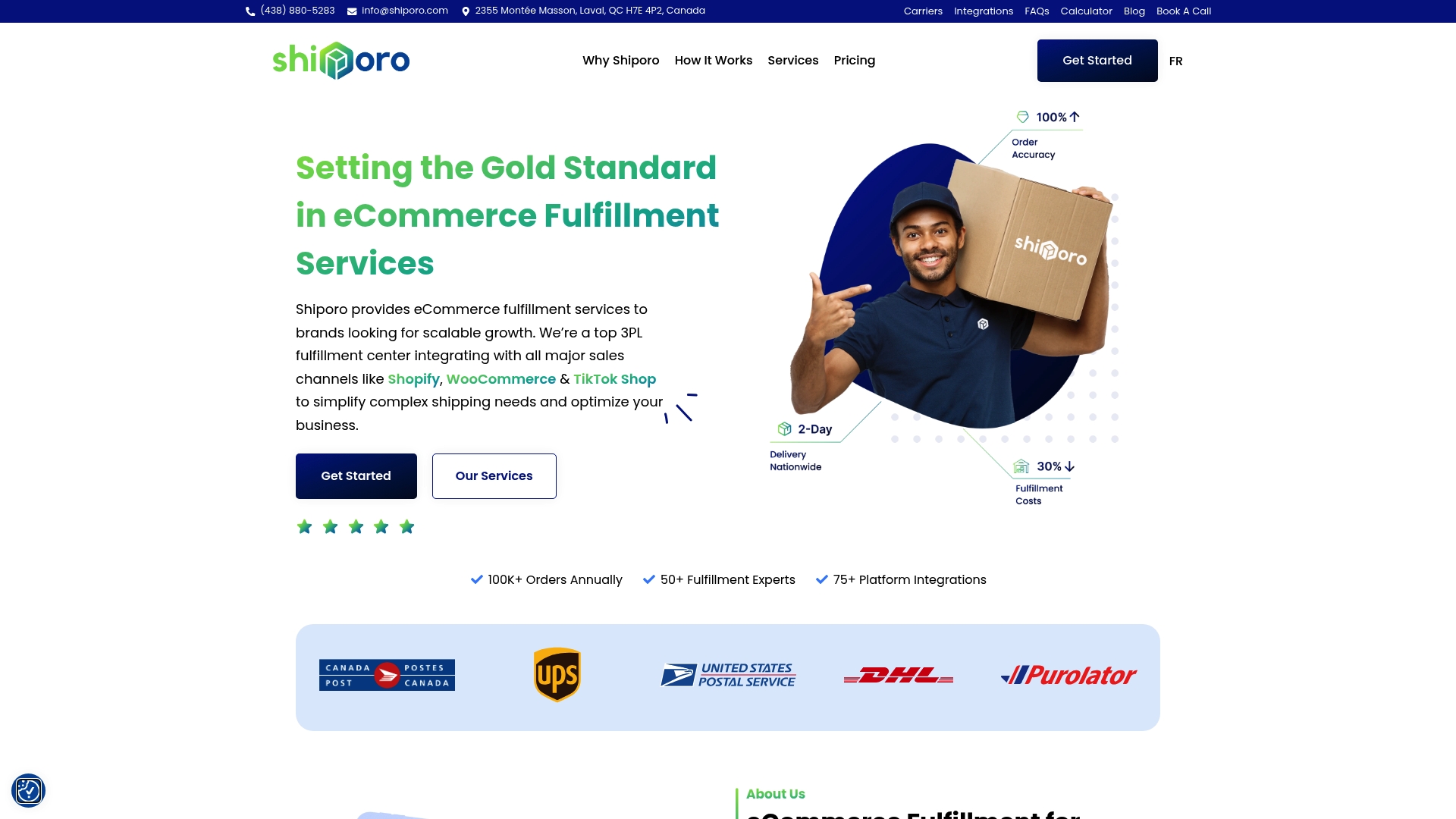
Shiporo’s eCommerce fulfillment services are built specifically for direct-to-consumer brands in Quebec and across Canada. The platform connects directly to Shopify, syncing orders and inventory in real time so you are never reconciling spreadsheets or chasing tracking numbers manually. Shiporo uses ShipHero as its warehouse management system, a WMS built specifically for DTC fulfillment, which means the operational infrastructure is purpose-built rather than adapted from a bulk-storage model.
Carrier rate comparison runs automatically across Canada Post, FedEx, UPS, Purolator, and regional carriers like Intelcom, so every shipment goes out on the best available rate for that destination and delivery window. Every order carries a 100% accuracy guarantee, and every client gets a dedicated account manager rather than a support ticket queue. For brands that want to reduce shipping costs without sacrificing delivery speed, that carrier flexibility is the practical difference between margin and margin erosion.
Shiporo is not a fit for every operation on this list. It is the right choice for eCommerce brands that need a fulfillment partner built around their platform, not a warehouse that happens to accept online orders.
Key takeaways
Montreal’s best 3PL providers in 2026 are differentiated by operational specialties, location relative to port infrastructure, and technology integration depth. Choosing on price alone, without assessing dock-to-stock SLAs, racking capacity, and drayage relationships, is the most common and most costly mistake in this market.
| Point | Details |
|---|---|
| Market is capacity-constrained | Montreal warehouse and drayage capacity is growing slower than port throughput, keeping rates firm and timelines tight through 2026. |
| Dock-to-stock SLA is the key metric | The standard is 48 hours under normal conditions, extending to 60–72 hours in Q4; avoid providers who claim faster year-round turnaround as it is not industry-supported. |
| Location affects every inbound cost | A facility in Lachine versus Mirabel represents a 37-kilometre drayage difference that adds time and cost on every container. |
| Onboarding takes 6–16 weeks | Systems integration, inventory transfer, and parallel operations each add time; plan the transition before you need it, not after. |
| Shiporo for eCommerce brands | Shiporo’s ShipHero WMS, platform integrations, and 100% accuracy guarantee make it the strongest fit for DTC brands scaling in Quebec. |
FAQ
What is the best 3PL in Montreal for eCommerce brands in 2026?
The best fit depends on your order volume, platform, and product type. For DTC brands on Shopify or WooCommerce, Shiporo’s purpose-built fulfillment infrastructure and real-time carrier rate comparison make it a strong option in the Quebec market.
How long does onboarding with a Montreal 3PL take?
A standard eCommerce onboarding runs four to eight weeks after contract signature, covering systems integration, inventory transfer, parallel operations, and full cutover. Complex or multi-region setups can take up to 20 weeks.
What should I ask a Montreal 3PL before signing a contract?
Ask for their published dock-to-stock SLA under normal and Q4 surge conditions, their WMS and integration capabilities, references from clients with similar volume, and a full breakdown of accessorial charges beyond the headline pick-and-pack rate.
Why is Montreal’s 3PL market so tight in 2026?
Port of Montreal throughput is growing faster than warehouse and drayage capacity can keep pace with, creating persistent operational friction. Warehouse facilities near the port are running at very high racking density, and drayage windows are compressed, driving up costs and extending inbound cycle times.
What red flags should I watch for when choosing a Montreal 3PL?
Avoid providers who claim 24-hour dock-to-stock year-round, cannot produce a published Q4 surge SLA, give vague answers about WMS integration, or are unwilling to provide client references with similar order volumes to yours.

