

TL;DR:
- Purolator, UPS Canada, and DHL Express are the top FedEx alternatives in Canada, each excelling in different shipping aspects. Regional carriers like Intelcom and UniUni dominate last-mile urban delivery, offering better density and speed for eCommerce. Shipping strategies benefit from carrier rate comparison platforms and integrated logistics solutions like Shiporo.
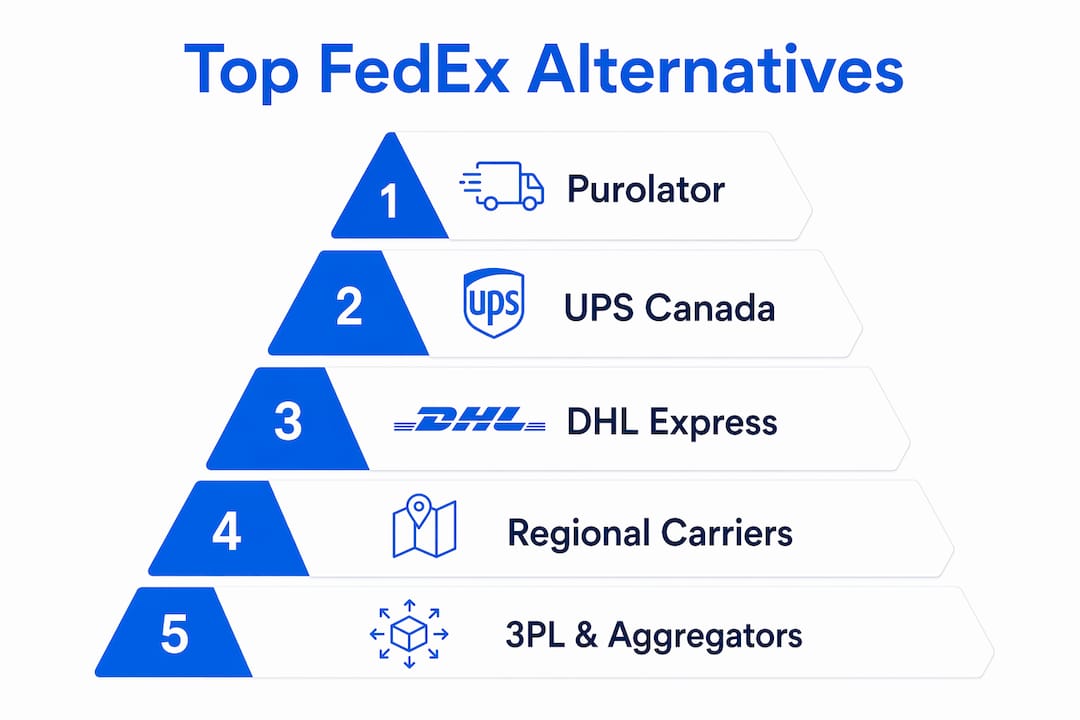
The strongest FedEx alternatives available in Canada right now are Purolator, UPS Canada, and DHL Express for most parcel and courier needs, with GoBolt, UniUni, Intelcom, and TForce Logistics filling important regional and last-mile gaps. For businesses that need full supply chain management rather than just parcel delivery, providers like DHL Supply Chain, UPS Supply Chain Solutions, C.H. Robinson, Kuehne + Nagel, and XPO Logistics cover that territory. Here is a quick orientation before the full breakdown:
- Purolator — best for fast domestic shipments; next-business-day delivery at around $91 for express within Canada
- UPS Canada — best for international shipping; UPS Worldwide Saver delivers internationally in 2 business days at around $160, offering a strong value among the major carriers for most Canadian exporters.
- DHL Express — best for cross-border parcels with advanced tracking
- GoBolt — best for eco-conscious urban deliveries
- UniUni — best for high-volume last-mile in dense urban markets
- TForce Logistics — best for time-sensitive parcel and freight with service guarantees
- Intelcom — best for flexible eCommerce delivery in Canadian cities
- Veho — best for residential last-mile with consumer-facing delivery features
- DHL Supply Chain — best for warehousing and end-to-end logistics
- UPS Supply Chain Solutions — best for integrated global freight management
- APL Logistics — best for freight forwarding and international supply chain
- C.H. Robinson — best for technology-driven freight management
- Agility Logistics — best for flexible global freight solutions
- Kuehne + Nagel — best for large-scale freight forwarding
- XPO Logistics — best for multi-modal transportation needs
Detailed profiles of the top FedEx alternative providers in Canada
Every carrier below serves the Canadian market. Their strengths differ enough that the right choice depends almost entirely on your volume, geography, and whether you are shipping a parcel or managing a supply chain.
| Provider | Best For | Service Speed | Coverage | Tracking & Reliability | Special Features |
|---|---|---|---|---|---|
| Purolator | Domestic express | Next business day | Canada-wide | Real-time tracking, guaranteed | Extensive Canadian network |
| UPS Canada | International shipping | 2 business days internationally | Global | Reliable tracking, UPS My Choice | Account management for businesses |
| DHL Express | Cross-border parcels | — | 220+ countries | Advanced real-time tracking | Express global network |
| GoBolt | Eco-friendly urban delivery | Same day to next day | Major Canadian cities | Real-time updates | Carbon-neutral delivery options |
| UniUni | Last-mile bulk delivery | — | Urban Canada | Tracking included | High-volume urban specialisation |
| TForce Logistics | Time-sensitive freight | Guaranteed windows | Canada and US | Service guarantees | Parcel and freight combined |
| Intelcom | eCommerce urban delivery | Next day in urban areas | Canadian cities | Real-time tracking | Flexible delivery scheduling |
| Veho | Residential last-mile | Same day to next day | Select Canadian markets | Consumer delivery notifications | Customer-facing delivery experience |
| DHL Supply Chain | Warehousing and logistics | Varies by contract | Canada and global | Integrated supply chain visibility | End-to-end logistics management |
| UPS Supply Chain Solutions | Integrated freight | Varies by service | Global | Freight tracking and visibility | Global freight and customs brokerage |
| APL Logistics | Freight forwarding | Ocean, air, ground | Global | Shipment visibility tools | Tailored supply chain solutions |
| C.H. Robinson | Freight management | Varies by mode | North America and global | Navisphere technology platform | Carrier network and tech tools |
| Agility Logistics | Global freight | Varies by mode | Global | Shipment tracking | Flexible freight solutions |
| Kuehne + Nagel | Large-scale freight | Ocean, air, road | Global | KN Login visibility platform | Comprehensive global operations |
| XPO Logistics | Multi-modal supply chain | Varies by mode | North America and global | Real-time freight tracking | Diverse transport capabilities |
Purolator is the most direct domestic FedEx alternative for Canadian businesses. It is the only major courier that is majority Canadian-owned, and its network reaches communities that international carriers often surcharge or skip. For express shipments within Canada, Purolator Express delivers next business day at a price point that consistently undercuts FedEx’s equivalent tier.

UPS Canada earns its place for international volume. The UPS Worldwide Saver service hits international destinations in 2 business days, and UPS offers 24/7 customer support with dedicated account management for business clients. One caveat worth knowing: customer reviews in Canada have historically been more mixed for UPS than for Purolator, particularly around residential delivery consistency.
DHL Express is the go-to for cross-border speed. Its global express network covers more than 220 countries, and its tracking technology updates in real time at each scan point. For Canadian exporters shipping to Europe or Asia, DHL Express often beats UPS and FedEx on transit time for certain lanes.
GoBolt takes a different angle entirely. It positions itself around sustainable urban logistics, offering carbon-neutral delivery options in major Canadian cities. Retailers with environmentally conscious customers find GoBolt a credible differentiator at checkout.

UniUni focuses on last-mile density. It handles high-volume parcel drops in urban markets efficiently, which makes it attractive for eCommerce brands shipping hundreds of orders daily into Toronto, Vancouver, or Montréal.
TForce Logistics (part of TFI International, which also owns Canpar Express) covers both parcel and freight with guaranteed delivery windows. Its service guarantees give it an edge for businesses where a missed delivery window has real downstream costs.
Intelcom has built a strong position in Canadian eCommerce fulfilment delivery. It offers flexible scheduling and adapts well to the volume spikes that come with peak seasons, which is why several large Canadian retailers use it as a primary last-mile partner.
Veho leans into the consumer experience side of delivery. Customers get proactive notifications and flexible delivery options, which reduces failed delivery attempts and the customer service calls that follow.
For supply chain and freight needs, DHL Supply Chain, UPS Supply Chain Solutions, APL Logistics, C.H. Robinson, Agility Logistics, Kuehne + Nagel, and XPO Logistics each offer end-to-end logistics management at scale. C.H. Robinson’s Navisphere platform stands out for technology integration, while Kuehne + Nagel and XPO Logistics bring deep multi-modal capabilities across North America and globally.
Pro Tip: Canpar Express, also part of TFI International, deserves a mention for cost-conscious domestic shippers. Its Select service delivers next business day within a region and in two business days across Canada at up to 40% less than other expedited options, with a money-back delivery guarantee.
How do these carriers compare on price, speed, and coverage?
Pricing across these carriers varies significantly depending on shipment weight, dimensions, destination, and the surcharges that apply to your specific lanes. A few concrete anchors help frame the comparison.
For domestic speed, Purolator Express offers next-business-day delivery within Canada at around $91. Canada Post’s Regular Parcel at around $27 is the cheapest domestic option, but it takes 7 business days. That gap between $27 and $91 is essentially the price of speed.
Internationally, UPS Worldwide Saver at around $160 for 2-business-day delivery is the strongest value among the major carriers for most Canadian exporters. DHL Express competes closely on certain international lanes, particularly to Europe.
Hidden fees are where many businesses get caught off guard. Remote area surcharges apply when a delivery address falls outside a carrier’s standard service zone, and they can add meaningfully to the base rate. Verifying service area maps before committing to a carrier is one of the most practical steps a business can take. A carrier that looks cheaper on the rate card may cost more once rural surcharges are applied.
Both FedEx and UPS implemented general rate increases of approximately 5.9% across services in 2025, and those increases carried into 2026 pricing. Dimensional weight pricing also plays a larger role now than it did a few years ago, meaning a light but bulky package can cost considerably more than its actual weight suggests.
For value-added services, tracking availability is now standard across all major carriers. Insurance coverage, returns management, and cash-on-delivery options vary. Canpar Express offers COD on both its Ground and Select service levels, accepting cash, cheque, or money order. Canada Post includes up to $100 liability coverage on Priority and Xpresspost shipments at no extra charge, with additional coverage available up to $5,000 for a fee.
Working with a logistics aggregator like InXpress Canada gives smaller businesses access to the negotiated rates that large shippers get by default. InXpress manages carrier relationships across DHL, UPS, Canpar, and Purolator through a single account, which simplifies invoicing and often produces better per-shipment pricing than going direct.
How to choose the right FedEx alternative carrier in Canada
The right carrier depends on four things: where you are shipping, how fast it needs to arrive, what it costs, and how much complexity you can manage. Most businesses get into trouble by optimising for one of those factors and ignoring the others.
Coverage comes first. A carrier with great urban rates may apply steep surcharges for rural or remote addresses. Before signing up with any provider, map your customers’ postal codes against the carrier’s service area. This is especially relevant in Quebec and the Atlantic provinces, where rural coverage gaps are more common.
Speed tiers matter more than you think. Next-business-day delivery and 2-day delivery are not interchangeable for most eCommerce customers. Decide which speed tier your customers expect, then compare only the carriers that can reliably hit it. Guaranteed delivery windows, like those TForce Logistics offers, are worth paying for when a missed delivery creates a customer service problem.
Pricing transparency is a real differentiator. Some carriers publish rate cards clearly; others require a quote. Hidden surcharges for fuel, residential delivery, address correction, and remote areas can add 20–30% to a base rate. Ask for a full landed cost estimate, not just the base rate.
Technology integration reduces errors. Real-time tracking is now table stakes, but automated shipment management, platform integrations with Shopify or WooCommerce, and API access for custom workflows separate the carriers that scale with your business from those that create manual work. For international freight management, customs documentation and broker relationships add another layer of complexity worth evaluating.
- Confirm the carrier’s service area covers your top delivery postal codes
- Request a full rate card including all surcharges, not just the base rate
- Check whether the carrier offers real-time tracking and delivery notifications
- Ask about returns management options if your business has meaningful return volume
- Evaluate customer support: is there a dedicated account manager, or just a call centre?
- For international shipments, confirm customs brokerage support and documentation requirements
Pro Tip: Working with a single logistics partner or aggregator, rather than managing three or four carrier accounts separately, typically reduces administrative overhead and gives you access to discounted bulk rates that individual accounts cannot match.
Shiporo gives Canadian eCommerce brands a smarter logistics approach
The carriers above handle the physical movement of parcels. What they do not handle is the operational layer that sits between your online store and the shipping label: inventory management, order accuracy, platform integration, and the carrier selection decision itself.
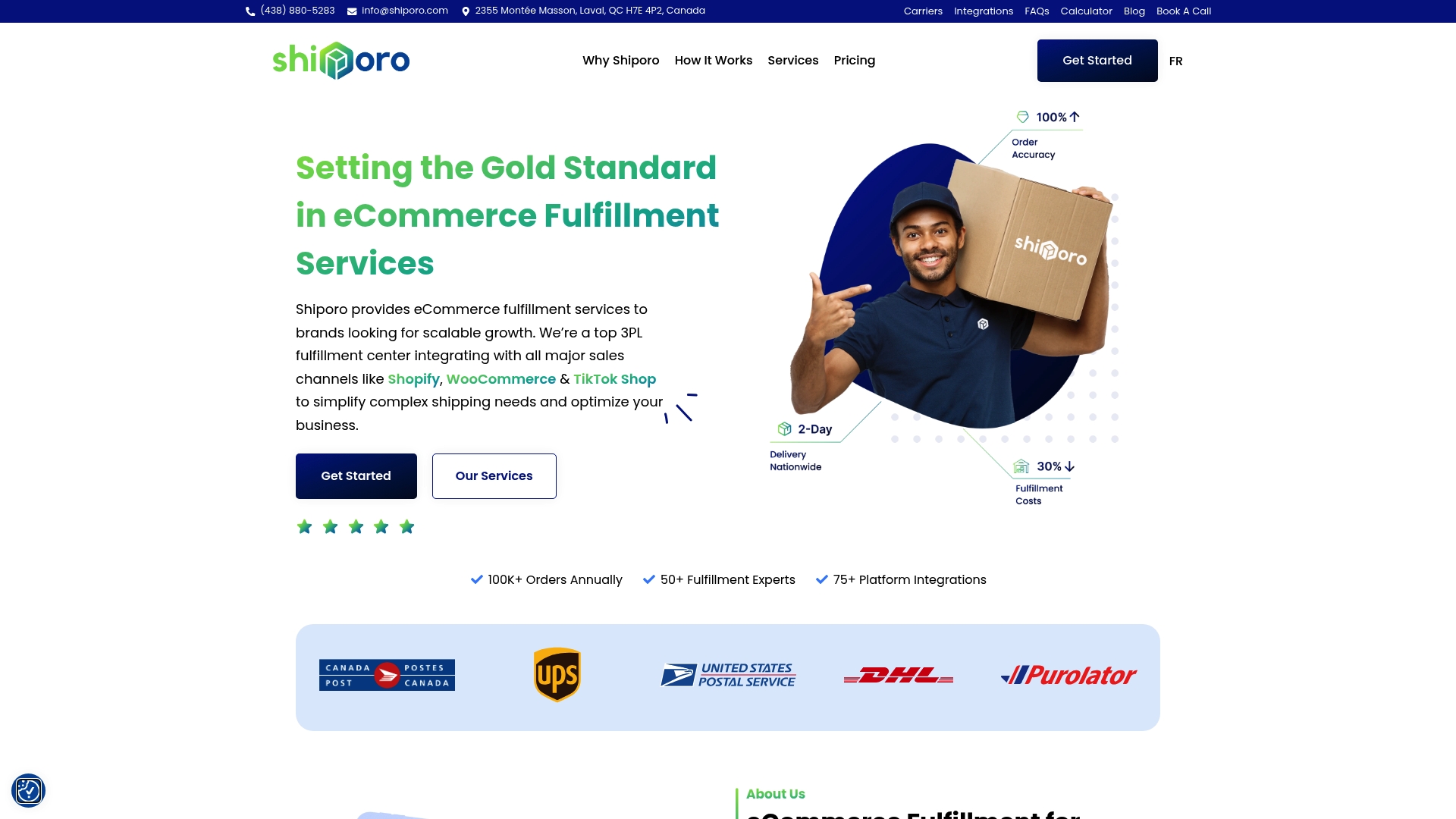
That is where Shiporo fits. As a 3PL fulfillment partner built specifically for the Canadian market, Shiporo connects directly with Shopify and WooCommerce stores, syncs inventory in real time, and compares live carrier rates across multiple providers so each order ships at the best available price. The 100% order accuracy guarantee and dedicated account managers mean you are not chasing down picking errors or waiting on hold with a generic support line.
For eCommerce brands in Quebec and across Canada that are growing past the point where self-managing carrier accounts makes sense, Shiporo handles bulk and freight coordination, returns management, and custom API integrations alongside standard pick-and-pack fulfilment. You get the carrier network without the carrier management overhead.
Key takeaways
Purolator, UPS Canada, and DHL Express are the three strongest direct FedEx alternatives in Canada, each leading in a distinct category: domestic speed, international value, and cross-border express respectively.
| Point | Details |
|---|---|
| Purolator leads domestically | Next-business-day delivery within Canada at around $91 makes it the most cost-effective express domestic option. |
| UPS Canada wins internationally | UPS Worldwide Saver delivers internationally in 2 business days at around $160, outperforming most alternatives on speed and cost. |
| Hidden fees change the math | Remote area surcharges and dimensional weight pricing can add significantly to base rates; always verify service area maps before committing. |
| Aggregators unlock better rates | A single logistics partner like InXpress Canada provides access to discounted bulk rates across multiple carriers without managing separate accounts. |
| Shiporo handles the layer above shipping | For Canadian eCommerce brands, Shiporo’s 3PL fulfillment integrates carrier rate comparison, order accuracy guarantees, and platform syncing in one place. |
The Canadian parcel market is more interesting than most people realise
There is a tendency to treat carrier selection as a commodity decision: pick the cheapest rate for the weight and move on. That framing misses what is actually happening in the Canadian logistics market right now.
Regional carriers like Intelcom, UniUni, and GoBolt are not just cheaper alternatives to the big four. They are purpose-built for the delivery density and speed expectations that eCommerce has created, and they are winning volume from FedEx and UPS in urban markets because they are genuinely better at last-mile delivery in those environments. GoBolt’s carbon-neutral positioning is not a marketing add-on; it is a real operational commitment that matters to a growing segment of Canadian consumers.
The more interesting shift is happening at the aggregator and 3PL layer. Businesses that used to manage three or four carrier accounts separately are consolidating through platforms that compare rates in real time and handle the carrier relationship on their behalf. This is not just about convenience. It changes the economics: a small eCommerce brand shipping a few hundred orders a month can access rates that previously required shipping thousands of packages. That structural change is what makes the current moment genuinely different from five years ago.
The carriers that will struggle are the ones that compete only on price without investing in technology, tracking quality, or delivery experience. Canadian consumers have been trained by eCommerce to expect real-time visibility and flexible delivery options. A carrier that cannot provide that will lose volume regardless of its rate card.
For businesses choosing a carrier or a logistics partner right now, the question is not just “who is cheapest today?” It is “which provider’s capabilities will still serve me well when my volume doubles?”
Useful sources for further research on Canadian shipping and logistics
For businesses that want to go deeper on carrier comparisons, rate structures, and logistics strategy in Canada, these resources are worth bookmarking.
- Purolator International courier services — official service descriptions and pricing for domestic and international shipments
- Canpar Express service guide — full breakdown of Ground, Select, and Express service levels, including COD and SMARTSpot pickup options
- Canada Post shipping service comparison — official comparison of Priority, Xpresspost, Flat Rate, and Regular Parcel services with tracking and coverage details
- InXpress Canada — multi-carrier shipping platform for small and mid-sized businesses, with access to DHL, UPS, Canpar, and Purolator rates through one account
- Expert Shipping: remote area surcharges in Canada — practical guide to understanding and avoiding remote area fees
- Gartner: FedEx Logistics alternatives — peer reviews of third-party logistics providers as alternatives to FedEx Logistics
- Shiporo carriers page — overview of the carrier network available through Shiporo’s fulfillment platform for Canadian eCommerce brands
FAQ
Who is FedEx’s biggest competitor in Canada?
Purolator is FedEx’s closest domestic competitor in Canada, offering next-business-day delivery across the country at competitive rates. UPS Canada competes directly on international lanes.
What are the best alternatives to FedEx for Canadian businesses?
Purolator, UPS Canada, and DHL Express are the strongest direct alternatives, covering domestic express, international shipping, and cross-border parcels respectively. Regional carriers like Intelcom and UniUni are strong choices for urban last-mile volume.
What is the FedEx equivalent in Canada?
Purolator is the most direct Canadian equivalent to FedEx, offering a comparable range of express domestic services, real-time tracking, and a national network. It is majority Canadian-owned and has broader rural coverage than most international carriers.
Is DHL or FedEx better for shipping from Canada?
DHL Express generally offers faster transit times and more competitive rates on certain international lanes, particularly to Europe. FedEx has stronger domestic infrastructure in the US, but for Canadian exporters shipping internationally, DHL Express is often the stronger choice on speed and tracking quality.
Can a 3PL like Shiporo replace managing multiple carrier accounts?
Yes. Shiporo’s eCommerce fulfillment platform compares live carrier rates across multiple providers and manages the shipping process end-to-end, so Canadian eCommerce brands do not need to maintain separate carrier accounts or negotiate rates independently.

