

EDI fulfillment is the process of automating order and shipment data exchange between your business systems and third-party logistics (3PL) providers through standardised electronic data interchange (EDI) transactions. The industry term is “electronic data interchange,” and it has been the backbone of supply chain communication for decades. Core transaction sets including the EDI 850 (Purchase Order), 856 (Advance Ship Notice), 810 (Invoice), 940 (Warehouse Shipping Order), and 945 (Warehouse Shipping Advice) carry every critical instruction between your systems and your warehouse. Getting these transactions right eliminates manual data entry errors, cuts order-to-ship cycle times, and keeps you compliant with retailer requirements like Walmart’s On-Time In-Full (OTIF) programme. For eCommerce brands scaling into retail channels or multi-warehouse operations, EDI fulfillment is not optional. It is the foundation of a reliable supply chain.
What does EDI fulfillment require to work?
Successful EDI fulfillment depends on three core systems working together: an Order Management System (OMS), a Warehouse Management System (WMS), and an EDI translator or middleware layer. The OMS captures orders from every sales channel. The WMS manages physical inventory and warehouse operations. The EDI translator converts your business data into standardised X12 transaction sets that trading partners can read.

The transaction sets split into two groups. Retailer-facing documents include the 850 (Purchase Order), 856 (Advance Ship Notice), and 810 (Invoice). Warehouse-facing documents include the 940, 945, and 846 for shipping orders, shipment confirmations, and inventory feeds respectively. Each group serves a different audience but must stay synchronised.
Communication between systems travels over one of three protocols:
VAN (Value-Added Network): A managed network that routes EDI documents between trading partners. Reliable but carries per-document transaction fees.
AS2 (Applicability Statement 2): A direct, encrypted internet connection. Preferred by major retailers like Walmart for speed and security.
SFTP (Secure File Transfer Protocol): File-based transfers over a secure server. Common with smaller 3PLs and lower-volume trading partners.
Before you go live, you also need to complete trading partner agreements, document mapping (converting your internal data fields to the correct EDI segments), and compliance testing. Most retailers provide a certification process you must pass before they accept live transactions.
Pro Tip: Map your internal SKU and UPC data to your trading partner’s requirements before you start integration work. Mismatched product identifiers are the single most common cause of failed EDI transactions at launch.
How does EDI fulfillment work step by step?
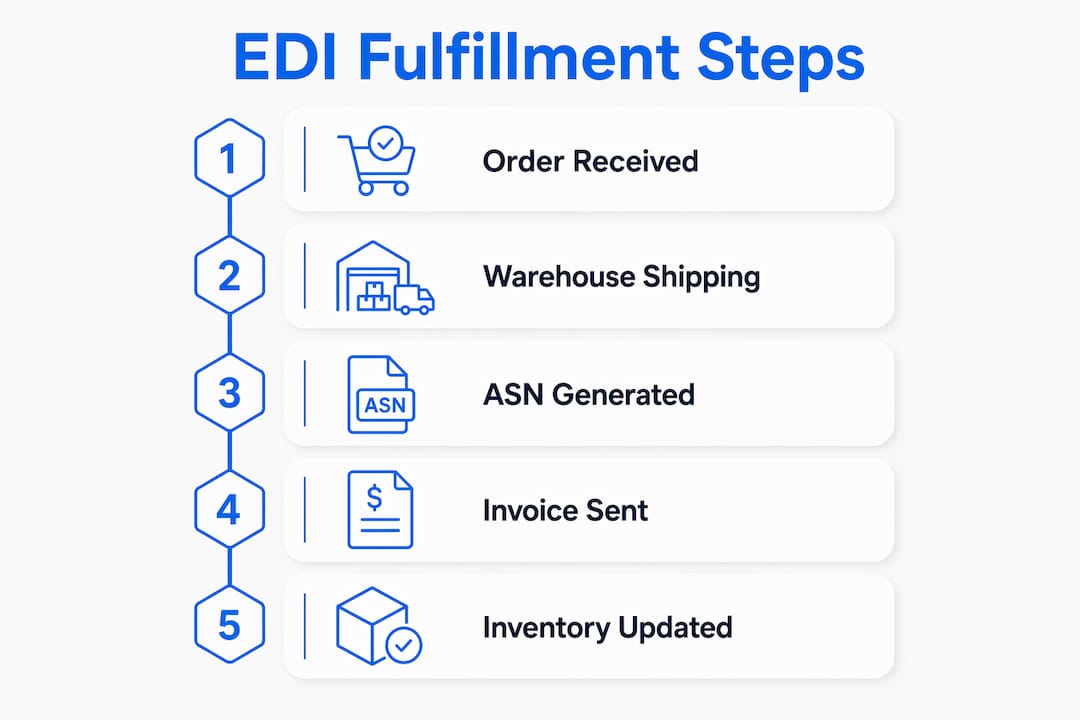
The EDI fulfillment workflow follows a clear sequence. Each step triggers the next, and a delay at any point creates downstream problems.
Receive the purchase order. Your retailer sends an EDI 850 to your OMS. This document contains item quantities, ship-to addresses, and required delivery dates.
Acknowledge the order. Your system returns an EDI 997 (Functional Acknowledgment) to confirm receipt. Some retailers also require an EDI 855 (Purchase Order Acknowledgment) to confirm you can fulfil the order.
Send the warehouse shipping order. Your OMS generates an EDI 940 and transmits it to your 3PL’s WMS. This tells the warehouse exactly what to pick, pack, and ship.
3PL picks, packs, and ships. The warehouse team fulfils the order. Once the shipment leaves the dock, the WMS generates an EDI 945 (Warehouse Shipping Advice) confirming what was actually shipped, including carrier and tracking details.
Generate the Advance Ship Notice. Your system receives the EDI 945 and transforms that data into an EDI 856 ASN for the retailer. The ASN must reach the retailer before or at the time the shipment arrives. Late ASNs trigger chargebacks.
Send the invoice. After shipment, your system generates an EDI 810 (Invoice) and transmits it to the retailer for payment processing.
Monitor acknowledgments. Every outbound document should receive an EDI 997 back from the trading partner. Missing acknowledgments signal a transmission failure that needs immediate investigation.
The accuracy of the EDI 856 ASN depends entirely on the quality of the 945 data your 3PL sends. Generating the ASN from scan-confirmed packing data at shipment, rather than from estimates, is the single most important practice for avoiding retailer chargebacks.
Pro Tip: Ask your 3PL how frequently they transmit the EDI 945 document. If they batch transmissions once daily, you may miss retailer ASN windows. Negotiate hourly or real-time 945 transmissions in your contract.
The table below shows the key EDI transaction sets and their roles in the fulfillment workflow.
| EDI Transaction | Document name | Direction | Purpose |
|---|---|---|---|
| 850 | Purchase Order | Retailer to brand | Initiates the order |
| 855 | PO Acknowledgment | Brand to retailer | Confirms order acceptance |
| 940 | Warehouse Shipping Order | Brand to 3PL | Instructs warehouse to fulfil |
| 945 | Warehouse Shipping Advice | 3PL to brand | Confirms shipment details |
| 856 | Advance Ship Notice | Brand to retailer | Notifies retailer of shipment |
| 810 | Invoice | Brand to retailer | Requests payment |
| 997 | Functional Acknowledgment | Both directions | Confirms document receipt |
Common EDI fulfillment mistakes and how to avoid them
Most EDI fulfillment failures trace back to a small set of recurring problems. Knowing them in advance saves you from costly chargebacks and retailer penalties.
ASN mismatches are the most expensive mistake. An ASN that does not match the physical shipment triggers automatic chargebacks from retailers. The root cause is almost always a 3PL generating the EDI 945 from pick lists rather than from scan-confirmed packing. Scan-confirmed packing data at the point of shipment is the only reliable source for ASN accuracy.
Delayed 945 transmissions create a cascade of problems. If your 3PL sends the 945 once a day at midnight, and a shipment leaves the dock at 8:00 AM, you have a 16-hour gap before you can generate the retailer ASN. Delayed 945 transmission frequency is one of the most overlooked contract terms when brands select a 3PL partner.
OMS and WMS integration gaps cause inventory inaccuracies. When the two systems do not share data in real time, your OMS may accept orders for stock that the WMS has already allocated or shipped. Integrating your OMS with your 3PL’s WMS for real-time inventory sync is the technical foundation that prevents overselling and backorders.
Automating EDI with a trusted full-service partner simplifies compliance, setup, mapping, integration, and ongoing support, accelerating benefits realisation for sellers. The brands that struggle most with EDI are those that treat it as a one-time setup rather than an ongoing operational discipline.
Additional mistakes to watch for:
Skipping compliance testing before going live with a new retailer
Using static product mapping that does not update when you add new SKUs
Failing to monitor 997 acknowledgments, leaving transmission failures undetected for days
Selecting a 3PL without verifying their EDI capabilities and supported transaction sets before signing a contract
Monitoring EDI performance on a weekly basis, tracking acknowledgment rates, ASN accuracy, and chargeback frequency, gives you the data to catch problems before they compound.
How does EDI fulfillment support retailer compliance and omni-channel efficiency?
Retailer compliance is where EDI fulfillment delivers its most measurable value. Walmart’s OTIF compliance requires precise EDI exchanges including 850 purchase orders, 855 acknowledgments, 856 ASNs, 846 inventory advice, and 810 invoices, all on strict timing rules. Missing a single transmission window can result in a financial penalty. Automated EDI removes the human error that causes those misses.
The EDI 846 (Inventory Inquiry/Advice) transaction is particularly powerful for omni-channel brands. It sends real-time inventory levels from your 3PL to your retailers and marketplaces, reducing the risk of overselling across channels. Brands selling on multiple platforms, including direct-to-consumer (DTC), Amazon, and wholesale retail, need this feed running continuously to keep all channels in sync.
The table below compares how EDI fulfillment performs across different channel types.
| Channel type | Key EDI transactions | Primary compliance risk |
|---|---|---|
| Wholesale retail (e.g., Walmart) | 850, 855, 856, 810, 846 | OTIF penalties, ASN chargebacks |
| Marketplace (e.g., Amazon Vendor) | 850, 856, 810 | Late ASN, invoice discrepancies |
| DTC (Shopify, WooCommerce) | 940, 945 (3PL facing) | Delayed shipment confirmation |
Legacy bolt-on EDI systems are giving way to native integrations within unified order management platforms. This shift matters because a unified OMS routes orders from retail, marketplace, and DTC channels through a single workflow, applying the correct EDI transaction set for each trading partner automatically. The result is less manual configuration, fewer mapping errors, and faster onboarding when you add a new retail partner.
Pro Tip: When evaluating an OMS or 3PL platform, ask specifically whether EDI is native to the platform or handled by a third-party bolt-on. Native integrations update automatically when trading partner requirements change. Bolt-ons require manual updates that often lag behind retailer specification changes.
Brands that invest in eCommerce fulfillment trends early gain a measurable advantage when retailers audit supplier compliance. A strong OTIF score opens access to better shelf placement, priority purchase orders, and more favourable payment terms.
Key takeaways
EDI fulfillment works when your OMS, WMS, and EDI middleware share real-time data, your 3PL transmits the EDI 945 frequently, and your ASNs are generated from scan-confirmed shipment data.
| Point | Details |
|---|---|
| Core transaction sets | The 850, 856, 810, 940, and 945 are the minimum required for retailer and 3PL EDI fulfillment. |
| ASN accuracy | Generate the EDI 856 from scan-confirmed packing data, never from estimates, to avoid chargebacks. |
| 945 transmission frequency | Negotiate real-time or hourly 945 transmissions with your 3PL to meet retailer ASN windows. |
| OMS and WMS integration | Real-time sync between your OMS and 3PL WMS eliminates inventory inaccuracies and overselling. |
| Native vs. bolt-on EDI | Native EDI integrations within a unified OMS reduce mapping errors and simplify multi-channel compliance. |
What I have learned from watching brands get EDI wrong
Working closely with eCommerce brands at various stages of supply chain maturity, the pattern I see most often is this: brands invest heavily in the technology setup and then treat EDI as finished. It is never finished.
The brands that get the most value from EDI fulfillment are the ones that monitor it like a live operation. They track acknowledgment rates weekly. They review chargeback reports the day they arrive. They have a direct line to their 3PL’s EDI team, not just their account manager.
The 3PL selection decision is more consequential than most brands realise. A 3PL with weak EDI capabilities will cost you far more in retailer chargebacks and lost orders than you will ever save on warehousing fees. I have seen brands switch 3PLs specifically because their original partner could not transmit the EDI 945 more than once per day. That single limitation was costing them thousands of dollars monthly in ASN penalties.
The other thing I would stress is the importance of getting your internal team aligned before you go live. EDI touches your operations, finance, and technology teams simultaneously. When a 997 acknowledgment fails at 2:00 AM, someone needs to know what it means and what to do about it. Investing in internal EDI literacy, not just external integration, is what separates brands that scale smoothly from those that spend months firefighting.
The shift toward unified order management is the right direction for 2026. The brands building on native integrations today will onboard new retail partners in days, not months.
— Luca
How Shiporo supports your EDI fulfillment operations
Shiporo is a Montreal-based 3PL built for eCommerce brands that need reliable, compliant fulfillment across retail, marketplace, and DTC channels.

Shiporo handles the full range of EDI transactions your supply chain requires, from warehouse-facing 940 and 945 documents to retailer-facing 850, 856, and 810 exchanges. Every client gets a dedicated account manager and a 100% order accuracy guarantee, so your OTIF scores stay protected. Shiporo integrates directly with Shopify and WooCommerce, and connects with major carriers through real-time rate comparisons to keep your shipping costs in check. If you are ready to remove the manual work from your order and shipment processes, explore Shiporo’s fulfillment services to see how the right 3PL partner makes EDI compliance straightforward.
FAQ
What is EDI fulfillment?
EDI fulfillment is the automated exchange of order and shipment data between a brand’s systems and its 3PL warehouse using standardised electronic data interchange (EDI) transaction sets. It replaces manual data entry with structured, machine-readable documents like the EDI 850, 940, 945, and 856.
What EDI transaction sets are needed for 3PL fulfillment?
The core 3PL EDI transactions are the 940 (Warehouse Shipping Order), 945 (Warehouse Shipping Advice), and 846 (Inventory Advice), which handle brand-to-warehouse communication. Retailer-facing transactions add the 850, 856, and 810.
How does EDI fulfillment prevent retailer chargebacks?
Chargebacks most often result from late or inaccurate ASNs (EDI 856). Generating the ASN from scan-confirmed packing data and ensuring your 3PL transmits the EDI 945 in near real time are the two practices that eliminate the majority of ASN-related penalties.
What is the difference between an OMS and a WMS in EDI fulfillment?
An OMS manages orders across all sales channels and triggers the EDI workflow. A WMS manages physical warehouse operations and generates shipment confirmations. Both systems must share real-time data for EDI fulfillment to function accurately.
How does Walmart’s OTIF requirement relate to EDI?
Walmart’s OTIF programme requires suppliers to deliver the right quantity on time, and it enforces this through strict EDI compliance rules. Suppliers must send 850 acknowledgments, 856 ASNs, and 810 invoices within precise timing windows or face financial penalties.

